

When GeoSurf shut down in 2023, many teams woke up one morning without their primary proxy provider. Overnight, scraping pipelines broke, ad verification jobs stalled, and everyone had to figure out the best GeoSurf alternatives to source their IP infrastructure.
Since then, the proxy market has moved pretty fast. New players showed up, leveling the playing field with the big names, all rolling out mobile and ISP networks on top of residential, which has also made pricing a lot more competitive.
While we take our hats off to Geosurf, which has been a pioneer in the enterprise scene, life goes on. This is why we’ve gathered the 7 best GeoSurf alternatives in 2026, comparing what they offer and how they stand out, to help you pick a provider that fits both your tech stack and your budget.
Back in the day, GeoSurf used to be a solid traffic provider that focused mainly on providing residential endpoints. The pitch was simple: millions of IPs worldwide, so you could see localized versions of sites and ads just like a real user in that country.
Because of that, it became a go-to tool for advertisers, market research teams, and anyone needing proxies for web scraping, where geo accuracy truly makes a difference.
In late 2023, however, GeoSurf announced that it was shutting down for good after losing a patent dispute. As a result, new signups were closed, existing customers were told to burn through remaining bandwidth, and that was that.
For existing users, this created two urgent questions:
The best GeoSurf alternatives below cover a wide range of needs, from solo operators and small teams to enterprises that want strict governance, SLAs, and integrated data extraction tools.
Before you go all in on any particular vendor, get crystal clear on what you actually need. Is it mostly residential traffic, a mix of 4G/5G and datacenters, or scraper-focused workflows?
The seven best GeoSurf alternatives here span all of those scenarios and give you a realistic shortlist for your best options in 2026.
Proxy-Seller is a premium enterprise proxy provider that bundles all the main network infrastructure under one roof, ethically sourced with user consent in over 220 countries and regions.
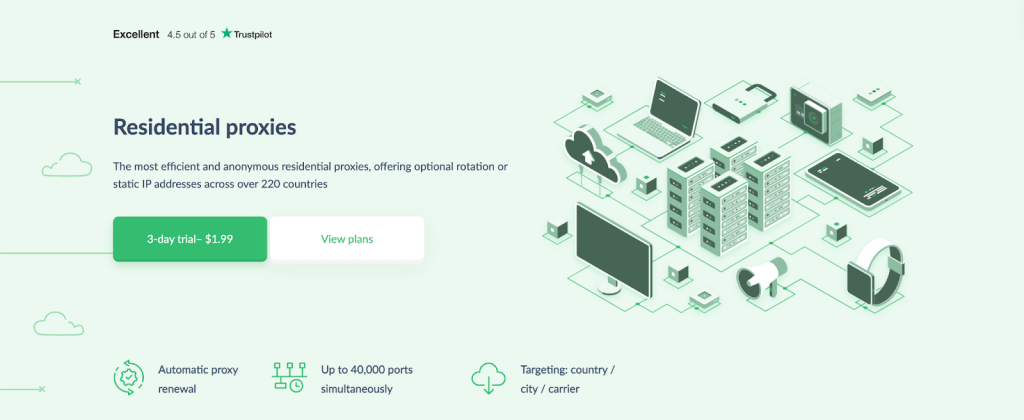
With this provider, teams get access to residential proxies, ISP or static IPs, datacenter IPv4 and IPv6, and rotating 4G/5G endpoints.
It’s ideal for recurring, automation-heavy use cases like SEO and SERP monitoring, marketplace and pricing intelligence, QA, app testing, and it even offers more specialized web infrastructure for social media and online gaming.
From the infrastructure side, Proxy-Seller is all about reliability, speed, protocol flexibility, and global coverage. You get HTTP, HTTPS, and SOCKS5 support, with dedicated channel speeds up to 1 Gbps and two authentication options, either username and password or IP allowlisting.
You can target by ISP and location, use rotating or sticky sessions, and customize rotation behavior for each separate project, even on mobile proxies.
The platform itself supports both solo users and teams, and you get dashboards and APIs with clear usage stats, project-level breakdowns, and seamless configuration options like rotation rules or how IPs are grouped.
On pricing, this provider offers the best balance of enterprise-grade volume and affordability, with IPs starting from around $0.7 per GB on selected plans (exact rates vary by plan and geo).
Best for: enterprises and small teams that want a flexible mix of residential, ISP, mobile, and datacenter infrastructure in one place, with strong uptime and accessible control to run workflows at scale.
Bright Data is one of the biggest players in the proxy and web data world, also offering all the main traffic endpoints, along with additional tools like a Web Unlocker, Web Scraper API, SERP API, and more.
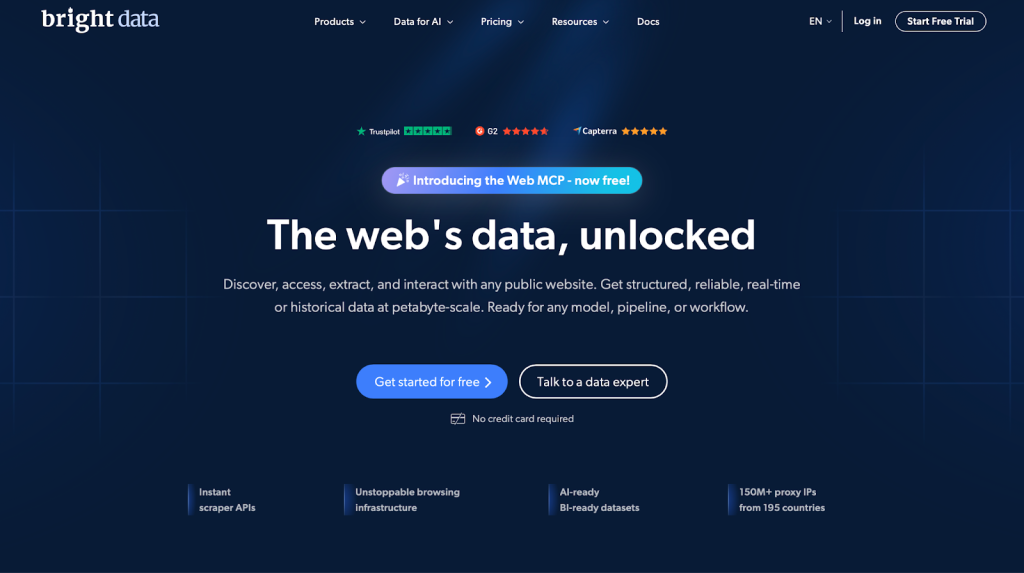
In day-to-day use, this platform operates like a full data collection platform, with its pool including over 150 million endpoints across roughly 195 countries with granular geo targeting, ASN filters, and detailed session controls.
If your team prefers not to maintain scraping logic and anti-bot setups in-house, the managed APIs and datasets let you buy unblocked HTML or structured data directly, instead of building your own routing, headless browsers, and bypass logic.
The flip side is complexity and price, as Bright Data’s pricing heavily depends on proxy type and your commitment level. As of 2026, official plans start around $5.88 per GB on certain monthly packages, while pay as you go tiers land even higher.
Most reviews position Bright Data as a premium, power user solution rather than a budget friendly option for simple tasks. Nonetheless, it’s still one of the best GeoSurf alternatives out there.
Best for: enterprises and advanced data teams that need both proxies and managed unblockers, scrape APIs, and datasets, and that are fine with paying a premium.
Oxylabs is another enterprise-grade platform and one of the most frequently mentioned best GeoSurf alternatives for complex, large-scale scraping environments. It runs residential, cellular, datacenter, and ISP endpoints along with a dedicated Web Unblocker and specialized scraping APIs.
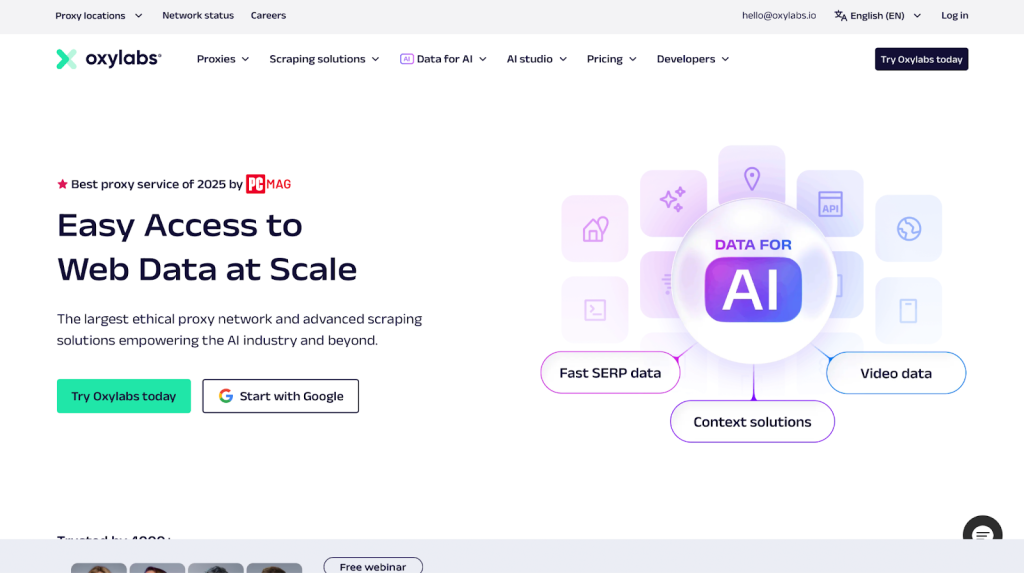
Their traffic pool is often quoted in the 100-175 million range across more than 195 countries, so geo coverage is not really an issue, making it a good fit for localized testing and high-volume data collection.
Performance tests often show high success rates on harder targets, supported by smart rotation and its unblocker tools.
Public pricing is split between self serve packs and custom enterprise deals. Pay-as-you-go traffic is advertised at roughly 8 dollars per GB, with subscription and high-volume plans dropping the price, sometimes into the 3 to 4 dollar per GB range for large commitments.
In practice, this vendor offers numerous additional tools and solid support, though the economics will only be justified for multi-layered, high-volume use cases.
Best for: organizations that need very large traffic pools, strong unblocking performance, and enterprise features like SLAs, dedicated support, and compliance help.
Decodo positions itself as a flexible, user-friendly provider with a lot of focus on simple usability, offering rotating and static residential, cellular, and datacenter traffic.
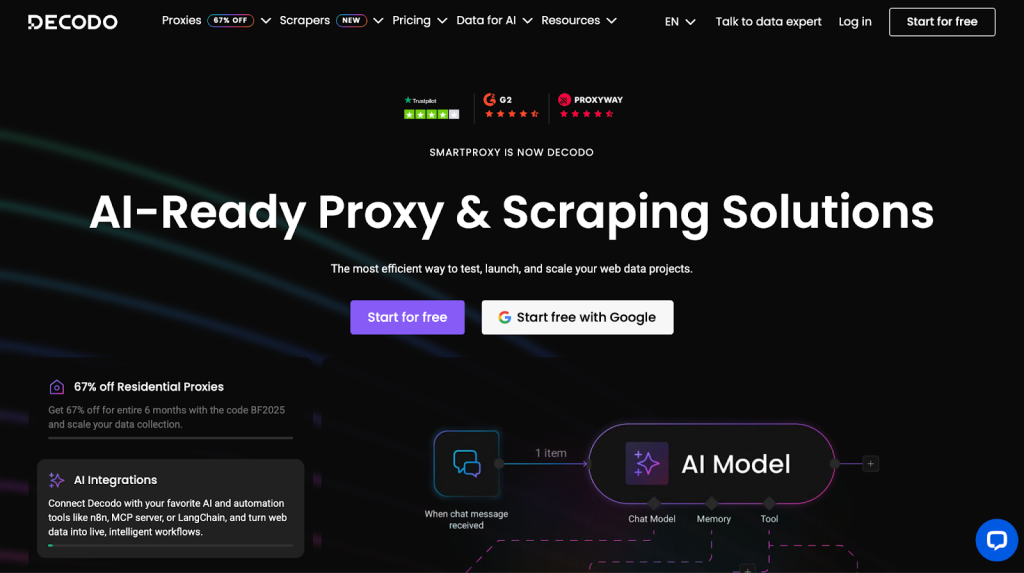
Users also get several extra tools like Site Unblocker, scraping APIs, and an anti-detect web browser.
They offer more than 125 million IPs in roughly 195 locations, which is comparable to some of the bigger players previously mentioned, though it’s still much less established as an enterprise provider.
The dashboard and onboarding flow are designed so that even non-technical teams can get their first working setup quickly using browser extensions, setup wizards, and ready-to-use snippets for popular scraping and automation tools.
Pricing is fairly flexible but clearly favors users who can commit at least some reasonable monthly volume. Current public info shows pricing typically ranges from $1.5-3.5 per GB, depending on plan size, with short trials available for tests.
The only real downside is that if you’re an enterprise team running complex workloads, this platform may slightly underdeliver.
Best for: agencies and mid-sized teams that want a solid web traffic infrastructure with simple and non-technical setup and control dashboards.
SOAX focuses mainly on residential and mobile proxies and brands itself as an intelligent data access platform. Its pool includes a large number of IPs (commonly quoted above 150 million) and a tighter but more focused US-based datacenter network.
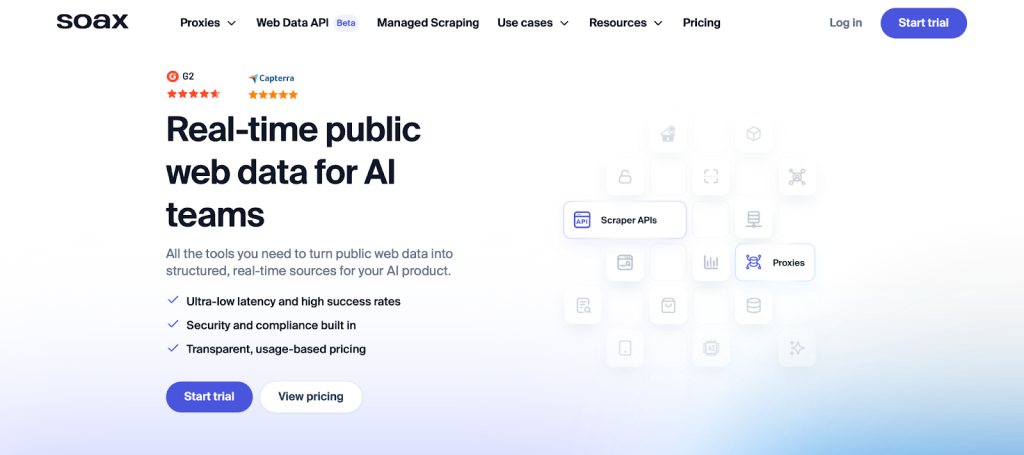
The main selling point is its straightforward granular targeting. You can filter by country, region, city, and ASN. On top of that, you can easily fine-tune how rotation behaves, so the IP behavior actually matches your workload.
This level of control makes SOAX attractive when you need very specific locations or carrier profiles, for example, with localized QA, app store, or in-app testing, or ad placement verification in narrow regions.
Independent benchmarks often mention high success rates and low response times, which is exactly what you want when looking for the best GeoSurf alternatives to migrate sensitive data.
Pricing is traffic-based and applies across all network types. A representative public plan is the Starter tier at about 90 dollars per month for 25 GB, or roughly 3.6 dollars per GB. Larger plans bring that number down further, and there is a limited trial option.
This puts SOAX in the mid range of the market, not the cheapest, but accessible enough for serious individual users and small teams.
Best for: users who rely heavily on precise geo or ASN targeting and need stable performance for QA, ad verification, and localized data collection.
NetNut is focused on high performance traffic endpoints and has started to position itself more and more as infrastructure for AI and business intelligence workloads.
The key architectural selling point is its use of direct connections through ISP partners, which can improve stability and lower detection rates compared to some traditional peer-to-peer models.
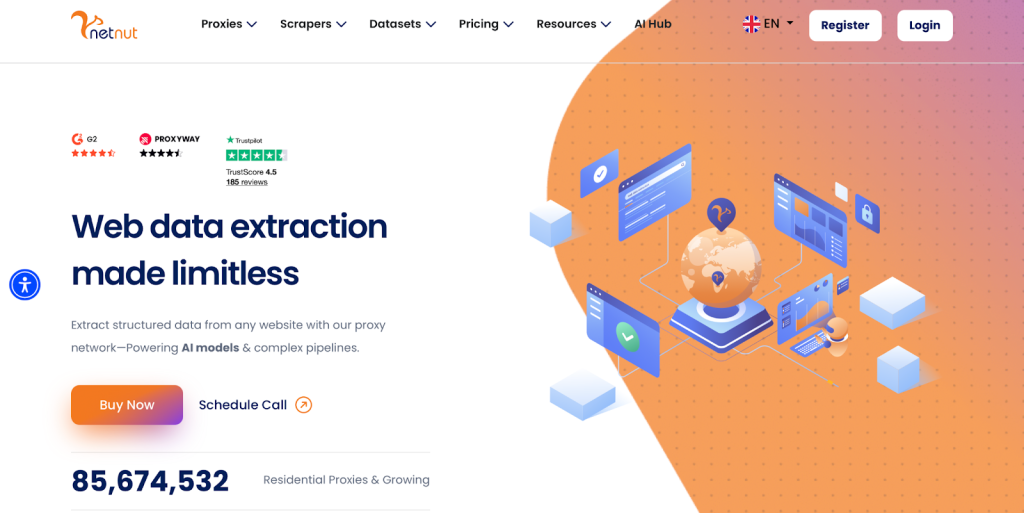
Public data suggests NetNut manages around 85 million IPs across over 195 countries, with both rotating and static options available. The product lineup also includes 4G/5G and datacenter traffic aimed at general web data collection, as well as a Website Unblocker.
Thor pricing is bandwidth-based, and typical plans start at around $3.5 per GB for smaller bundles, with high volume and enterprise deals dropping closer toward the 2-2.5 dollar per GB range.
Best for: high volume scraping, analytics, and AI training pipelines where throughput, stability, and ISP-backed infrastructure matter more than affordable entry pricing.
Webshare is a budget-friendly proxy vendor that has scaled quickly and now processes hundreds of millions of requests each month. It offers shared and dedicated datacenter networks, as well as rotating and static proxies.
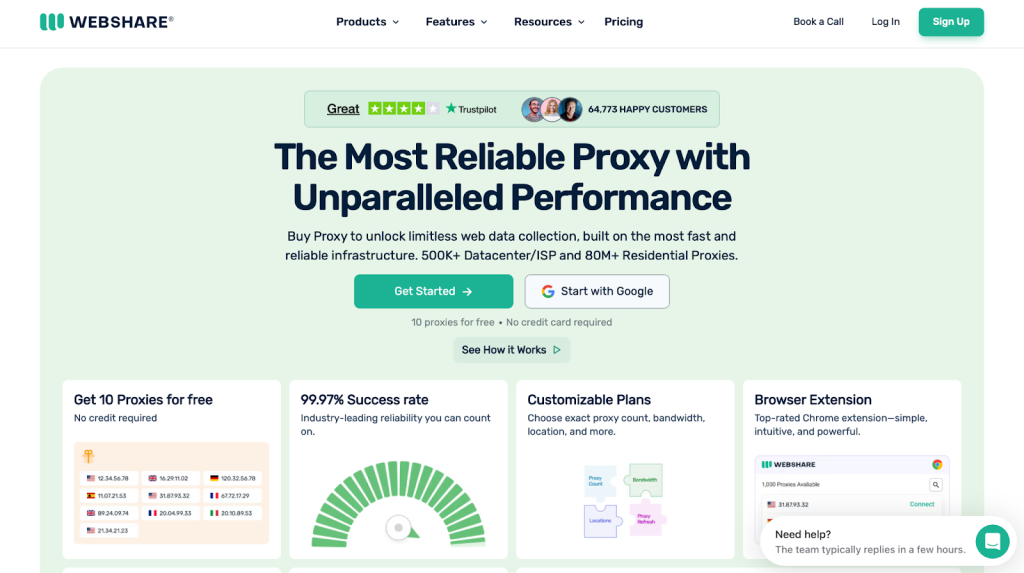
What makes Webshare stand out among the best GeoSurf alternatives is its very simple, low friction set up and onboarding flow.
Their entry tier is also very affordable, allowing new users to grab a small but permanent free allocation of datacenter proxies, then grow into paid shared or dedicated networks once needed.
The platform does not currently bundle advanced tools like scraping APIs or web unblockers, but you do get a very intuitive dashboard, real-time usage monitoring, and a neat browser extension for manual tests and quick geo switching.
Pricing is one of Webshare’s main levers, because their shared datacenter plans start at just a few cents per IP per month, while rotating residential traffic starts around $3.50 per GB.
As you can tell, that is very aggressive pricing compared to most competitors, but the tradeoffs are there — much lower feature depth, since there are no specialized IPs, no native scraping API layer, and no true enterprise support.
Best for: beginners and budget-conscious teams that want straightforward, affordable proxies with intuitive dashboards and are happy to run their own scraping and unblocking logic.
With several strong options on the table, choosing the best GeoSurf alternatives for your business or personal workloads comes down to four main angles: required proxy mix, performance and reliability, governance and visibility, and total cost.
If your main need is stable, high volume traffic, then platforms that lead with large IP pools and strong rotation, like Proxy-Seller, Oxylabs, and Bright Data, are natural first candidates.
If your team spends more time on account management and manual operations, you may care more about simple dashboards and browser tools. In that case, Webshare or Decodo can save a lot of operational friction.
Performance and observability sit right behind that. While it may take some time, test out your top picks to find out their success rates on your specific targets, spot any error breakdowns and logs, and how easy it is to track usage by project.
Finally, dig into the real pricing structure instead of just the headline "from X dollars per GB" copies, because that can oftentimes be misleading. Instead, check for minimum monthly commitments, whether bandwidth rolls over or resets, how unblockers or scraping APIs are billed, and what level of support and SLAs you get on each tier.
GeoSurf shutting down forced a lot of teams to take a step back and reassess how they source residential and mobile IPs. The good news is that in 2026, the ecosystem is more mature and diverse than it was when GeoSurf was still around.
The 7 best GeoSurf alternatives mentioned in this guide are all top choices that actually outperform the original on scale, reliability, and features.
If you are moving away from GeoSurf or simply rethinking your IP stack, the most effective next step is to test a small batch of these providers on your real workloads.
Start with Proxy-Seller — it’s very easy to set up and get going, and it provides premium residential, 4G/5G, ISP, as well as specialized proxies for social media, gaming, and more, so rest assured you’ll find the right network infrastructure.

 PHP
PHP Node.js
 Python
 Java
Java Golang
 en
en  Español
  中國人
中國人  Tiếng Việt
  Deutsch
  Українська
  Português
  Français
  भारतीय
  Türkçe
  한국인
한국인  Italiano
  Indonesia
  Polski
Comments: 0