 Proxy for Telegram
 Proxy for LinkedIn
 Proxy for Google
 Proxy for Ebay
 Proxy for Twitter
 Proxy for TikTok
Best Mobile Proxy Providers 2026: Which One to Choose?

Choosing between the best mobile proxy providers 2026 has to offer isn’t just about “who’s the cheapest” or “who has the biggest IP pool” anymore.
4G/5G proxies have quietly moved into the critical path of numerous workflows, such as multi-account management on social and marketplaces, scraping sensitive websites, app QA, ad verification, and localized UX testing, just to name a few.
Pick the wrong provider and you’re suddenly dealing with endless blocks, broken sessions, and a budget that just continues to evaporate.
In this short guide, I'll walk through what cellular proxies actually are, what really matters when choosing a provider in 2026, and then compare the top mobile proxy providers side by side.
What Is A Mobile Proxy and Why It Matters in 2026
Simply put, a mobile proxy routes your traffic through IP addresses that belong to real-world network carriers (3G/4G/5G/LTE) and devices connected to those cellular networks.
This way, your target website or app now has a cellular IP that looks like a normal smartphone user just browsing around.
That changes things quite a lot. Mobile IPs typically carry a higher “trust score” and are less likely to get auto-flagged or blocked. The traffic footprint also looks a lot more like real user behavior, seriously helping with increasingly strict anti-bot systems.
On top of that, these IPs are usually rotated on a schedule by the provider (or manually on demand), which makes it much harder to fingerprint a single connection.
In real life, this is why these proxies are so widely used for:
- running multiple accounts on platforms that don’t like datacenter IPs
- collecting web data from targets that aggressively filter non-residential traffic
- testing app user flows across locations, devices, and carriers
So the best mobile proxy providers 2026 lists online aren’t just the ones shouting the biggest numbers. The real winners are those that can consistently mimic natural SIM-based behavior and actually deliver the advantages of using mobile proxies under real, and when needed, heavy workloads.
How I Selected The Best Mobile Proxy Providers 2026
I didn't build this list from marketing pages or vendor press releases. To compare the best cellular network providers on the market in a meaningful way, I used a simple framework built around the factors that make or break a provider:
Real Carrier IPs
Mobile IPs should come from mobile operators, not from relabeled residential or datacenter ranges. So I started with what each provider discloses about its carriers and ASNs.
IP Pool and Coverage
First things first — how big and how diverse is the IP pool? Ideally, the provider should be transparent about how many 4G/5G/LTE IPs they actually have, which countries and cities they cover, and how many carriers they include. A larger and more diverse pool seriously lowers the chance of hitting the same IPs while giving you more flexibility.
Pool Freshness
I don’t rank providers by the biggest number. A smaller, well-maintained pool often beats a larger one that’s already burned, so I treat headline IP counts as a rough indicator.
Rotation and Session Control
Rotation logic is what makes your traffic look “natural” and keeps sessions usable. Different providers do this differently — some rotate on a timer or on every request, while others let you manually trigger rotation via an API or control link.
Performance and Reliability
Mobile network IPs have to work under real-life traffic, not just in theory. So a few key factors to look out for include low, consistent response times, minimal connection drops, and solid uptime (most serious vendors aim for 99%+). Most top providers highlight 4G/5G speeds and high uptime, which is great, but you still want to validate those claims with your own workloads.
Tooling, API, and Integrations
The more your team relies on automation, the more your life depends on dashboards, APIs, and logs. The best mobile proxy providers 2026 typically offer clear stats and usage breakdowns, configurable rotation rules, and flexible authentication (user/pass and IP whitelisting). This is absolutely essential for running multiple projects or environments on the same IP stack.
Pricing Model and Scalability
When it comes to IP infrastructure providers, pricing structures are all over the place. Some offer pricing per-GB (bandwidth-based), per-IP (fixed endpoints, often unlimited traffic), or with custom hybrid models. In any case, transparent pricing and easy scaling are way more important than any flashy “from $X” badges. I took the prices in this guide from each provider’s official pages, not from invoices, old screenshots, or third-party reviews.
Live Service and Compliance
A good price means little if the service is gone or its IP sourcing is questionable. I confirmed that each provider on this list is still selling its product and looked for public reports of enforcement actions against it.
Best Mobile Proxy Providers 2026: Top Options Compared
Now that I've covered the basics, it’s time to explore the best mobile proxy providers 2026 has to offer, taking into account the key evaluation factors I discussed above.
| Provider | Approx. IPs total (only mobile) | Countries / locations | Claimed uptime / success | G2 rating* | Pay-as-you-go | Free trial / refund | Starting price** |
|---|---|---|---|---|---|---|---|
| Proxy-Seller | 50M+ (1M+) | 20 (mobile), 220+ (residential) | 99.7% uptime / 99.5% success | 4.8/5 | Yes | No standard free trial / free POC for enterprise teams | From $10 |
| ProxyEmpire | 30M+ (4M+) | 170+ | 99.9% uptime | 5/5 | Yes | $1.97 paid trial | From $4.50/GB (PAYG) |
| Bright Data | 150M+ (7M+) | 195+ | 99.99% | 4.7/5 | Yes | Free trial | From $8/GB ($4/GB with promo code) |
| Oxylabs | 175M+ (20M+) | 140+ | 99.9% | 4.5/5 | No (plans from $15/month) | $5 welcome credit | From $7.50/GB |
| Proxidize | 20M+ | 195+ | 99.5% target success | 4.7/5 | No (GB packs) | No free trial / 30-day refund | From $2/GB |
| SOAX | 191M+ (33M+) | 195+ | 99.95% success | 4.8/5 | Yes | No free trial / free Sandbox account | From $5/GB (PAYG) |
| IPRoyal | 34M+ (4.5M+) | 195+ | 99% | 4.7/5 | No (per-GB or time-based plans) | No free trial / 24-hour test plan | From $6.80/GB or $10.11/day |
| Decodo (ex-Smartproxy) | 125M+ (10M+) | 160+ | 99.9% | 4.6/5 | Yes | Free trial + 14-day refund | From $4/GB (PAYG) |
| Infatica | 45M+ (5M+) | 195+ | 99.9% | 4.8/5 | Yes | 7-day paid trial | From $8/GB (PAYG) |
| LimeProxies | 40M+ (3M+) | 100+ | 99.9% | N/A | No (monthly GB packs) | Trial on request | From $75/month (5 GB) |
| Proxy-Cheap | 100M+ (5M+) | 100+ | 99.9% | N/A | Yes | No | From $5.99/GB |
* G2 ratings at the time of checking.
** Public prices from each provider’s official pages. Promotional rates may apply.
Proxy-Seller: Flexible 4G/5G Mobile Proxies and Mixed IP Stack
Proxy-Seller offers rotating 4G/5G/LTE proxies pulled straight from real carriers, with full control over how and when those IPs change. Each cellular network comes as its own endpoint, and you can either let it rotate on a fixed timer or switch the IP manually using a rotation link or the control panel, depending on your workflow needs.
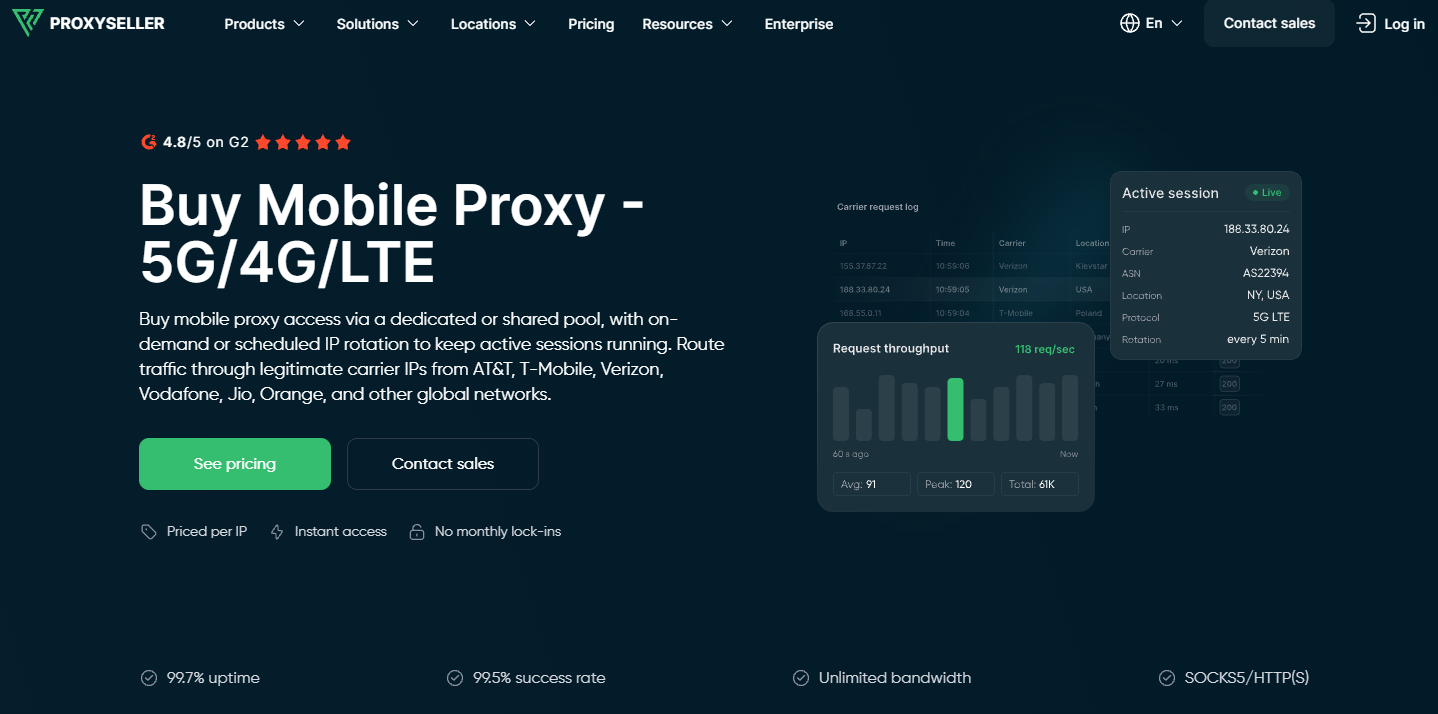
Another big upside is that Proxy-Seller’s cellular network layers live inside a larger ecosystem. It also includes ISP and residential proxies, as well as hyper-custom proxies tailored for gaming, social media, and more, all on the same platform.
Key advantages of Proxy-Seller:
- Real 4G/5G/LTE carrier IPs with rotation controlled either by timer or on demand
- HTTP(S) and SOCKS5 support that seamlessly plug into browsers and custom scripts
- Dedicated and shared resources, depending on how isolated you need things to be
- Integration with an accessible control panel for managing proxy rotation and settings
- 24/7 support with help on configuration when needed, for instance, with creating and setting your own 4G/5G proxies
Proxy-Seller gives a lot of flexibility to users who want to build or manage their own infrastructure setups. That said, their hosted SIM-based networks and default rotation presets can be deployed without having to “engineer” your own stack.
Overall, among the top mobile proxy providers in 2026, Proxy-Seller stands out as one of the most versatile options in this guide: a single platform where you can combine 4G/5G/LTE networks with ISP, residential, and tailored setups for gaming or social, fine-tune rotation the way your projects need it, and lean on 24/7 hands-on support when something breaks or needs tweaking.
For most teams, from smaller setups to larger data and growth teams, that mix of flexible infrastructure, mixed IP stack, and practical help is very hard to match.
Mobile proxies from $10
Choose mobile proxies from real mobile carriers in more than 20 countries worldwide
Try 4G/5G/LTE proxies from real carriers on your own traffic and see how they handle blocks, stability, and speed in your existing workflows. Mobile proxy plans start at $10 and are available for weekly rental.
ProxyEmpire: Proxies with Data Rollover and Deep Filtering
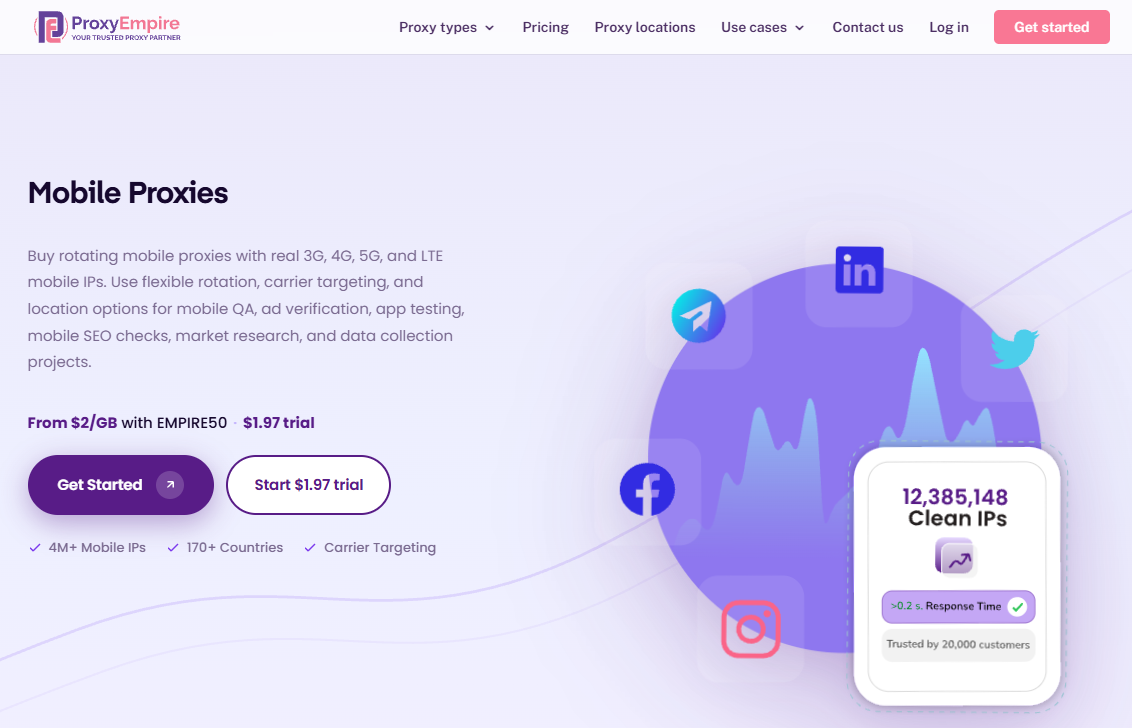
ProxyEmpire leans into flexibility and control. It offers dedicated and rotating 4G/5G proxies backed by a pool of 4M+ mobile IPs across 170+ countries, with filtering down to country, region, city, and carrier. The same account also opens 30M+ residential IPs, so teams can mix mobile and residential traffic without a second vendor.
Key advantages of ProxyEmpire:
- 4M+ mobile IPs in 170+ countries with carrier and city-level targeting
- Non-expiring bandwidth: unused traffic rolls over to the next billing cycle instead of being lost
- Dedicated 4G/5G plans with unlimited bandwidth and full control over IP changes
- 24/7 live chat support, plus dedicated account managers for corporate clients
Rotating mobile traffic starts at $4.50/GB pay as you go and drops to $2/GB at 1,000 GB, and a $1.97 trial includes 50 MB of mobile traffic to test real targets first.
The trade-off is that the dashboard exposes a lot of filters and network stats, which suits technical teams better than users who want a fully hands-off setup.
Bright Data: Large-scale Network with Fine Targeting
Bright Data runs one of the biggest IP providers available, with millions of 4G/5G/LTE IPs across a large number of countries and carriers. It’s heavily focused on granular targeting and bundles cellular networks into a broader data collection and scraping platform.

Key advantages of Bright Data:
- Huge, diverse IP pool across many global locations
- Fine-grained geo and carrier targeting for ad verification, competitive research, and localized testing
- Strong ecosystem on top: scraping APIs, pre-built datasets, browser tools, and detailed documentation
The catch? Cost and complexity.
Bright Data’s proxies are usually priced on bandwidth at the higher end of the market. This may make sense for enterprise users, but it will definitely be steep for smaller teams. Also, the platform itself is very feature-rich — great when you need it, but it will feel like overkill if all you want is a functional SIM-based provider.
Oxylabs: Enterprise-grade Proxies with Broad Coverage
Oxylabs positions its mobile network layer as part of an enterprise-grade network layer and web data infrastructure. The company advertises a pool of over 20M IPs with a strong emphasis on stability and precise geo-targeting.

Key advantages of Oxylabs:
- Large and geographically diverse cellular IP pool
- Advanced geo-targeting, including continent, country and, region filters
- Clean integration with other Oxylabs tools, such as scraping APIs and web unblocker solutions
Oxylabs is very clearly aimed at enterprise buyers. Their pricing is typically per-GB and optimized for high traffic volumes. It’s worth mentioning that this platform only makes sense when you already have an existing data-collection process and the technical staff to plug everything in place and maintain.
For small-scale projects and SMBs, Oxylabs can end up feeling much more complex, and more expensive, than you would realistically need.
Proxidize: Mobile-first Proxies with Flat Per-GB Pricing
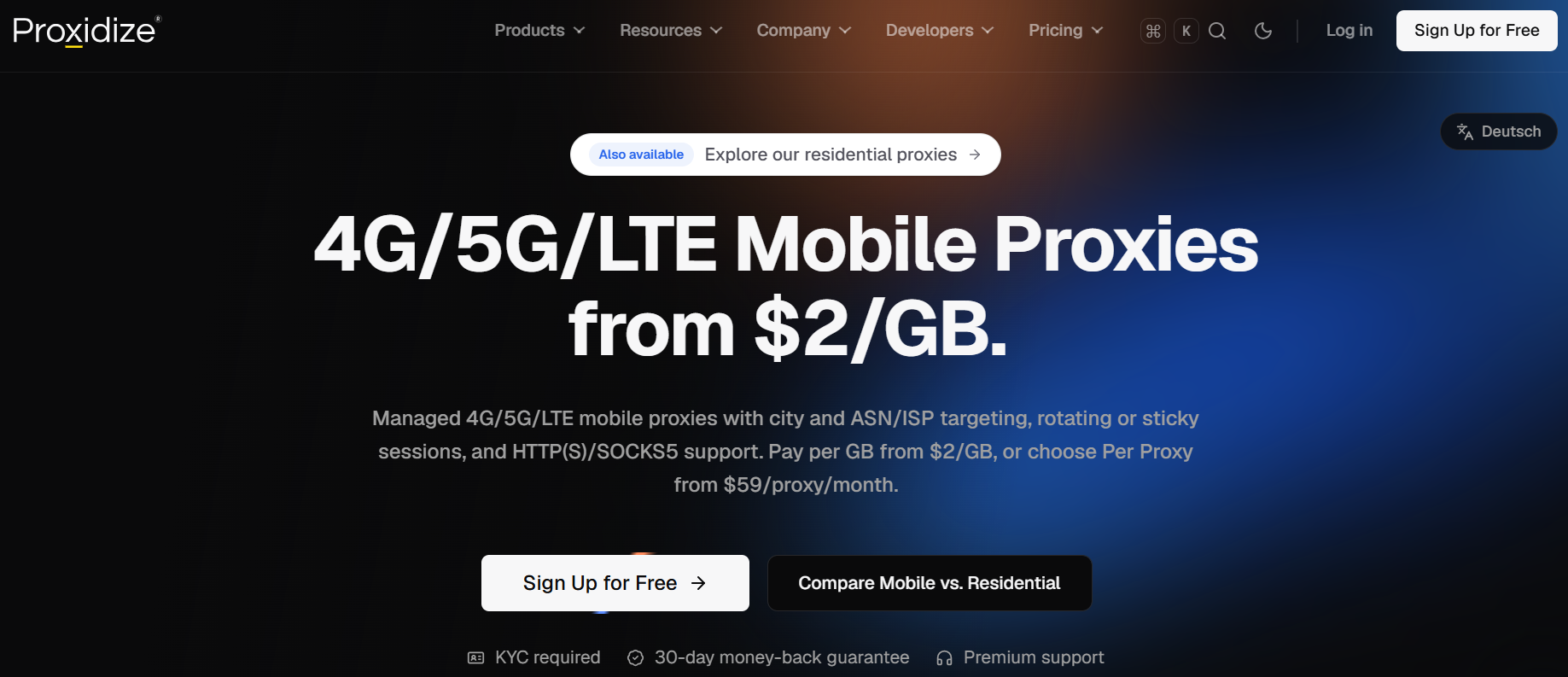
Proxidize focuses on mobile proxies rather than a broad mixed stack. You can buy access to its shared mobile pool by the GB or pay per proxy, with targeting by country, city, and ASN/ISP. The company says it runs on nationwide mobile operators, not MVNOs or resellers, and that’s one of the first things I look for in this category.
Key advantages of Proxidize:
- Flat $2/GB on self-serve plans, from 25 GB ($50) up to 10 TB
- Per-proxy plans at $59 per proxy per month
- Country, city, and ASN/ISP targeting
- 30-day money-back guarantee if you’ve used less than 10 GB
The trade-off is transparency on scale. I couldn’t find a public pool size or country count, so I’d check that your target locations are covered before you buy. There’s also no free trial, and bandwidth expires after one month.
SOAX: Massive Pool with Granular Targeting
SOAX positions itself as a unified platform with a very large cellular network on top. It advertises 33M+ carrier-based IPs in 195+ countries, with strong filtering options down to city and ASN level, making it attractive for teams that care about very precise location profiles.

Key advantages of SOAX:
- 33M+ cellular IPs with coverage in 195+ countries, allowing you to hit most markets worldwide
- Targeting that drills down to country, region, city, and in some cases carrier/ASN for very specific location setups
- Both rotating and sticky LTE sessions (up to roughly an hour) for mixed scraping, login flows, and account scenarios
- Focus on ethically sourced IPs and a broader network that aims for 99.9% uptime
As with other large-scale platforms, the main drawbacks are complexity and cost. SOAX's per-GB rate depends on your plan and the target country, starting at $5/GB on top-up credits, and the number of dials and switches can be more than you really need if you’re just after a simple, plug-and-play setup instead of a full data collection platform.
IPRoyal: Budget-Friendly Proxies with Unlimited Traffic
IPRoyal has built a reputation as a more affordable provider, and that extends to its mobile proxies as well. Its 5G/4G/3G/LTE service offers a pool of 4.5M+ IPs from real devices, with dedicated plans or rotating plans billed per GB that are easier to digest for smaller teams and solo users.

Key advantages of IPRoyal:
- Mobile IPs sourced from real devices and carrier networks, tuned for anonymity and fewer automated blocks
- Unlimited bandwidth on dedicated plans, plus rotating plans from $6.80/GB
- Support for 3G/4G/5G, HTTP(S) and SOCKS5, plus simple time-based rotation (for example, every 20–60 minutes) you can set and forget
- Pricing geared toward individuals, small agencies, and SMBs that need carrier-based IPs without enterprise-level spend
On the downside, IPRoyal’s SIM-based coverage isn’t as extensive as what you get with the more business-oriented solutions like Proxy-Seller, and you won’t find as many integrated scraping APIs or higher-end automation features baked in. For teams that just want straightforward, cost-effective IPs and can live without the “extras,” that’s usually a reasonable trade.
Decodo (formerly Smartproxy): Cellular Proxies with Strong Tooling
Much like most other best mobile proxy providers 2026 has, Decodo offers carrier-based proxies along with a broader stack of residential, ISP, and datacenter IPs. Its product is built around an ethically sourced pool of 10M+ SIM-network IPs spread across 160+ locations and over 700 ASNs, with a lot of thought put into targeting and session control.

Key advantages of Decodo:
- 10M+ carrier-based IPs with targeting across 160+ locations and 700+ carriers/ASNs for very fine-grained routing
- 3G/4G/5G/LTE support tuned for app testing, ad verification, and multi-account scenarios that need stable sessions
- HTTP(S)/SOCKS5 support, APIs, and a well-designed dashboard to manage sessions, usage, and traffic patterns
- Extra features like scraping APIs, browser utilities, and more, all wired into the same IP infrastructure backend
Where Decodo can be less appealing is pricing and positioning. Mobile plans reward higher traffic volumes: rates run from $4/GB pay as you go down to $2.25/GB at 500 GB, so small projects and early pilots pay noticeably more per GB.
Infatica: P2P Network for Tougher Targets
Infatica offers mobile proxies as a premium layer on top of its residential and datacenter services. Its cellular network is built on millions of real-life IPs from a peer-to-peer device network, spread across many regions, and aimed at tougher targets where standard residential or datacenter IPs tend to struggle.

Key advantages of Infatica:
- Mobile IPs coming from real devices in a peer-to-peer network, built to stay highly anonymous and look like normal user traffic
- Broad global reach, with cellular addresses spread across a wide range of countries and regions
- HTTP/SOCKS support plus an API you can wire straight into scraping frameworks, automation tools, or your own internal systems
- Aimed specifically at tougher use cases like mobile app testing flows and ad verification, where weaker IP types tend to break down
However, Infatica’s pricing sits in the middle of the market and can climb as usage scales, and the P2P model means the network mixes wireless and Wi-Fi connections instead of being purely carrier-grade end to end. Some benchmark tests also show uneven performance outside of preferred regions, so it’s the kind of provider you’ll want to trial carefully on your own targets before financially committing serious volume.
LimeProxies: Fast Private Proxies with Options
LimeProxies is known for its fast private and datacenter network layers, but it also offers mobile and residential options, including a dedicated SIM-based pool in the low-million-IP range. Its selling points are speed, uptime, and direct support rather than sheer scale or heavy scraping tooling.

Key advantages of LimeProxies:
- Real LTE-carrier IPs built to slip past CAPTCHAs and mobile-only content or access restrictions
- A pool of 3M+ cellular IPs plugged into a wider IP network that claims 99.9% uptime
- Geo-targeting across 100+ countries, with filters down to country, city, or state for more precise routing
- Clear emphasis on fast setup and responsive human support when you actually need someone to step in and help
The main limitation is depth of product: LimeProxies doesn’t offer the same advanced scraping APIs, analytics, or massive carrier-based pools that some of the bigger platforms bring to the table. For very complex or high-scale LTE data operations, more specialized providers may be a better long-term fit. LimeProxies is more relevant in the small-to-mid range.
Proxy-Cheap: Affordable Static and Rotating Proxies
Proxy-Cheap, as its name suggests, sits firmly in the “budget” category and leans into that positioning. It offers static mobile IPs in 24 countries and rotating mobile proxies across 100+ countries, billed per GB from $5.99. For teams that want to experiment with carrier-based proxies without committing to enterprise-level pricing, this is one of the more approachable options.

Key advantages of Proxy-Cheap:
- Static mobile IPs in 24 countries, available in shared or dedicated form
- Rotating carrier proxies with flexible rotation settings and low starting prices for entry-level plans
- Per-GB billing with no monthly commitment or setup costs, which helps when your traffic varies
- HTTP/SOCKS support that works well for social media workflows, app testing, and ad verification scenarios
For budget-conscious teams or anyone trying 4G/5G/LTE network IPs for the first time, this tool is a practical, low-friction way to get started. The obvious trade-off is that you don’t get the same network scale, compliance posture, or advanced features as with the more premium providers like Proxy-Seller.
Get started with Proxy-Seller
Choose shared or dedicated mobile proxies
Set up your first mobile proxy in a few minutes, route key projects through carrier-grade IPs, and benchmark the results against your current setup. Shared mobile proxy pricing starts at $10 weekly.
Are Mobile Proxies Legal?
Mobile proxies are legal to use in most jurisdictions. What matters is how you use them and whose terms of service your traffic touches. A proxy changes your IP address, not your legal obligations.
Here’s what I recommend:
- Collect only publicly available data
- Don’t bypass logins or paywalls
- Respect each platform’s terms of use
- Don’t collect personal data without a legal basis
I also suggest choosing a provider with consent-based IP sourcing and a clear acceptable-use policy, because where a network’s IPs come from can become your problem too.
This isn’t legal advice. Rules vary by country and platform, so check with your legal counsel for your specific use case.
Which Provider Is Right for You?
Choosing between the best mobile proxy providers 2026 has in store comes down to three main factors: your scale, your in-house technical capacity, and how much risk you’re willing to take on around blocks and instability.
If you want a flexible provider that combines cellular with numerous other IP network layers under one roof, Proxy-Seller gives you that perfect balance. Flexible rotation, mobile coverage in 20 countries, multiple IP types, and reliable infrastructure that works for both smaller teams and more advanced enterprise setups.
So, what is the best mobile proxy provider?
The best way to decide this is to run a short, controlled pilot with two or three providers from my list. The provider that delivers the best mix of success rate, latency, and total cost on your real workloads is the best option for your business.
PROXIES FROM $0.02/IP
Ready to put this into practice?
Pick a proxy type and location, and start using it within minutes.
Instant delivery
24/7 support
Refund policy
About the author