

For most performance teams, optimizing Facebook ads cost has become increasingly challenging. Costs jump by geo, niche, and campaign type, and if they’re not careful, in many instances, they’ve climbed faster than the results.
If you want to bring acquisition costs under control, chasing cheap clicks isn’t enough. You need a clear picture of how pricing actually works, where money silently leaks across the funnel, and which levers reliably push cost per result down over time.
Most decisions around Facebook ads cost are made on a small cluster of core metrics. They’re connected, but each has its own unique value to better understand ad performance:
Remember: Meta optimizes for the objective you pick. If you choose traffic, the system goes looking for people who click easily, rather than focusing on people who often buy. That’s how you risk ending up with low CPC and terrible CPA at the same time.
Every single impression on Facebook is assigned through an auction, but the platform doesn’t just hand it to the highest bidder and call it a day. It picks the ad with the highest total value for that impression.
Total value is a mix of three things:
An advertisement with strong estimated action rates and good quality can win auctions at a lower price than a competitor that simply bids more but is less relevant. That’s why creatives and targeting matter so much for Facebook ads cost.
At the same time, external pressure still moves your prices. More advertisers chasing the same audience, very tight geo targeting, limited placements, and seasonal spikes all increase competition and push the CPM up.
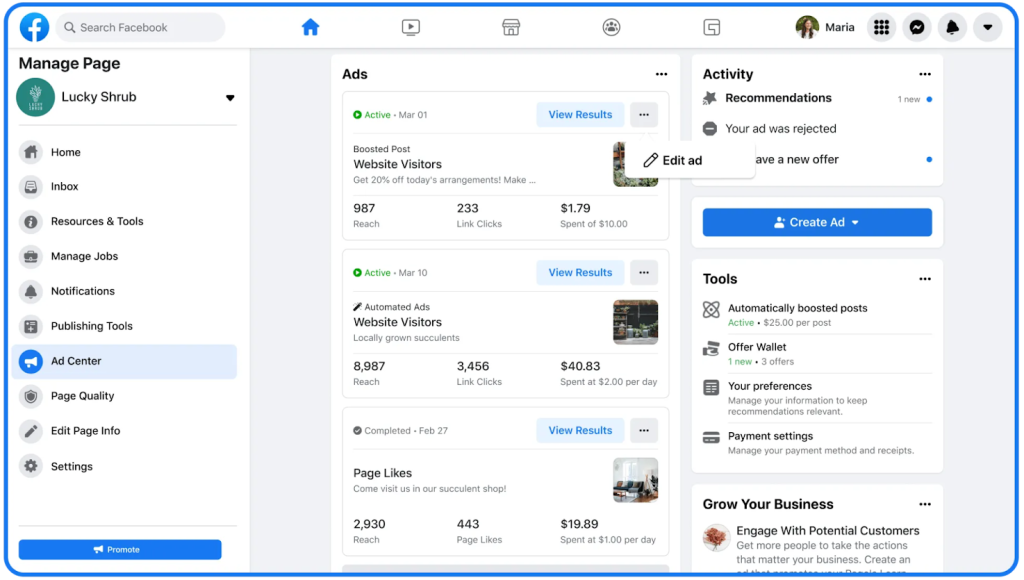
Source: Facebook
Benchmarks aren’t concrete goals, but they do help you see whether your account is wildly off or within a normal range.
Recent aggregated datasets across industries usually show the average cost of Facebook ads (CPC) somewhere around 1.50-2.00 USD, with some verticals way above and others way below.
Average CPM is often reported in the -7 USD range globally, but again, it swings a lot depending on your niche, country, and campaign objective. Performance-heavy campaigns in competitive markets can sit well above that, while broad awareness in cheaper regions will be less.
The important part is to also compare the quality of likes and impressions. A small retargeting audience full of high-intent users will almost always show a higher Facebook ads cost per thousand impressions than a broad campaign in a low-income market, even though it will almost certainly result in more paid customers down the line.
What really matters is not whether your CPC or CPM matches the general answer to “how much do Facebook ads cost”, but whether your CPA and ROAS are sustainable for your margins in the specific markets you’re targeting.
Before we go into bids or budgets, you need to know what is actually making Facebook ads cost spike.
A common structural issue is splitting what should be one campaign into many smaller campaigns and paid post sets, each with a smaller budget. Because spend is fragmented, every campaign collects much fewer conversions, so the system struggles to learn who to actually target.
As a result, many ad sets sit in the learning phase or keep re-entering it after minor changes. In practice, that volatility usually comes from account structure rather than from the auction mechanics.
Targeting choices show up directly in cost. Very narrow audiences and heavy filters (geo, interests, demographics) shrink the user pool and often push CPM up. Overlapping audiences make it even worse, because your own promo sets can end up competing against each other for the same audience.
On the other side, wide-open targeting with a weak offer usually drives low-intent clicks. People click out of curiosity, don’t convert, CTR drops, CPC rises, and CPA goes up, even if CPM still looks fine.
Creatives are one of the biggest drivers of Facebook ads cost inside the auction. If people scroll past or react badly, the system gets a clear signal. Low CTR, weak engagement, and negative feedback hurt advertisement quality and can make each impression more expensive over time.
You’re likely facing a creative bottleneck if CTR is consistently low for your vertical, frequency rises while results get worse, or the promise in the paid promo doesn’t match what users see on the landing page. Until those elements are fixed, Facebook ads optimization on bids or targeting will not give you the results you hope for.
Once you know where the problem sits, you can adjust the main levers that affect the cost per result and actually answer what is a good cost per result facebook ads for your specific account.
For starters, your optimization event has to match your real goal. If the objective is set to Traffic but you care about Purchases, the system will focus on people who click easily, not on buyers. That’s how you get low CPC with poor revenue results.
Bidding strategy defines how tightly you control Facebook ads cost:
A simple flow would be to start with automatic bidding, watch the CPA range over a meaningful period, then add cost caps or bid caps only after you have the accurate data to anchor them.
Next, defining your audience strategy is just as important, and here it’s all about intent and structure. A clear funnel usually has three layers:
It’s also worth noting that setting clear exclusions can stop these layers from cannibalizing each other, where you end up paying more for reaching the same customer multiple times.
Last but not least, good creatives are an absolute must. Τhe top-performing promo creatives usually focus on one main benefit, one attention-grabbing visual, and one crystal clear call to action.
It’s equally important to match your creatives to your unique audience, so for instance, if you’re targeting younger customers — short-form videos and carousels tend to work best, whereas if you’re a B2B firm targeting executives — concrete social proof and specific numbers add that necessary layer of credibility.
Not all Facebook ads cost problems live in the setup account. Many start with tracking gaps and low conversion rates after the actual click.
If tracking is incomplete, your reported Facebook ads cost per result looks higher than it really is, and optimization suffers. Conversions that never hit Events Manager can’t be used to train the algorithm.
Make sure the Meta Pixel is installed on all relevant pages, with standard or custom events firing on key actions. Use the Conversions API alongside the Pixel (with proper deduplication) to reduce data loss from browser restrictions.
Set consistent attribution windows across campaigns so CPA and ROAS comparisons are clean, and you’re optimizing on a realistic view of performance.
If the conversion rate goes up while CPC stays flat, cost per acquisition drops, and in many accounts, this is exactly where the biggest savings are.
Your landing page has to line up with the ad, meaning — same promise, brand-consistent visuals, and a clear version of the offer they clicked on. If the page loads slowly, especially on mobile, you’re simply burning paid clicks before anyone even sees it.
Keep forms and checkout flows lean for the step you’re asking for, and back them up with real proof like reviews and guarantees to remove doubt.
Treat conversion rate optimization as ongoing work, not a one-off task you tick off a Facebook ads optimization checklist, and keep running A/B tests on copy, layout, offers, and CTAs to see what drives Facebook ads cost per result down the most.
Once the fundamentals are in place, advanced tactics can help further squeeze more efficiency out of your spend.
Creatives still matter, as the system can only optimize based on the assets you feed it. In practice, many teams run both — automation to handle scaled evergreen campaigns, and manual setups to test new angles or important segments.
High-intent visitors (web page viewers, cart adders, long video viewers, etc.) can get more direct, stronger offers, while lighter engagers will usually need a softer step first, usually focusing on education, social proof, and something that first builds trust.
If the same users see the same creatives too often, performance drops, so it’s better to rotate them or adjust audiences rather than to simply keep raising bids. Historical data will also help focus spending into the top-performing times of day and/or days of the week to further improve efficiency without increasing overall budget.
So far, we’ve mostly talked about what happens inside the paid media account and the funnel. At higher spend levels, another important question appears: are your paid posts actually being shown correctly to real users in the right markets?
That’s where Meta campaign verification and monitoring come in, and growth hacks on Facebook with proxies become an integral part of the performance stack.
Verification is simply checking that your advertisements show where they should, how they should, and to the people you actually want to reach.
In practice, that means:
Across several regions, doing this manually is a pain. That’s why teams lean on proxy networks for Facebook for routing traffic through IPs in specific countries or networks that let you see campaigns the same way real users there see them.
From there, it’s much easier to catch missing or wrong localization, a broken landing page in one market, or traffic patterns that suggest low-quality clicks or bots.
Fixing these issues proactively helps optimize your Facebook ads cost, as a result of fewer wasted impressions and clicks, fewer broken journeys, and more budget going towards actual conversion opportunities.
If you’re running paid promotions in several countries, the complexity ramps up. Currencies, languages, offers, regulations, expectations — all of that changes by market.
Choosing the right proxy for Facebook makes cross-region testing practical, as you can check:
That visibility lets performance teams catch problems and implement fixes early. For instance, a broken localized page in one country, or a redirect misconfiguration that only affects certain mobile networks, can quietly push CPA up for weeks if no one is looking from inside that environment.
Proxy-Seller is a premium proxy network provider that offers performance teams, enterprise teams, and individual users a wide range of proxy types and locations tailored to these Facebook verification and monitoring workflows.
Residential proxies, mobile 4G/5G networks, ISPs, and data-center IPs across over 220 regions let teams see exactly how their campaigns behave for users in different countries and network conditions.
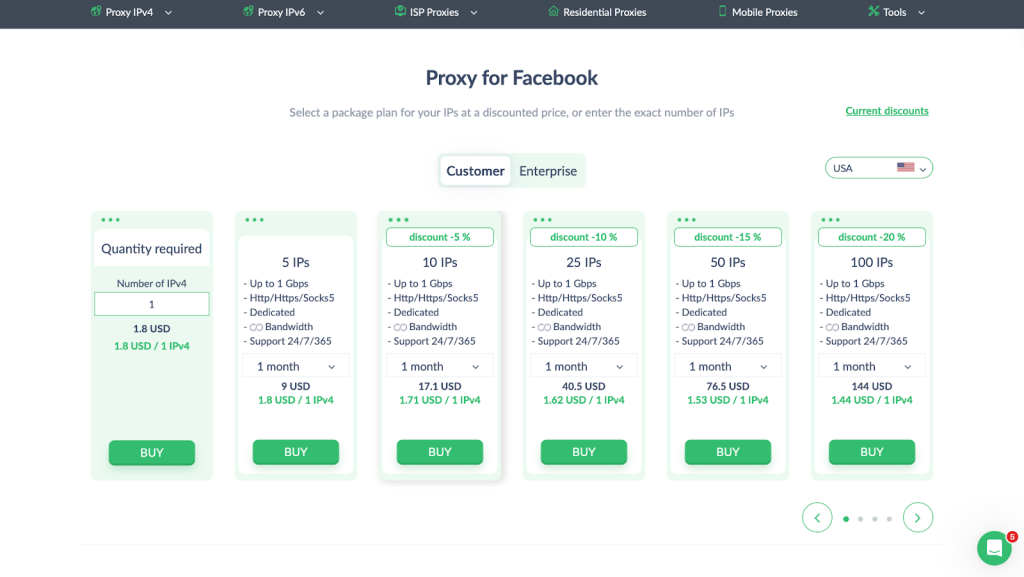
Authentication stays simple, with options that plug into existing tools and scripts without any extra hassle.
For media buyers and growth teams, a provider like Proxy-Seller has a simple job: let you see what users in each region actually see so you can catch the technical issues that quietly push Facebook ads cost up, especially as budgets grow and you move into new markets.
Lower Facebook ads cost by using proxies to see exactly what users see in each country before you scale budgets.
Optimizing Facebook ads cost comes down to tuning the entire acquisition system, rather than chasing a single metric or flicking a few quick switches in Ads Manager.
It’s a mix of the goals and bids you choose, how clean your campaign and audience structure is, whether tracking and landing pages actually convert, and how you layer in things like automation and value-based targeting.
Once that foundation is in place and you are validating delivery with ongoing verification and cross-region checks through a reliable proxy setup, costs become less random and more of a controlled, predictable input you can scale with confidence.

 PHP
PHP Node.js
 Python
 Java
Java Golang
 en
en  Español
  中國人
中國人  Tiếng Việt
  Deutsch
  Українська
  Português
  Français
  भारतीय
  Türkçe
  한국인
한국인  Italiano
  Gaeilge
  اردو
اردو  Indonesia
  Polski
Comments: 0