 Proxy for Telegram
 Proxy for LinkedIn
 Proxy for Ebay
 Proxy for Twitter
 Proxy for TikTok
 Proxy for Google
How to set up and use proxies in Playwright
Summary generated by AI:
Playwright is a widely used framework that enables developers and testers to write automated tests in various programming languages that can be run on all browsers. Its user-friendly interface has attracted many users to it.
Video Guide for Setting Up a Proxy in Playwright
How to Use Proxies in Playwright
Using private proxies with Playwright can significantly enhance the speed and efficiency of your automated access testing. With the option to choose from different regions and the availability of high-quality, reliable proxies from Proxy-Seller, you can test your connection speed and quality in both single-threaded and multi-threaded modes.
How to Use Playwright Proxy with Authorization
To configure the Playwright proxy, you will need to edit the code in the playwright.config.ts file. To do this, follow these steps:
- Install the Playwright framework on your device.
- Open the playwright.config.ts file for editing.
-
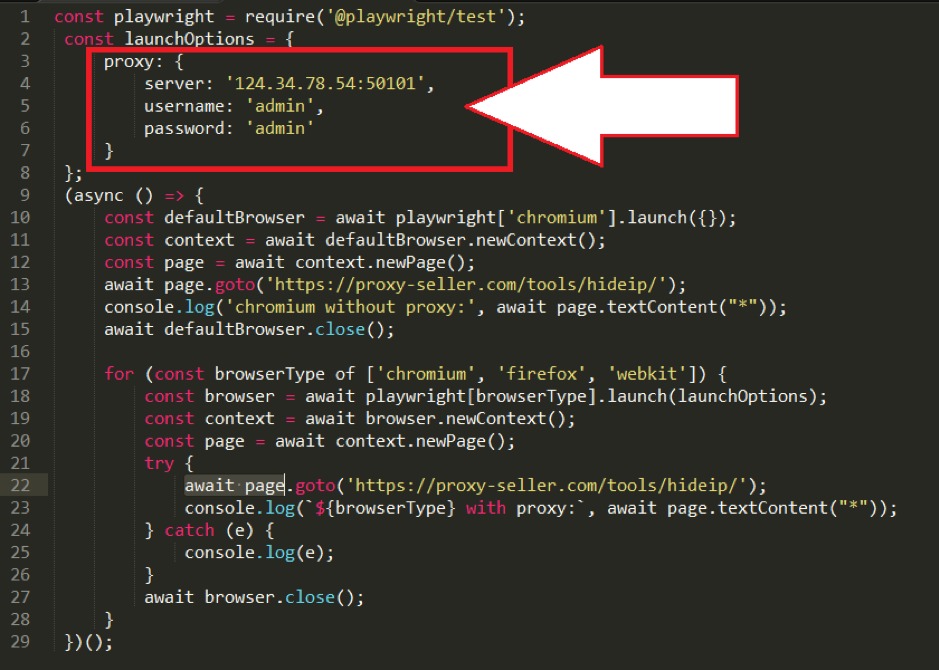
Paste the following code into the file:
proxy: { server: username: password: } -
Replace the server field with the IP address and port, separated by a colon, of the proxy to be used with Playwright. If the proxy requires a username and password, enter them in the username and password fields, respectively.
-
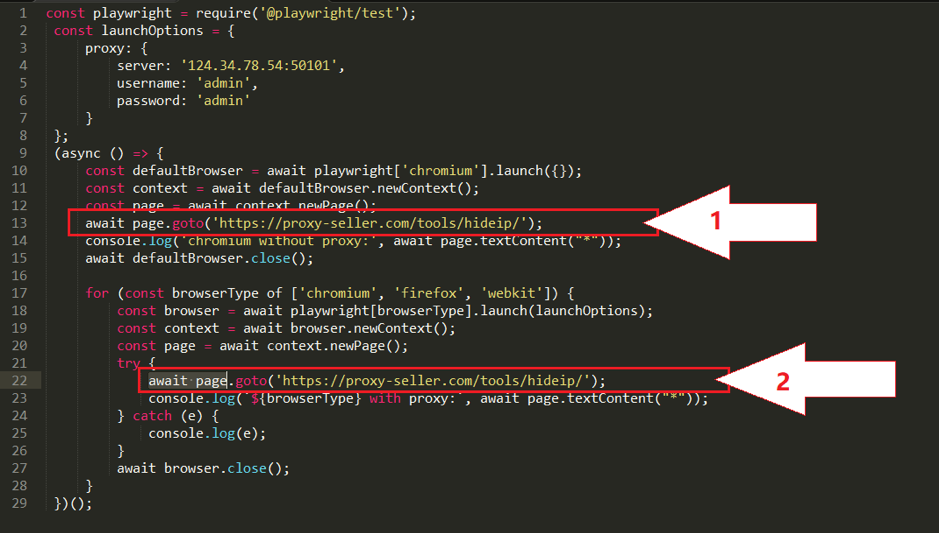
To check if the IP matches the selected region, use the Proxy-Seller check service at https://proxy-seller.com/tools/hideip/ for the await page.goto parameter.
- Save the changes to the configuration file.
Setting Up a Proxy in Playwright
- Run pip install playwright to get the Playwright Python package.
- Then install the browser binaries with playwright install. This prepares your environment for browser automation.
- Next, you need a proxy server. You can find free proxies on lists like https://free-proxy-list.net/, but keep in mind they often have issues.
For the best results in automated testing, use private proxies for Playwright from Proxy-Seller. These proxies have high-speed communication channels of up to 1 Gbps, low ping, and simultaneous support for HTTP, HTTPS, SOCKS5 connection protocols. Proxy-Seller offers fast, secure proxies with global coverage and multiple proxy types, such as IPv4, IPv6, residential, ISP, and mobile proxies. They are dedicated to one user and come with a guarantee of quality.
To configure a Playwright proxy Python setup, follow these steps:
- Choose your proxy server and get its address in the format IP:Port.
- Specify the proxy protocol (HTTP, HTTPS, SOCKS5) before the server address if needed.
- Pass the proxy parameter when launching the browser in your Playwright script.
- Test the setup by visiting a service like https://httpbin.io/ip to verify your outgoing IP.
A practical list of proxy protocols Playwright supports:
- HTTP: Use http://IP:Port
- HTTPS: Use https://IP:Port
- SOCKS5: Use socks5://IP:Port
When using free proxies, beware of pitfalls like connection timeouts and DNS resolution failures. Proxy errors often result from unreliable servers or network restrictions. If you encounter timeouts, try switching proxies or increasing timeout settings.
Playwright Proxy Configuration Example
Here’s a simple example using Playwright’s async API in Python:
from playwright.async_api import async_playwright
import asyncio

async def run():
    proxy_server = "http://123.45.67.89:8080" # Replace with your proxy address
    async with async_playwright() as p:
        browser = await p.chromium.launch(proxy={"server": proxy_server})
        context = await browser.new_context()
        page = await context.new_page()
        await page.goto("https://httpbin.io/ip")
        content = await page.content()
        print(content)
        await browser.close()

asyncio.run(run())
This code passes the proxy parameter in the playwright proxy settings. You can change “http://” to “socks5://” or “https://” to match your proxy protocol. Always verify your proxy by checking the returned IP.
Proxy-Seller makes it easy to integrate proxies in your Playwright scripts. Their dashboard allows quick proxy selection and management. The service provides stable connections, strong security, and compliance guarantees. Plus, they back their proxies with 24/7 support and a proxy replacement/refund policy, perfect for production use.
Rotating Proxies in Playwright
Proxy rotation helps you avoid detection and blocking during scraping by changing your IP frequently. You can rotate proxies per request or after a set number of requests or time intervals. This reduces the chance that websites will flag your traffic as automated.
To implement proxy rotation in your Playwright proxy Python setup, start by creating a proxy pool – a list of multiple proxy servers. Here’s how to manage rotation in a simple way:
- maintain a list of proxy addresses;
- select a proxy randomly for each browser launch using Python’s random module;
- update the pool dynamically if you get proxy failures.
Proxy Rotation Example
Example code to pick a proxy from a pool:
import random
from playwright.async_api import async_playwright
import asyncio

proxies = [
    "http://111.22.33.44:8000",
    "socks5://55.66.77.88:1080",
    "https://99.100.101.102:443"
]

async def run():
    proxy_server = random.choice(proxies)
    async with async_playwright() as p:
        browser = await p.chromium.launch(proxy={"server": proxy_server})
        context = await browser.new_context()
        page = await context.new_page()
        await page.goto("https://httpbin.io/ip")
        content = await page.content()
        print(f"Using proxy: {proxy_server}")
        print(content)
        await browser.close()

asyncio.run(run())
Free rotating proxies are often unreliable and can cause frequent failures. For large-scale or stable scraping, use advanced rotating proxy services that automate proxy changes and handle health checks.
You can also integrate with third-party proxy rotation APIs like Proxy-Seller, which offers extensive proxy types and locations that can rotate based on your needs. These services handle load balancing and provide retry mechanisms when proxies fail.
A key to effective rotation includes:
- balancing load evenly across proxies;
- retrying requests with a different proxy on failure;
- caching proxies per session to avoid excessive switching that breaks session consistency.
By controlling proxy rotation smartly, you keep scraping smooth and reduce the risk of blocks.
Debugging and Monitoring Proxy Usage in Playwright
Using playwright proxy settings can cause issues like connection drops, slow responses, or IP leakage. To fix these, enabling detailed logging is essential. Turn on verbose logging in Playwright to track proxy requests and spot failures.
You can capture and analyze network events using Playwright’s tracing and event listeners. Here’s a basic setup to log network requests and detect proxy problems:
from playwright.async_api import async_playwright
import asyncio

async def run():
    async with async_playwright() as p:
        browser = await p.chromium.launch(proxy={"server": "http://your.proxy:port"})
        context = await browser.new_context()

        context.on("requestfailed", lambda request: print(f"Request failed: {request.url}"))
        context.on("request", lambda request: print(f"Request: {request.url}"))

        page = await context.new_page()
        await page.goto("https://httpbin.io/ip")
        await browser.close()

asyncio.run(run())
Final Words: Advanced Proxy Monitoring and Debugging
For ongoing monitoring, consider external tools like Proxy-Seller’s proxy management dashboard. It provides real-time proxy health tracking, APIs for control, and instant notifications. These features help you spot and resolve proxy issues quickly.
Set up retry logic in your scripts to switch proxies on failures, ensuring continuity. Also, validate the geolocation of your outgoing IPs using services like ipinfo.io to confirm that your proxies route traffic correctly.
Proxy-Seller also offers monitoring tools and 24/7 dedicated support to help you debug and switch proxies seamlessly during automation. Their IPs comply with GDPR and other regulations, so you can trust their ethical sourcing for secure and reliable proxy management.
By actively monitoring and debugging your Playwright proxy usage, you maintain stable scraping sessions and improve your automation’s success rate.