

Finding the best IPv6 proxies means finding a provider that offers the right balance of stable performance, decent geographical coverage, and sufficient flexibility to scale as your needs evolve.
Just as important, it’s also ensuring that the provider fits your unique business workflows, works with your exact targets, and, of course, makes sense for your budget.
Below is a practical breakdown of the strongest private proxies on the market in 2026, along with where each one shines and where to look out for certain trade-offs.
An IPv6 proxy routes your traffic and requests through an IPv6 address, so the final ‘destination’ sees that IP address rather than your device’s. It’s the latest version of the Internet Protocol, designed to provide a much larger address space than IPv4, removing the scarcity problem and dropping the pricing per IP once volumes start to scale.
The catch? Compatibility still matters. If the website you’re targeting doesn’t fully support such traffic, even the best IPv6 proxies won’t be able to get the job done.
In short, it’s an engineering choice that affects compatibility, routing assumptions, and how easily you can expand your IP pools.
As a rule of thumb, IPv4 is the safer bet when “it has to work everywhere,” while IPv6 is great when your stack and targets are fully ready to support it.
The best IPv6 proxies are the most effective way to scale your workflows when:
You know your targets handle such traffic-routing end-to-end
Your apps, tools, libraries, and network path all support it without weird fallbacks
You need big pools and you’re ready to validate compatibility before rolling out
On the other hand, your team may be better off with IPv4 when:
Your target or toolchain has spotty or unknown compatibility
You run mixed environments (mobile + desktop + servers) and want the simplest path
You want fewer variables when debugging connectivity or failures
These proxies shine when you need scale, consistency, and a large pool of unique IPs without spending a fortune, making them especially appealing for:
Public web scraping → collecting public-facing data across large sets of pages without depending on a small, static IP pool.
SEO monitoring and SERP tracking → running recurring search result workflows across multiple locations.
Marketplace and listing monitoring → tracking product pages, stock updates, and catalog changes at scale.
Ad verification → checking how public ads actually appear across different regions and devices.
Automation workloads → spreading requests across many IPs for more stable and structured workflows, such as social media automation and scraping Telegram channels.
For many business workflows, the best IPv6 proxies solve a very simple problem: how to scale IP-heavy tasks without paying premium pricing for every single address.
That’s also why many buyers looking for the best affordable IPv6 proxies 2026 has to offer usually start with datacenter IPs instead of jumping straight into premium residential networks.
The main upsides are pretty clear:
Lower cost at volume: dedicated IPv6 packages are usually much cheaper per IP than v4 offers.
Broader IP availability: gives users access to far larger address pools.
Strong fit for repeatable tasks: especially useful for web scraping, monitoring, and testing workflows that need consistency.
Straightforward scaling: many providers offer these IPs in simple dedicated packages with fast activation.
The platforms below were chosen based on clear offerings, verified user reviews, clear pricing structure, and global coverage.
Some of them position themselves as more dedicated IPv6 packages, while others offer it as part of a much broader proxy server infrastructure for residential or enterprise use.
That difference matters more than people think, especially if you’re comparing the best IPv6 residential proxies providers with direct datacenter sellers.
Proxy-Seller stands out as the strongest all-around option as it combines low entry pricing for dedicated IPv6 with broad protocol support, solid location coverage, and a much wider proxy ecosystem, all packaged into a neat and intuitive user dashboard.
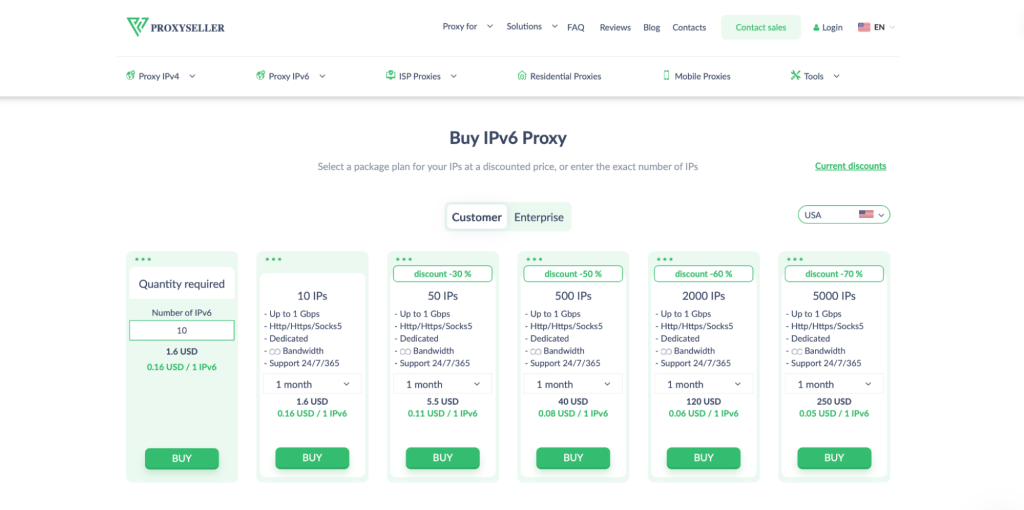
Its official IPv6 offer starts at $0.16 per IP, supports HTTP, HTTPS, and SOCKS5, covers 17+ countries, and delivers speeds of up to 1 Gbps.
On top of that, the platform also offers residential, ISP, and mobile proxies, which gives teams flexibility and a very natural upgrade path if they end up needing more network types down the line (and chances are, they will).
Key features:
Dedicated IPv6 proxies from $0.16 per IP
Support for HTTP, HTTPS, and SOCKS5
17+ countries available for IPv6, and over 195 for other network types
High speed up to 1 Gbps with instant activation
Access to residential, ISP, mobile, and IPv4 products within the same ecosystem
Pricing is one of the most competitive in this list, especially for users who want the best IPv6 proxies at scale instead of paying premium rates or settling for slightly cheaper but less reliable options.
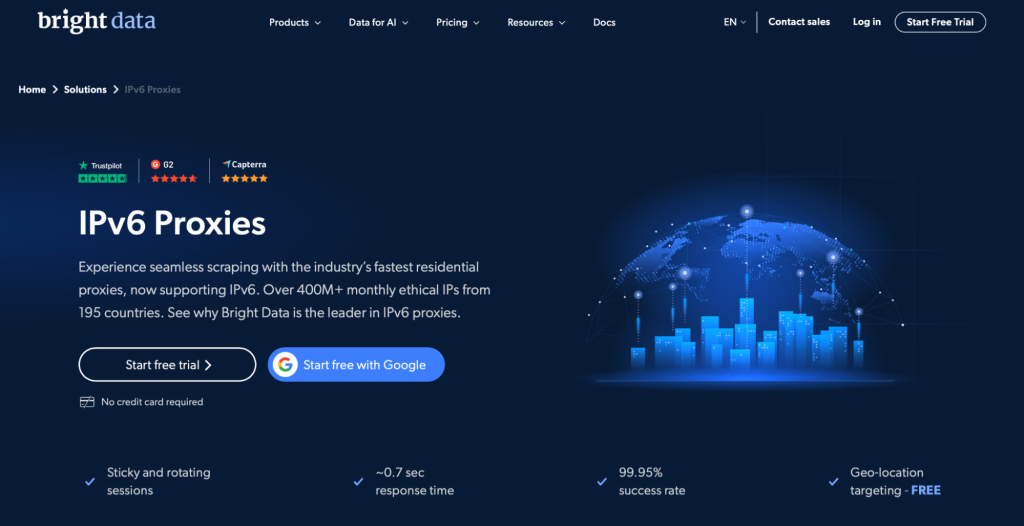
Bright Data is more of a premium, enterprise-level option. Its IPv6 is packaged within its residential proxy network, where the company promotes over 400M+ IPs across 195 countries, along with sticky and rotating sessions, roughly 0.7-second response times, and a 99.95% success rate.
Key features:
400M+ monthly ethical IPs across 195 countries
Sticky and rotating proxies
Advertised ~0.7 sec response time and 99.95% success rate
Broader platform layer with APIs, and enterprise controls
Bright Data sits firmly on the premium end, with residential pricing starting from $4.00/GB on a pay-as-you-go basis, while static IP packages begin from $1.8/IP for 10 IPs.
It’s best suited for larger teams that are looking for the best rotating IPv6 proxies providers with additional platform depth, and don’t mind the more premium pricing that comes along with it, especially when it comes to scaling.
IPRoyal takes a broader portfolio approach to proxies. Its official offer is built more around residential, rotating IPv6 access than bare-bones dedicated packages, which gives it a very different profile from desiccated providers like Proxy-Seller or Geonix.
It’s a solid option for users who want a recognizable brand and may later expand into other network categories as well.
Key features:
Entry pricing from $2.45/GB
Broader residential network and wider IP catalog
Accessible setup for mixed use cases like SEO tracking and public data collection
Additional related leasing options through subnet services
IPRoyal is not the strongest pick for buyers who only want a dedicated and affordable IPv6, but it definitely works great for users who want a more familiar provider, a wider product range, and a simpler way into rotating such traffic.
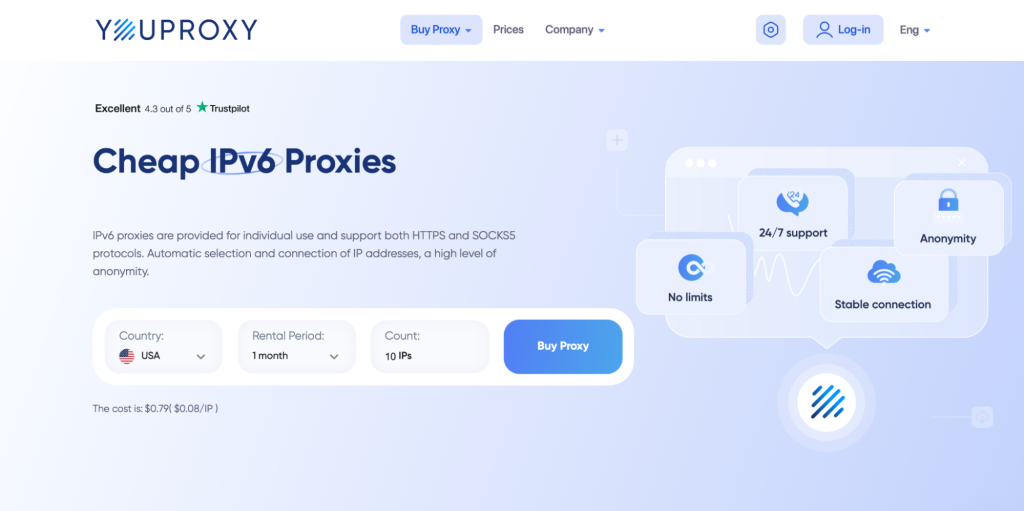
YouProxy positions itself as a straightforward private IPv6 provider with simple purchase flows and budget-friendly pricing. It advertises rates from as low as $0.8 per IP and positions itself around scalable infrastructure use cases like data scraping and market research. It only offers 7 countries to choose from, which may be enough for some, but probably less than ideal for teams with workflows spanning numerous locations.
Key features:
Private IPv6 proxies from $0.8 per IP
Positioned for business automation and high-volume tasks
Technical documentation and FAQ resources
Ready-made IP:port bundles with login and password
API for IP changes and account statistics tools
This platform is best for teams that want a relatively simple solution without needing extra geo coverage, larger IP pools, and additional features down the line. In short, its value is strongest when ease of access matters more than ecosystem depth.
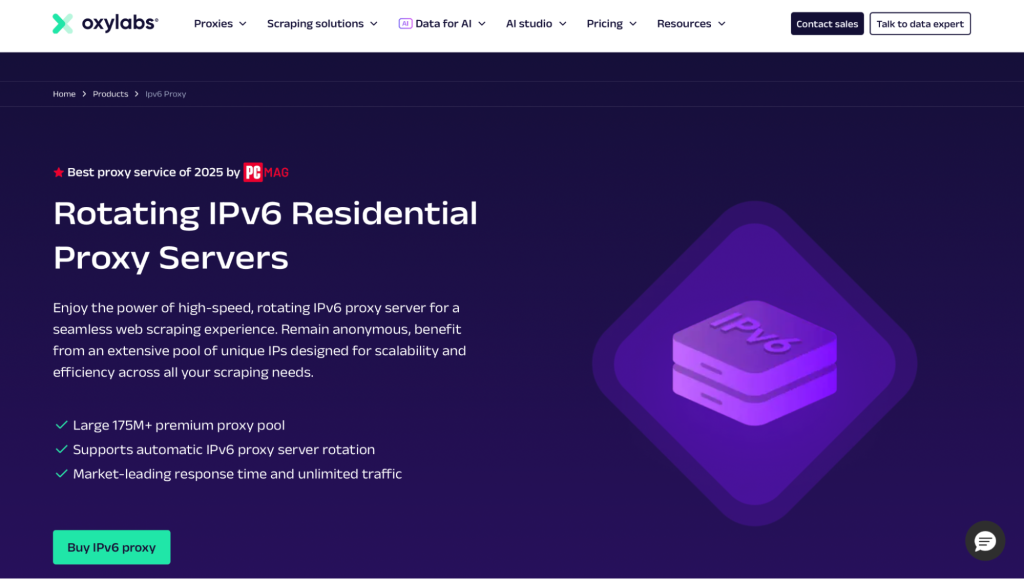
Oxylabs is another provider that firmly sits in the premium tier. Its IPv6 offer is built around rotating residential infrastructure rather than a standalone, cheaper package. It's a highly reliable solution for larger, data-heavy teams that need scale, platform support, and broader operational control around their IP infrastructure.
Key features:
Official IPv6 product with rotating residential IP pools
Pricing starts from $4/GB
Advertised 99.9% uptime and unlimited concurrent sessions
Single backconnect entry for rotating pool access
24/7 support and broader enterprise-grade tooling
Once again, Oxylabs is priced like a premium provider and is therefore best suited for teams that want proven platform depth, stronger support, and a legitimate enterprise-grade alternative when comparing the best IPv6 proxy platforms out there.
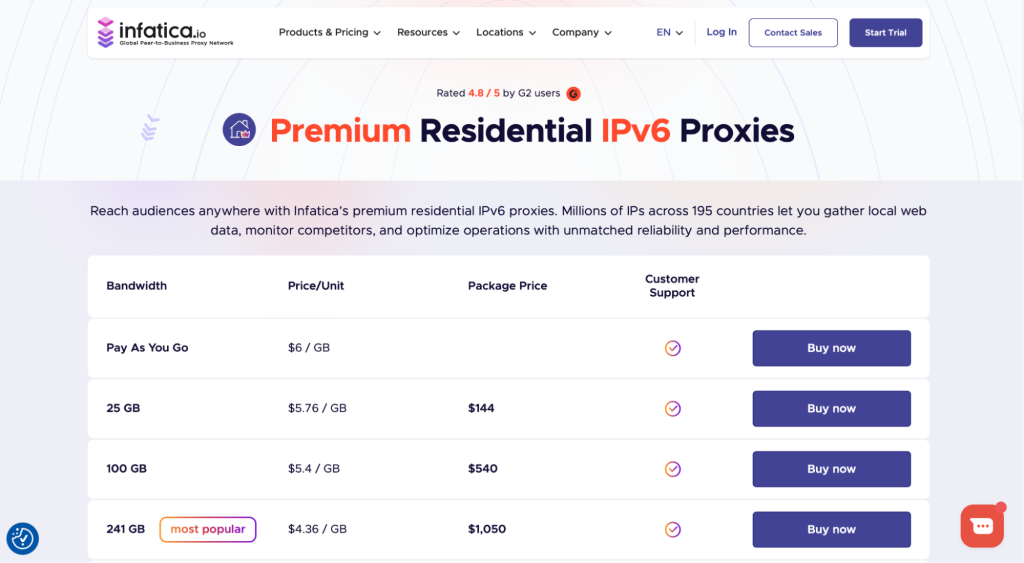
Infatica also offers IPv6 through its premium residential proxy network rather than a dedicated package. That distinction matters when it comes to affordability, especially once traffic volumes start scaling.
It frames the service around large-scale residential coverage, geo targeting, and IP rotation controls, making it a worthy contender for teams comparing the best IPv6 proxies.
Key features:
More than 500k+ residential IPs
Coverage across 195 countries with country, city, and ZIP targeting options
Rotation time selection, plus both login/password and IP whitelist authentication
Advertised high uptime (99.9%), low latency, and 0.4s response time
Infatica’s IPv6 residential pricing starts at $6/GB pay as you go, with prices slightly dropping with higher volumes. It’s a solid solution for teams that want residential coverage, geo-targeting, and rotation controls.
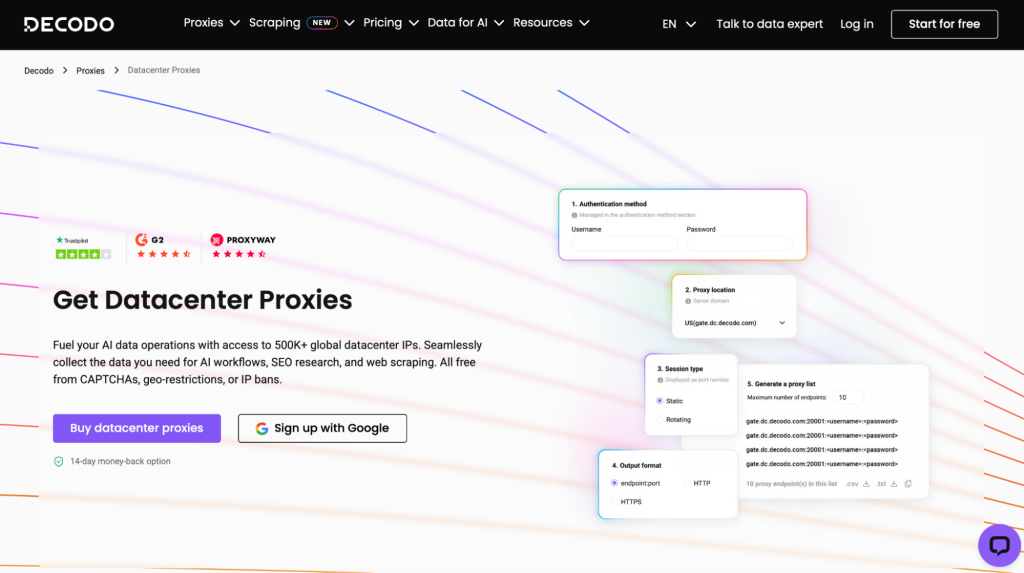
Decodo supports IPv6 within its residential package, even though it’s not a dedicated seller. Its documentation explains that the residential pool includes both v4 and v6 by default, with the option to specify the IP version through configuration. That makes it more relevant to buyers evaluating the best IPv6 datacenter proxies providers, though with less operational flexibility.
Key features:
Residential pool supporting both v4 and v6 IP addresses by default
Pricing starts at $4/GB pay-as-you-go, with regular plans from $3.75/GB
Supports both username/password authentication and IP-based whitelisting (though IPv6 addresses are currently unsupported for whitelisted-IP authentication)
The wider platform includes residential, ISP, mobile, and datacenter networks
Decodo is best looked at as a value-driven residential proxy platform with IPv6 support, not as a dedicated seller. It’s a solid option for teams that want such access inside a broader stack and may later need static residential, mobile, or datacenter products.
Not every buyer looks at proxies the same way — some care about price above all else, while others need residential rotation, cleaner documentation, or a smoother path into other network types down the line.
For the most affordable IPv6 proxies options United States teams consider, the top picks are Proxy-Seller, Infatica, and YouProxy. Proxy-Seller leads on overall value as it combines low entry pricing with a broader infrastructure behind it. YouProxy is especially strong on raw affordability, while Infatica remains a reliable option for fast, functional ordering. In any case, all 3 offer the best cheap IPv6 proxy for US scraping with residential and datacenter proxies.
For teams that may later branch into residential, mobile, or ISP proxy networks, the strongest options are Proxy-Seller, Bright Data, and Decodo. These platforms are not just selling IPs, but offer a broader path for diverse workloads. If your evaluation is closer to the best rotating IPv6 proxies providers, this group matters far more than the cheapest-per-IP list.
If your priority is scale, repeatability, and simple dedicated packages, Proxy-Seller, Infatica, and YouProxy are the most relevant names to look at. This is usually the group where buyers compare direct dedicated sellers rather than premium platforms such as Oxylabs or Bright Data.
And if you’re looking for balanced providers across the board, Proxy-Seller, IPRoyal, and YouProxy.io are often the top picks. Proxy-Seller offers the strongest mix of pricing, premium IPs, and network depth. IPRoyal works well for users who want a broader residential-style catalog, while YouProxy.io is a practical pick for simple yet effective use.
At the end of the day, all of the platforms on our list offer the best IPv6 proxies, but they differ in terms of additional features provided, other IP networks available, and, of course, pricing. The right solution for your team will ultimately depend on those factors, as you’ve probably understood by now that some are simply a better fit for your exact business workflows.
For many teams, Proxy-Seller is the top pick, offering an all-around balance of affordable pricing, broad geographic coverage, premium IP pools, and network flexibility. Its low-commitment $1.99 trial also makes it easy to get started right away and test performance before scaling.

 PHP
PHP Node.js
 Python
 Java
Java Golang
 en
en  Español
  中國人
中國人  Tiếng Việt
  Deutsch
  Українська
  Português
  Français
  भारतीय
  Türkçe
  한국인
한국인  Italiano
  Indonesia
  Polski
Comments: 0