

If you’re considering or already using Webshare for scraping, automation, or multi-account projects, it’s smart to line it up against at least one serious Webshare alternative before you start to scale.
The proxy market isn’t what it was a few years ago: numerous providers now offer tighter geo-targeting, clearer compliance, better SLAs, and flexible pricing plans.
In this brief guide, we will compare the top players on the market and help you choose the right platform, with Proxy-Seller being one of the main picks for many teams looking for the top proxy provider.
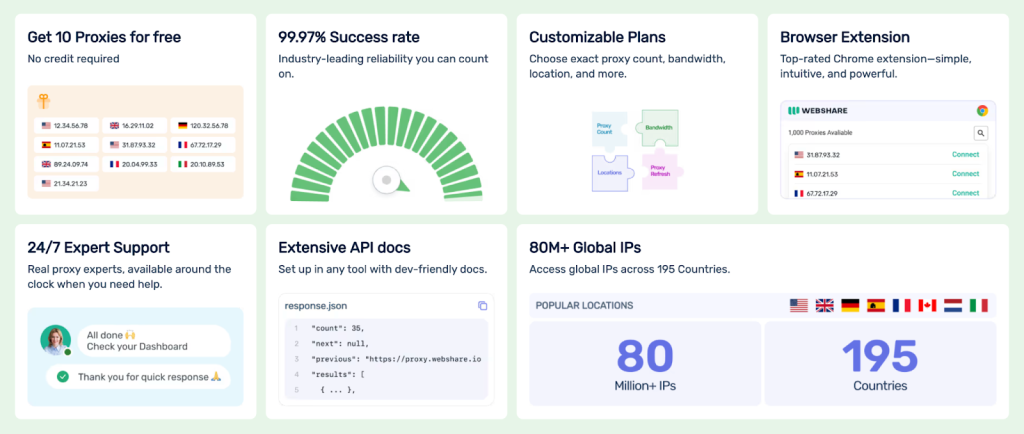
Webshare is a low-cost proxy provider primarily aimed at individuals and small teams. Its core offer is simple — datacenter proxies, static residential IPs, and rotating residential plans with a permanent free tier and very aggressive per-IP and per-GB pricing.
As workloads grow, though, many teams start looking for a Webshare alternative that gives them more precise geo control, more predictable and reliable performance under heavy load, and stronger guarantees around security, uptime, and compliance.
Webshare’s product line is intentionally narrow:
On top of that, it offers a permanent free plan with 10 shared datacenter proxies and up to 1GB of monthly bandwidth, which keeps the entry barrier extremely low.
This platform is a good fit for users who:
Teams usually start looking for a different solution when they:
Below is a high-level snapshot of the platform back-to-back with its top competitors. It is not a full feature matrix, we’ll cover that in more detail shortly, but it summarizes who each provider is best for, what pricing model it has, and what kind of stability and targeting you can expect:
|
Provider |
Best for |
Entry price / trial |
Targeting depth |
Billing model |
Uptime / stability |
|---|---|---|---|---|---|
|
Webshare |
Budget self-serve users |
Free tier; paid from ≈ $3.50/mo |
195+ countries; some city options |
Per IP & per GB, monthly |
≈ 99.7–99.97% |
|
Proxy-Seller |
SMBs & growing teams |
Trial from ≈ $1.99 |
220+ geos; city/ISP on many plans |
IP & GB; subs + pay-as-you-go |
99%+ advertised |
|
Bright Data |
Enterprise data platforms |
Res PAYG ≈ $5.88/GB |
195+ countries; granular city |
IP & GB; pay-as-you-go + monthly |
≈ 99.99% target |
|
Oxylabs |
Large-scale / premium scraping |
DC ≈ $12/mo; res higher |
195+ countries; city on key pools |
Mainly GB, monthly bundles |
99.9%+ target |
|
Decodo |
Mid-market & agencies |
Res PAYG ≈ $3.50/GB |
195 locations; city on many pools |
IP & GB; pay-as-you-go + monthly |
High; plan-dependent |
|
IPRoyal |
Low-cost / small teams |
Res from ≈ $1.75/GB |
30M+ IPs; country & city |
Pay-as-you-go + subscriptions |
Good; value-focused |
|
NetNut |
Persistent sessions / ISP traffic |
Bundles from ≈ 100GB |
195+ countries; strong city focus |
GB-based monthly bundles |
≈ 99.99% SLA |
*Values are taken from public product pages and recent independent reviews as of early 2026; concrete numbers and plan names may change over time.
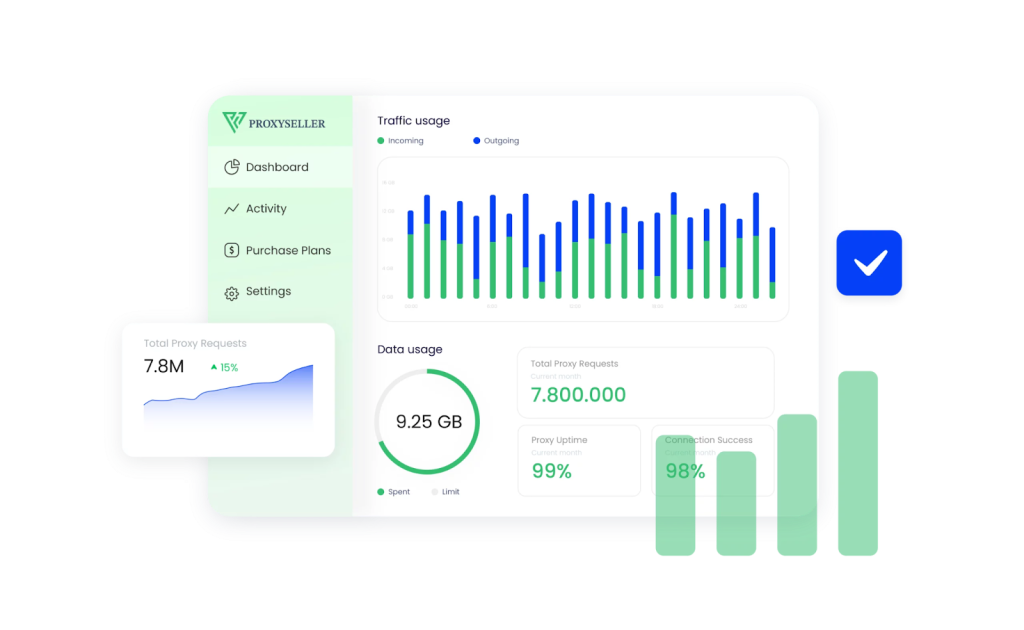
Proxy-Seller positions itself as a flexible Webshare alternative for teams that have outgrown very small workloads but don’t want enterprise pricing and overhead yet. It offers datacenter IPv4/IPv6, residential, ISP, and 4G/5G mobile proxies with HTTP(S) and SOCKS5 support, plus coverage in 220+ countries and regions, all managed from a straightforward dashboard.
Source: Multilogin
The platform is built for developers, SEO/data teams, growth/marketing roles, individual users, and enterprise teams that prioritize stability and control.
Instead of a free plan, Proxy-Seller uses a low-cost paid trial model and then lets customers scale via subscriptions or pay-as-you-go packages. That makes it a realistic top choice for teams that want room to grow without immediately signing big annual deals.
Webshare offers limited free proxies, while Proxy-Seller offers a very affordable trial, so both providers have accessible entry. But once you move to increased scale and more serious web activities, especially on residential or ISP IPs, Proxy-Seller’s offer starts to look much more relevant:
For small companies and serious scraping teams, that $1.99 trial is often more useful than a free plan, because you’re actually testing the exact proxy type you plan to use in production, not just shared datacenter IPs.
Webshare’s story is strong on global reach: tens of millions of residential IPs, 195 countries, rotating proxies, 99.97% uptime, and HTTP/SOCKS5 support. For smaller workloads, that’s usually enough.
Proxy-Seller leans into granularity and control on top of global coverage:
In practice, Proxy-Seller is often the more effective Webshare proxy alternative when you:
Both tools are self-serve and web-based, but they optimize for slightly different users.
Webshare focuses on speed and simplicity: sign up, grab your free IPs, pick a plan, and you’re moving in minutes. The dashboard lets you manage proxy lists, usage, and locations, but you won’t find deep observability or workflow features built in.
Proxy-Seller keeps the same “no-friction” approach and adds:
If you’re tweaking setup weekly and juggling multiple large-scale projects, this structure is what makes Proxy-Seller feel a providers that’s truly designed to scale operations.
This is where the more serious proxy providers start to separate from the rest.
On the social proof side, Proxy-Seller holds a solid Trustpilot score of 4/5, with hundreds of positive reviews. Customers frequently highlight stability, affordable pricing, and responsive customer support, while also pointing out real issues when they happen.
Webshare also enjoys a strong reputation and high Trustpilot ratings and is often recommended as a top low-cost provider, but it doesn’t lean as heavily on ISO and formal governance in its positioning.
On the compliance and security side, Proxy-Seller’s operator, SSV IT PROVIDER ONLINE SERVICES LTD, has implemented ISO/IEC 27001:2022 for information security management and follows ISO 9001:2015 quality management principles across core processes, from development to support.
For regulated organizations or large teams going through vendor security reviews, those ISO references are often the deciding factor when shortlisting their top picks.
In real life, teams usually switch to Proxy-Seller when:
In those situations, Proxy-Seller tends to become the default Webshare alternative to pilot first.
Start your Proxy-Seller trial today to test deep geo-targeting, stable uptime, and flexible pricing on your own workloads.
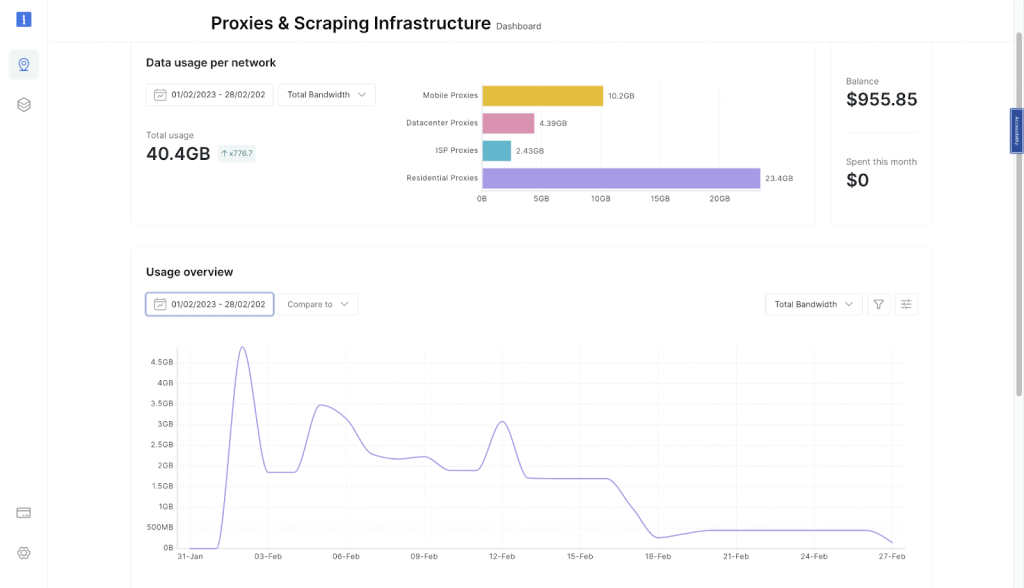
Bright Data is often the first enterprise name that comes up when people look for a feature-heavy proxy solution. It started as a proxy network and grew into a full web data platform with a huge IP pool, advanced scraping APIs, and ready-made datasets.
Where Webshare is optimized for low prices and simplicity, Bright Data is built for scale, compliance, and feature depth.
Source: Proxyway
Bright Data offers:
Its core customers are large e-commerce players, pricing and market intelligence platforms, and data companies that treat public web data collection as a strategic function and need both raw proxies and higher-level tooling. However, unless you’re a large enterprise in need of all those additional features, this is probably not a winner in the Bright Data vs Webshare comparison.
Bright Data is significantly more expensive — residential proxies typically start at roughly $5.88/GB on entry plans, with lower rates at higher commitments and some specialty products priced even higher.
In return, you get:
Webshare’s competitive pricing sits much lower, and its datacenter IPs are among the cheapest around. The trade-off is that you don’t get the scraping automation and orchestration layer that Bright Data provides.
Oxylabs is another enterprise-grade platform that often shows up among the top Webshare alternatives. It’s known for its large-scale infrastructure, advanced tools, and strong compliance posture, while its counterpart stays positioned as the budget-friendly, self-serve option, even after becoming part of the same group.
Oxylabs offers:
Most of its customers are enterprises and high-growth platforms that need guaranteed capacity, specialized features, and dedicated account management.
Despite being in the same corporate family, Web Share is still positioned as a lean, low-cost product with minimal overhead for smaller teams and individuals.
Oxylabs plays firmly in the premium bracket:
Webshare, on the other hand, keeps very low starting prices, a permanent free tier, and a user-friendly interface, but with far fewer built-in tools and less emphasis on ISO compliance.
For very high-volume, uptime-critical pipelines, Oxylabs clearly comes out ahead in the Oxylabs vs Webshare debate.
For many mid-market teams, though, moving first to Proxy-Seller as a more cost-efficient, ISO-backed solution is a more reasonable next step.
Beyond the “big three” (Proxy-Seller, Bright Data, Oxylabs), there are several other Webshare alternatives that work well for specific setups.
Decodo combines a global pool of about 125M+ IPs across 195 locations with a clean dashboard and a mix of residential, mobile, and datacenter proxies.
Its pay-as-you-go residential pricing starts at around $3.50/GB, and it offers extras like Site Unblocker and web scraping APIs. It’s a solid provider for teams that have outgrown basic tooling but don’t yet need the full complexity or cost of enterprise providers.
NetNut differentiates itself with strong ISP and static residential options and long-lived sessions, backed by a 99.99% uptime guarantee on core networks.
Pricing is clearly enterprise-oriented: residential and ISP plans often start in the tens or hundreds of GB per month, with entry-level per-GB pricing around $8/GB on a 100GB bundle.
For workloads like account-heavy e-commerce monitoring, NetNut can be a powerful Webshare.io alternative, but it’s usually overly excessive for early-stage or smaller projects.
IPRoyal is often mentioned as a budget leader, with residential traffic starting around $1.75/GB, plus options for datacenter, static residential, and ISP proxies.
It’s a reasonable alternative for freelancers and small teams that want more proxy types without blowing up their budget, and are willing to accept more variability in quality and stability compared to more premium platforms like Proxy-Seller.
To make the landscape more practical, it helps to break down each Webshare.io alternative by use case scenarios to better understand which is a better fit for your team.
Make Proxy-Seller your go-to proxy provider when reliability and precise geo-targeting are non-negotiable.
This platform is still a solid option for budget-conscious users and straightforward workloads, especially with its free tier. As soon as you need more precise geo targeting, stronger compliance, or more predictable high performance at scale, you’ll want to look at at least one serious Webshare proxy alternative.
Proxy-Seller, with premium residential, mobile, and datacenter proxies, flexible pricing, global coverage, ISO-backed processes, and an intuitive dashboard, is a strong starting point for many teams that have outgrown a light-weight provider, but aren’t looking to jump into full enterprise pricing.
There isn’t one “best” Webshare alternative. For big enterprise stacks, Bright Data or Oxylabs usually win. For most mid-market teams, a Proxy-Seller or Decodo hit the sweet spot, while ultra budget setups often pick IPRoyal on pure $/GB.
Yes. Proxy-Seller is a strong Webshare alternative for SEO and scraping: 220+ countries, city and ISP targeting, 99% uptime, high concurrency, and a mix of datacenter, residential, ISP, and mobile proxies that covers most data pipelines.
Bright Data is the premium proxy provider: higher prices, but huge proxy pools, scraping APIs, and ready-made datasets. Webshare is cheaper and simpler, focused on core proxy infrastructure and a free tier, without the advanced tools Bright Data ships with.
For small businesses, Proxy-Seller is usually the most practical alternative thanks to the $1.99 trial, flexible pricing, and ISO-backed governance. Decodo and IPRoyal are good to test alongside it when your main filter is residential cost per GB.
Don’t rip and replace. Keep your existing setup, plug in your new platform in parallel, move non-critical traffic first, watch success rate/latency/cost, then gradually shift core workloads and retire Webshare only once the new stack is stable.

 PHP
PHP Node.js
 Python
 Java
Java Golang
 en
en  Español
  中國人
中國人  Tiếng Việt
  Deutsch
  Українська
  Português
  Français
  भारतीय
  Türkçe
  한국인
한국인  Italiano
  Indonesia
  Polski
Comments: 0