

Choosing the right proxy provider in 2026 comes down to a pretty simple question: which one actually fits the way you work and what you’re willing to spend. In this comparison article, we’ll explore two of the top providers on the market - Oxylabs and Proxy-Seller. We'll review their pricing, network types, technical capabilities, support, and overall fit.
The goal is to help you figure out whether Proxy-Seller is the better option if you want something flexible, cost-efficient, and easy to use, or whether Oxylabs is the stronger match for a more enterprise-focused setup.
Both providers offer the main proxy categories that most serious buyers care about: residential, mobile, ISP/static residential, and datacenter, with premium and reliable IPs. Where they really differ is in how those products are positioned.
Oxylabs is built around large-scale data collection and a broader enterprise stack that goes beyond plain IP networks, offering web scraping APIs, unblockers, and adjacent tooling.
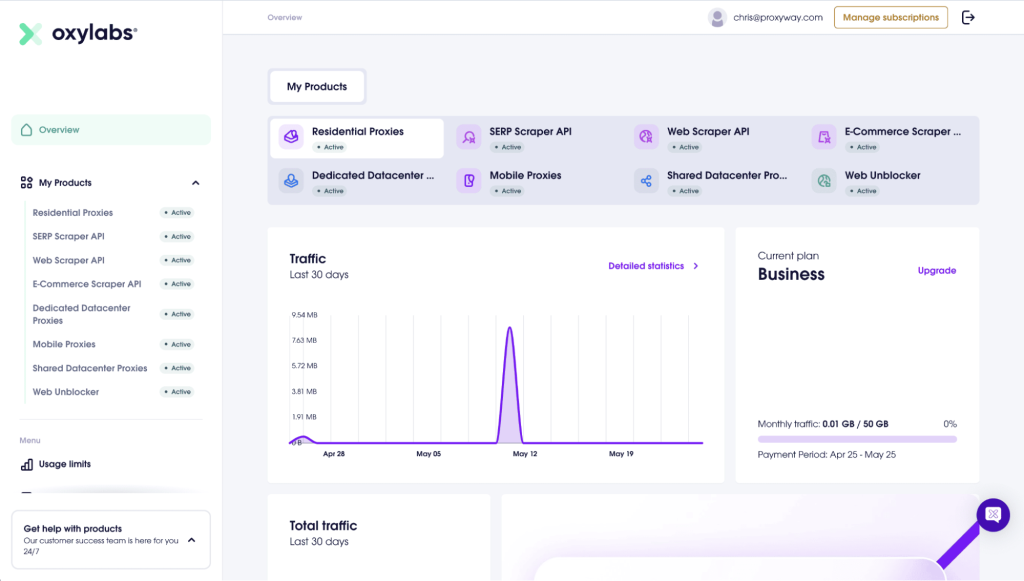
Proxy-Seller stays more focused on modular IP infrastructure, with lower entry points, easier setup, and solid coverage across the core network types.
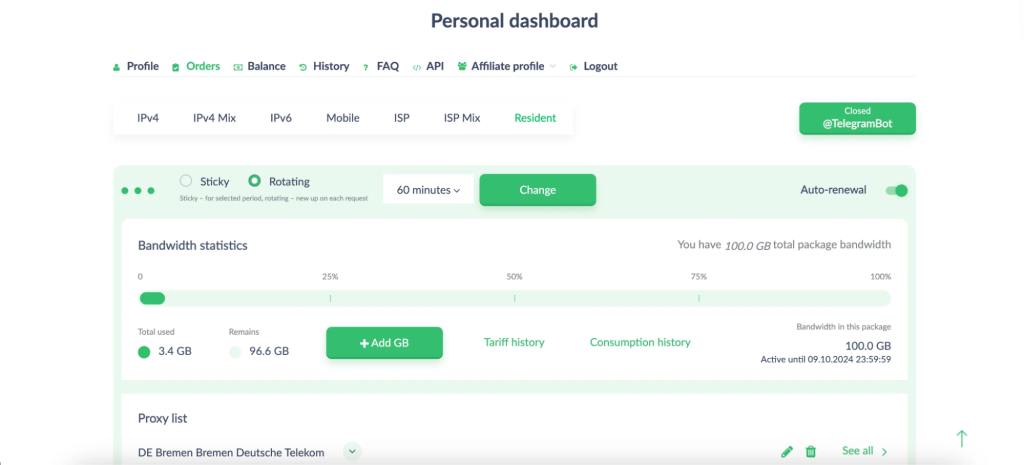
So this is less about which of the two is “better” in some universal sense, and more about which one better fits what your team actually needs to operate their workflows.
If you want enterprise procurement, massive IP pools, and extra data-collection tooling under one roof, Oxylabs will naturally appeal more.
And if you want a broad IP network catalog, faster self-serve purchasing, and tighter control over spend, Proxy-Seller will be the easier choice to justify, including for enterprise teams that don’t necessarily want to buy into a wider bundled platform.
|
Feature |
Oxylabs |
Proxy-Seller |
Why It Matters |
|---|---|---|---|
|
Residential proxies |
✔ |
✔ |
Core choice for public web data collection, monitoring, and ad verification |
|
Mobile proxies |
✔ |
✔ |
Useful for mobile-specific workflows and app-level testing |
|
ISP proxies / static residential |
✔ |
✔ |
Better for long sessions and stable connections |
|
Datacenter proxies |
✔ |
✔ |
Strong fit for speed-first, cost-efficient operations |
|
Pricing |
$$$ (residential from $8/GB) |
$$ (residential from $0.7/GB) |
Quick visual signal of budget fit and entry cost |
|
Pay-as-you-go |
Available for residential and mobile |
Available for residential; flexible self-serve for other products |
Helps teams handle variable demand |
|
Target audience |
Enterprise-leaning |
SMBs, agencies, flexible teams |
Helps buyers identify best-fit procurement model |
The main takeaway is pretty clear - both vendors cover all the technical basics and offer all the main network types that most teams need, but the commercial approach is slightly different. Oxylabs offers scale and platform breadth, while Proxy-Seller focuses on accessibility, flexibility, and a much lower starting cost.
The Oxylabs pricing model mixes traffic-based and per-IP billing, depending on the pricing plans you choose. Self-serve Oxylabs residential proxies pricing starts at $8/GB on pay-as-you-go, and rotating datacenter proxies start from $1.20/IP.
So yes, buyers do get a few different ways to purchase, but the overall setup still feels geared toward teams running larger operations or using more of the Oxylabs stack than just the IP network pool.
An Oxylabs proxy server usually isn’t being sold as some stripped-down commodity, nor is it any better than those of other reputable providers out there. However, Oxylabs also sells scraping APIs, unblocker tools, and other enterprise-focused data products, so part of that premium is tied to this platform depth.
For buyers who need that wider ecosystem, the price can be justified. But for buyers who mostly want reliable private proxies without a lot of friction or unnecessary tools, that higher entry point is probably not worth it.
Proxy-Seller takes a more modular approach as well - residential starts at just $0.7/GB, ISP proxies start at $1/IP, and the platform pushes self-serve access across residential, ISP, datacenter IPv4/IPv6, and mobile IP connections.
In practical terms, this gives buyers more room to match the exact network type, rental period, and spend level to their actual use cases, rather than jumping into any enterprise-grade commitments. There’s also a low-commitment and affordable 3-day trial for just $1.99 to test the platform before scaling.
This is why Proxy-Seller becomes a real cost-effective alternative - its flexible pricing model fits smaller test cycles, mixed workloads, and teams that don’t want to pay for excess capacity they may never use.
That doesn’t automatically make Oxylabs overpriced, it just means value depends on what you actually need. If you truly need enterprise-scale volume and a wider platform, Oxylabs’ pricing can make sense. If you mainly need a solid and reliable IP infrastructure with more flexible entry points, Proxy-Seller will be the better fit for most teams. And that’s including certain enterprise buyers that don’t need a big surrounding tooling stack.
Residential proxies are the primary choice for the most common business workflows, including public web data collection, monitoring, market research, SEO, and ad verification.
This is where the biggest visibility gap shows up. The Oxylabs residential proxy offering publicly advertises a vast pool of 175M+ residential IPs. It comes with targeting across 195 proxy locations and features like session control and unlimited concurrent sessions.
Proxy-Seller’s residential network is smaller on paper, but still sizeable enough for virtually any real-world use cases. 20M+ addresses across 220+ countries and regions, with GEO and ISP targeting, rotation modes, and analytics inside the control panel. It also offers HTTPS and SOCKS5 support, plus username/password or IP whitelisting.
The trade-off here is simple - Oxylabs wins on raw network size, while Proxy-Seller leads on entry cost and purchasing flexibility.
Mobile proxies are extremely useful for any cellular-specific workflows and app-level testing.
Oxylabs leads in publicly stated scale, offering 20M+ mobile IPs across 140+ countries, 99.9% uptime, with pay-as-you-go starting at $9/GB. This makes it a solid option for larger mobile-heavy testing and data collection workflows.
Proxy-Seller comes at this from a slightly different angle - instead of centering the pitch only around per-GB billing, it frames its proxy mobile offering as part of a wider mixed stack and leans into self-serve deployment, configurable setups, and broad product availability, allowing teams to switch between network types in a simple, intuitive dashboard.
On the ISP side, Oxylabs starts at $1.60/IP, while Proxy-Seller starts at $1/IP, both positioning them as dedicated static residential IPs sourced from major ISPs.
Datacenter proxies are the best fit for high speed, cost-efficient operations, and they sit in the performance-first layer of both product catalogs. Both providers clearly position these networks as a cost-effective option for heavy workloads at scale, where speed and predictable cost matter more than the higher trust factor associated with household-looking traffic.
Oxylabs advertises 2M+ dedicated datacenter IPs with self-service access starting from $1.20/IP. Proxy-Seller offers datacenter IPv4 and IPv6 with speeds up to 1 Gbps, unlimited bandwidth on core offers. Its IPv6 pricing starting at $0.16/IP - once again, much more cost-effective, especially for high-volume workloads.
From a technical standpoint, both providers fully cover the main protocols (HTTP, SOCKS5) and network infrastructure that buyers expect.
Proxy-Seller supports HTTP, HTTPS, and SOCKS5, along with username/password authentication and IP-based authentication. Similarly, you get the HTTP, HTTPS, and Oxylabs SOCKS5 proxy options tied to residential traffic for use cases like review monitoring and ad verification.
For teams plugging proxies into crawlers, browsers, QA setups, or multi-account environments, these protocol overlaps remove one of the bigger compatibility concerns right away.
Session handling is one of those areas where the implementation matters far more than the feature list. Oxylabs highlights session control in its residential line and flexible targeting in both household and cellular products.
Proxy-Seller emphasizes rotation modes, project-level usage controls, and control-panel visibility on residential proxies. In practice, both can support most serious operational workflows, with the difference being mostly commercial.
The main difference here is that Proxy-Seller makes it much easier to get started in terms of setup, without any heavy commitment, while Oxylabs wraps similar capabilities into a broader enterprise-style platform.
Oxylabs positions itself as a mature enterprise infrastructure vendor, pairing a large public network pool with 99.9% uptime across multiple product types, with a feature set designed for data collection at scale.
Proxy-Seller focuses more on fast activation, up to 1 Gbps speeds, broad protocol support, and a unified catalog covering all the main network types, also with 99.9% uptime.
Either way, both are clearly built for production use. The main difference is mostly that Oxylabs sells scale as a premium layer, while Proxy-Seller focuses on giving teams useful, high-utility infrastructure without pushing them into enterprise-style buying from day one.
For SEO monitoring, public web data collection, eCommerce tracking, ad verification, QA, social media management, and price monitoring, truthfully, either provider can work, depending on your scale and workflow.
Oxylabs is the natural fit for larger organizations that want huge pools and extra data products under one roof, and don’t mind footing the extra bill for those add-ons.
Proxy-Seller is often more suitable for small & medium businesses, agencies, and lean in-house teams that still need reliable IP infrastructure covering all the main network types, but care more about cost control and fast self-serve deployment. In fact, it also works well for many enterprise teams that care more about procurement flexibility and price-to-performance than bundled platform extras.
Support is another real divider here: Oxylabs includes 24/7 customer support and a dedicated support team and personal account manager, which lines up well with the structured ongoing oversight that enterprise teams expect.
Proxy-Seller also offers 24/7 expert support, along with instant activation and a buying experience that feels more immediately accessible.
Buyers who want assigned account ownership may lean toward Oxylabs, whereas buyers who care more about faster day-to-day access and lower-friction onboarding will probably find Proxy-Seller more practical.
At the end of the day, the better provider depends on what you’re actually buying for.
Oxylabs is a strong pick for enterprise-scale teams that want very large IP pools, a mature vendor profile, and access to a wider range of data-collection products.
Proxy-Seller makes more sense for buyers who want more flexible IP options, simpler setup, lower starting costs, and room to scale based on actual demand, not some enterprise contract framework.
That’s really where it pulls ahead. For teams looking at alternatives to Oxylabs proxy services, Proxy-Seller feels like one of the more practical, better-balanced options. For most real business use cases, it hits the sweet spot on quality, flexibility, and cost control.

 PHP
PHP Node.js
 Python
 Java
Java Golang
 en
en  Español
  中國人
中國人  Tiếng Việt
  Deutsch
  Українська
  Português
  Français
  भारतीय
  Türkçe
  한국인
한국인  Italiano
  Indonesia
  Polski
Comments: 0