
IPIDEA Shutdown: 13 Proxy Providers Blocked by Google – What Happened & Safe Alternatives

Comments: 0

Content of the article:

Your Proxy Provider May Have Just Been Shut Down

On January 28, 2026, Google's Threat Intelligence Group disrupted one of the largest residential proxy networks ever discovered. The operation targeted IPIDEA – a backend infrastructure that secretly powered at least 13 different proxy and VPN brands.

If you've been using any of the following services, your proxy infrastructure is now compromised:

Affected Proxy Services

Provider Status
922 Proxy ⛔ Disrupted
LunaProxy ⛔ Disrupted
PyProxy ⛔ Disrupted
IP2World ⛔ Disrupted
PIA S5 Proxy ⛔ Disrupted
360Proxy ⛔ Disrupted
ABC Proxy ⛔ Disrupted
Cherry Proxy ⛔ Disrupted
Tab Proxy ⛔ Disrupted

Affected VPN Services

Provider Status
Galleon VPN ⛔ Disrupted
Radish VPN ⛔ Disrupted
Door VPN ⛔ Disrupted

Affected SDK/Infrastructure

Component Impact
LumiApps SDK Removed from 600+ Android apps
Asocks Infrastructure disrupted

Need to switch immediately?

Talk to Sales About Migration → Fill out the form to get a custom migration plan with special conditions for affected customers.

What Exactly Happened?

Google's Threat Intelligence Group, in collaboration with law enforcement, executed a coordinated takedown of the IPIDEA residential proxy network. Here's what they found:

The Scale of the Operation

  • ~7,400 command-and-control servers disrupted
  • 600+ Android applications contained trojanized SDK (LumiApps)
  • 3,075+ Windows files identified with malware signatures
  • Millions of devices unknowingly enrolled in the proxy network
  • 550+ threat actors used the network in just 7 days before disruption

Timeline of Events

Date Event
2019-2020 IPIDEA begins operating, builds residential proxy network through SDK partnerships
2021-2023 Multiple proxy brands launch using IPIDEA infrastructure (922, Luna, PyProxy, etc.)
Early 2025 Google Threat Intelligence begins investigation after detecting botnet-like traffic patterns
Q4 2025 Law enforcement coordination begins across multiple jurisdictions
Jan 28, 2026 Google executes coordinated takedown, disrupts C2 infrastructure
Jan 29-30, 2026 Affected providers experience widespread outages, customer complaints surge
Feb 2026 Industry-wide scrutiny of residential proxy sourcing practices

How the IPIDEA Network Actually Worked

Understanding what went wrong helps you evaluate providers more carefully.

The Problem with IPIDEA's Approach:
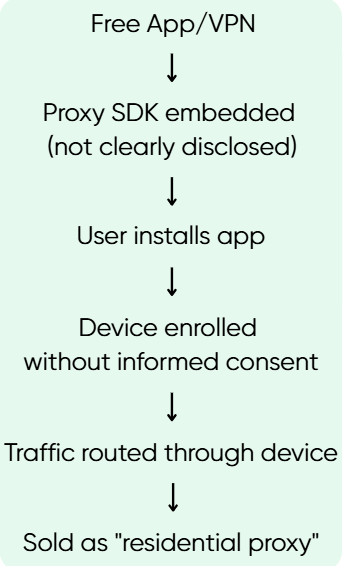
How the IPIDEA Network worked

The issue wasn't SDK-based proxy networks in general – it was how IPIDEA operated: users installing a flashlight app or free VPN had no clear understanding their device would become a proxy exit node.

Why Google Took Action

The investigation revealed that IPIDEA wasn't just a proxy network – it was infrastructure for cybercrime:

  1. Deceptive device enrollment: Users were tricked into installing apps that secretly turned their devices into proxy exit nodes without meaningful consent
  2. Scale of abuse: Google characterized the operation as having "botnet-like" characteristics due to the scale of unauthorized device enrollment
  3. No real consent: Despite claims of "ethical sourcing," there was no transparent, informed consent from device owners
  4. How it was exploited: These conditions made the network attractive for misuse, including credential stuffing, DDoS, and fraud.

Google's Official Statement

"While some providers may indeed behave ethically and only enroll devices with the clear consent of consumers, any claims of 'ethical sourcing' must be backed by transparent, auditable proof of user consent."

Why This Matters for Your Business

If you were using any of the affected providers, you face several immediate risks:

1. Operational Disruption

Your data collection, ad verification, or price monitoring workflows are now broken. The IP pools you relied on no longer exist or are severely degraded.

2. Compliance Exposure

If your company has compliance requirements (SOC 2, GDPR, internal policies), you may have unknowingly used infrastructure linked to criminal activity. This creates audit and liability concerns.

3. Data Integrity Questions

Traffic routed through compromised infrastructure may have been intercepted, logged, or manipulated. Consider what data passed through these proxies.

4. Vendor Risk Materialized

This is exactly the scenario that procurement and security teams worry about. Your vendor's vendor turned out to be problematic.

How to Choose a Safe Proxy Provider Now

The IPIDEA shutdown is a wake-up call for the entire industry. Here's how to evaluate providers going forward:

Red Flags to Watch For:

  • Unusually low prices – Ethical IP sourcing costs money. If prices seem too good to be true, question the source.
  • Vague sourcing explanations – "Ethically sourced" without specifics is meaningless.
  • No company history – Many affected providers were relatively new or rebranded frequently.
  • Resistance to compliance questions – Avoiding or delaying requests for a DPA, KYC/KYB details, and audit discussions, or reacting defensively.
  • Vague about IP sourcing – If they can't clearly explain how residential IPs are obtained with user consent, that's a problem.

Green Flags to Look For:

  • Transparent sourcing model – Can they explain exactly how IPs are obtained?
  • Long track record – Companies operating for 5+ years predate the problematic SDK models.
  • Enterprise compliance readiness – DPA/SCC, KYC/KYB processes, audit trails.
  • Clear acceptable use policy – And evidence they enforce it.
  • Documented consent mechanism – For residential IPs, how do device owners opt in?

Questions to Ask Any New Provider

  1. "How do you source your residential IPs? Can you document the consent mechanism?"
  2. "Were you affected by the IPIDEA/LumiApps disruption?"
  3. "Can you provide DPA and security documentation?"
  4. "How long have you been operating under your current infrastructure?"
  5. "What's your acceptable use policy, and how do you enforce it?"

Provider Vetting Checklist:

Question Good Answer Red Flag
How do you source residential IPs? Clear explanation of partnerships and consent model "Proprietary" or vague answers
Do users know their device is a proxy? Yes, with clear disclosure "It's in the terms of service"
How do you prevent abuse? Specific controls, AUP enforcement No clear policy
Can you provide compliance documentation? Yes, DPA/security docs available Resistance or delays

Why Proxy-Seller Is Different

We understand you need to move fast. Here's why Proxy-Seller is a safe choice:

10+ Years Track Record

Proxy-Seller has been operating since 2014 – long before SDK-based residential proxy models existed. Our infrastructure and sourcing methods predate and are completely independent from IPIDEA and similar networks.

Not Connected to Affected Networks

We were not affected by the January 2026 disruption. Our residential IP pool uses a fundamentally different sourcing model that does not rely on:

  • Trojanized mobile apps
  • Deceptive SDK installations
  • Third-party networks of questionable origin

Ethical Sourcing Model

Our residential IPs come from:

  • Legitimate partnerships with clear consent mechanisms
  • Transparent opt-in programs where users knowingly participate
  • Fair compensation for bandwidth sharing
  • Clear opt-out mechanisms that are actually honored

Enterprise Compliance Ready

We serve enterprise customers who require:

  • DPA/SCC documentation – Ready for GDPR compliance
  • KYC/KYB verification – We verify our sources
  • Acceptable Use Policy – Actively enforced, not just on paper
  • 24/7 support – Real humans, not just chatbots

Product Range

Product Use Cases Key Features
Residential Proxies Ad verification, price monitoring, market research 195+ countries, sticky sessions, real user IPs
ISP Proxies SEO monitoring, SERP tracking, social media Static residential IPs, unlimited bandwidth
Mobile Proxies App testing, mobile ad verification Real 4G/5G carrier IPs, geo-targeted
Datacenter IPv4/IPv6 Proxies High-speed scraping, bulk operations Dedicated IPs, maximum performance

Migration Offer for Affected Customers

We know switching providers is disruptive. To make your transition easier, we're offering affected users a special migration package:

What You Get

  • Free Migration Assistance – Our team will help you transition your setup
  • API Compatibility – Similar API format means minimal code changes
  • Priority Support – Direct access to technical team during migration
  • No Lock-in – Month-to-month available, cancel anytime
  • Special Conditions – Custom pricing and bonus traffic for customers migrating from affected providers

How to Get Started

  1. Book a call with our sales team – We'll assess your current setup and needs
  2. Get a custom migration plan – Including timeline, configuration help, and special pricing
  3. Start migrating with dedicated support – Our team assists throughout the transition

Ready to Switch?

Contact Sales - enterprise@proxy-seller.com

Mention you're migrating from an affected provider to get special conditions.

Frequently Asked Questions

Was my proxy provider affected?

If you were using 922 Proxy, LunaProxy, PyProxy, IP2World, PIA S5 Proxy, 360Proxy, ABC Proxy, Cherry Proxy, Tab Proxy, or the associated VPN services (Galleon, Radish, Door VPN), your provider was part of the IPIDEA network that was disrupted.

How to check if a provider not on this list was affected:

  • Are they experiencing unexplained outages since Jan 28?
  • Has their IP pool size dropped significantly?
  • Are they being vague about "infrastructure issues"?
  • Did they recently announce "switching to new infrastructure"?

Is my data at risk?

Traffic routed through compromised infrastructure could potentially have been logged or observed by malicious actors who also used the network.

Assess your risk level:

What you sent through proxy Risk Action
Read-only public data scraping Low Continue normally with new provider
Login credentials High Change passwords immediately
API keys / tokens High Regenerate all keys
Payment information Critical Monitor accounts, consider card replacement
Internal company URLs Medium Review access logs, consider URL changes

How quickly can I migrate?

Most customers can migrate within 24-48 hours. Our API format is similar to most providers, requiring minimal code changes. Our support team can assist with the transition.

Typical migration timeline:

  • Simple setup (single use case, basic config): 2-4 hours
  • Medium complexity (multiple targets, custom rotation): 1 day
  • Enterprise setup (multiple teams, compliance requirements): 2-5 days

Will my success rates be the same?

Success rates depend on many factors: target sites, request patterns, geographic needs. We recommend:

  1. Start with a trial to benchmark against your specific targets
  2. Test the same URLs you were accessing before
  3. Compare metrics over 24-48 hours before full migration

Many customers report improved success rates due to our pool quality, but your results depend on your specific use case.

What if I have prepaid balance with an affected provider?

Unfortunately, this is between you and that provider. We cannot honor balances from other services. However, we offer special conditions for customers migrating from affected providers – contact our sales team to discuss.

To pursue recovery from your old provider:

  • Document your remaining balance with screenshots
  • Check their terms of service for refund policies
  • Consider chargeback if paid recently by card
  • File complaint with payment processor if no response

Can I trust any residential proxy provider now?

Yes, but with appropriate diligence. The issue wasn't residential proxies as a category – it was a specific sourcing model (SDK-based enrollment without real consent).

Trustworthy residential proxy characteristics:

  • Transparent about sourcing methodology
  • Long operating history predating SDK models
  • Willing to answer compliance questions
  • Serves enterprise customers with due diligence requirements
  • Has verifiable legal entity and business presence

How do I explain this to my compliance/security team?

Key points for internal communication:

  1. What happened: A backend infrastructure provider (IPIDEA) was disrupted by Google due to concerns about device enrollment practices and criminal usage of the network
  2. Our exposure: We used a proxy service that relied on this infrastructure
  3. Risk assessment: Low/Medium/High based on your data types
  4. Actions taken: Migrated to new provider with verified sourcing practices
  5. Prevention: New vendor due diligence checklist implemented

We can provide documentation to support your internal review - contact enterprise@proxy-seller.com

What's the difference between your proxy types?

Type Best For IP Source Session Length
Residential Protected sites, anti-bot bypass Real home internet users (opt-in) Rotating or sticky (up to 30 min)
ISP (Static Residential) Long sessions, account management ISP partnerships, static assignment Unlimited (same IP)
Mobile Mobile-specific verification, social Real mobile carriers Rotating or sticky
Datacenter High-speed, bulk operations Data center IPs Dedicated (same IP)

What does your coverage look like - by country, city, and ASN?

We cover 195+ countries with residential proxies. For specific city or ASN-level targeting:

  • Check our coverage page: proxy-seller.com/locations
  • Contact sales for specific requirements
  • Request a trial to test coverage for your needs

Step-by-Step Migration Guide

If you're switching from an affected provider, here's exactly what to do:

Step 1: Document Your Current Setup (30 min)

Before changing anything, capture your existing configuration:

Export these settings:

  • Proxy endpoint URLs/IPs
  • Authentication credentials format (user:pass or IP whitelist)
  • Rotation settings (sticky session duration, rotation interval)
  • Geographic targeting (countries, cities, ASNs)
  • Protocol settings (HTTP/HTTPS/SOCKS5)
  • Concurrent connection limits
  • Any custom headers or configurations

Document your usage patterns:

  • Average requests per day/hour
  • Peak usage times
  • Which targets/sites you're accessing
  • Current success rates (if you track them)

Step 2: Audit Your Exposure (15 min)

Consider what data passed through the compromised network:

Data Type Risk Level Action
Public web scraping (prices, listings) Low No immediate action needed
Login credentials sent through proxy High Rotate credentials immediately
API keys in requests High Regenerate API keys
Session tokens Medium Clear sessions, re-authenticate
Internal URLs exposed Medium Review access logs

Step 3: Set Up New Provider (1-2 hours)

With Proxy-Seller:

  1. Create account at proxy-seller.com
  2. Choose product type:
    • Residential → for sites with aggressive anti-bot (social media, marketplaces)
    • ISP → for stable, long-session work (SEO monitoring, account management)
    • Datacenter → for high-volume, speed-critical tasks
    • Mobile → for mobile-specific verification
  3. Configure authentication:
    • Option A: User:Pass authentication

    	 proxy_host:proxy_port:username:password
    
    • Option B: IP Whitelist. Add your server IP to dashboard and use proxy without credentials
  4. Test with small traffic before full migration

Step 4: Update Your Code/Tools

Common configuration changes:

Most proxy formats are similar. Typical change:

Before (example 922proxy format):


	 proxy = "http://user:pass@922proxy.com:port"

After (Proxy-Seller format):


	 proxy = "http://user:pass@proxy-seller.com:port"

For popular tools:

Tool Config Location
Scrapy settings.py → PROXY
Puppeteer/Playwright Launch args --proxy-server
Selenium proxy capability in options
cURL -x flag or environment variable
Octoparse/ParseHub Built-in proxy settings

Step 5: Validate Before Full Switch

Run parallel tests for 24-48 hours:

Test checklist:

  • Success rate comparable or better
  • Response times acceptable
  • Geographic targeting accurate
  • Rotation working as expected
  • No authentication errors
  • Billing tracking correctly

Step 6: Monitor Post-Migration

First week, track:

  • Success/failure rates by target
  • Any new blocks or CAPTCHAs
  • Bandwidth consumption vs. estimate
  • Response time patterns

Choosing Your Next Provider: Due Diligence Checklist

Use this checklist when evaluating any proxy provider. A legitimate provider should answer "yes" to most of these:

Sourcing & Ethics

  • Can they explain specifically how residential IPs are obtained?
  • Do they have documented consent mechanisms (not just "ethically sourced" claims)?
  • Can they provide sample consent flows or partner documentation?
  • Have they been operating for 5+ years under the same model?
  • Are they transparent about which geographies/ASNs they cover and how?

Business & Compliance

  • Do they offer proper invoicing (not just card payments)?
  • Are Net-15/30 payment terms available?
  • Can they provide DPA (Data Processing Agreement)?
  • Do they have a published Acceptable Use Policy?
  • Will they sign your vendor security questionnaire?
  • Do they have a legal entity you can verify?

Technical & Support

  • Is there 24/7 support with real humans?
  • Do they offer a trial or POC period?
  • Is there a dashboard with usage tracking?
  • Can you get dedicated account management?
  • Do they have a status page for incident transparency?

Red Flags That Should Disqualify a Provider

  • "We can't disclose our sourcing for competitive reasons" → Legitimate providers can explain their model without revealing trade secrets
  • Only accepts cryptocurrency or anonymous payment → Real businesses accept standard payment methods
  • Prices dramatically below market rate → Ethical residential sourcing costs money. >$0.50/GB residential is suspicious.
  • No company address or legal entity information → You can't do vendor diligence on a ghost
  • Founded recently, aggressive marketing, no track record → Many affected providers followed this pattern

Use Case-Specific Guidance

Different use cases have different risk exposures and migration priorities:

SEO & SERP Monitoring

Your exposure: Low-medium. SERP data is public.

Migration priority: High (operational continuity)

What to verify with new provider:

  • Coverage for your target search engines (Google, Bing, Yandex, etc.)
  • Geographic accuracy for local search results
  • Success rate on Google specifically (most aggressive anti-bot)
  • Consistent rotation to avoid SERP personalization

Recommended product: ISP or Datacenter proxies for stability; Residential for heavily protected SERPs

Price Intelligence & E-commerce Monitoring

Your exposure: Low-medium. Price data is public.

Migration priority: High (data freshness matters)

What to verify with new provider:

  • Coverage for target marketplaces (Amazon, eBay, Walmart, etc.)
  • Sticky session support (for multi-page navigation)
  • Geographic coverage matching your markets
  • Handling of JavaScript-heavy sites

Recommended product: Residential proxies with sticky sessions

Ad Verification & Brand Safety

Your exposure: Medium. You may have accessed ad platforms with credentials.

Migration priority: High (verify no credential exposure)

Actions:

  1. Rotate any ad platform credentials that passed through proxy
  2. Check for unauthorized access in platform audit logs
  3. Verify geographic accuracy is maintained with new provider

Recommended product: Mobile proxies (for mobile ad verification) or Residential

Social Media Management

Your exposure: High if credentials passed through proxy.

Migration priority: Critical

Actions:

  1. Change passwords for all managed accounts immediately
  2. Enable 2FA if not already active
  3. Review account activity for unauthorized actions
  4. Consider the proxy history when investigating any account restrictions

Recommended product: Mobile or ISP proxies (for account stability)

Web Scraping (General)

Your exposure: Depends on what you scraped.

Migration priority: Medium-high (operational continuity)

What to verify:

  • Success rates on your specific targets
  • Rate limits and concurrent connection allowances
  • Retry and rotation behavior

Recommended product: Match to your targets – Residential for protected sites, Datacenter for permissive targets

Summary: What To Do Now

If you were affected by the IPIDEA shutdown:

  1. Stop using affected providers – The infrastructure is disrupted and unreliable
  2. Audit what data passed through – Understand your exposure
  3. Choose a provider with verified ethical sourcing – Ask the hard questions
  4. Document your due diligence – For compliance purposes, show you responded appropriately

Proxy-Seller offers:

  1. 10+ year track record
  2. No connection to IPIDEA
  3. Transparent sourcing practices
  4. Enterprise compliance ready
  5. Special migration conditions for affected customers

Fill out the form and submit your migration request - we’ll follow up with next steps.

Questions? Contact us at  enterprise@proxy-seller.com

Comments:

0 comments