

Bright Data is one of the most recognisable names in web data collection, but it’s far from the only reliable option on the market. A lot of engineering, sales, and marketing teams, as well as individual users, are actively looking for a Bright Data alternative that’s easier to get started with, more flexible on price, or better aligned with their compliance checklist.
In this guide, we’ll walk through the main Bright Data competitors, where each of them fits, and why Proxy-Seller often ends up as the most practical and versatile choice for 2026.
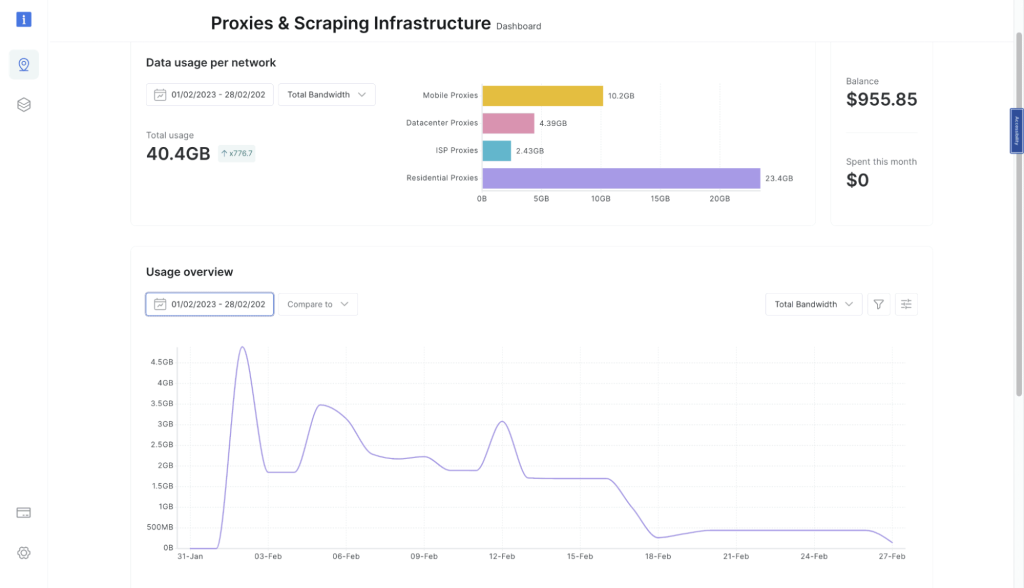
This platform positions itself as a full web data platform. Under one roof you get large proxy network pools (residential, mobile, ISP, and datacenter proxies) plus additional tools: scraping APIs, Web Unlocker, and a catalogue of pre-built datasets. Residential traffic typically starts around 5 USD per GB on entry-level, pay-as-you-go plans, with slightly lower effective rates on larger monthly bundles.
The main audience is technical and growth-focused teams that need structured web workflows at scale, with most common use cases being:
Source: Proxyway
The upside is obvious: huge IP pools, fine-grained geo and ASN targeting, multiple proxy types, and enterprise tooling built in.
The flip side is complexity and a relatively high barrier to entry. That’s exactly why many teams keep a Bright Data alternative or two in their back pocket, especially budget-conscious teams that don’t need all the additional features.
There are several most common reasons why many teams start looking for a different proxy provider:
To evaluate Bright Data competitors in a fair way, it helps to put everyone against the same key checklist: pricing and entry barrier (pay-as-you-go vs plans, minimum spend, trial options), rotation modes and targeting (countries, cities, ISPs, ZIPs), setup complexity, security, and best-fit use cases.
The top Brightdata alternatives in 2026 — Proxy-Seller, Oxylabs, IPRoyal, Apify, and Decodo, all have clear strengths in different areas:
|
Provider |
Price per GB (indicative) |
Entry barrier |
Rotation modes |
Geo / ISP targeting |
Setup complexity |
Security & certifications |
Best fit use-cases |
|---|---|---|---|---|---|---|---|
|
Bright Data |
~4–8 USD/GB on plans |
Higher minimums, multi-tool mix |
Rotating, sticky, sessions |
195 locations; (country, city, state, ZIP, ASN, carrier) |
Self-serve + sales, strict |
Enterprise governance framework |
Full web data platform |
|
Proxy-Seller |
From ~0.7 USD/GB at volume |
Small bundles, low-cost trial |
Rotating and sticky |
200+ locations; (country, state, city, ISP) |
Instant self-serve |
ISO-aligned security & quality practices, strong reviews |
Web scraping, marketing workflows, social, e-commerce, marketplaces |
|
Oxylabs |
~8 USD/GB PAYG, less on plans |
PAYG from 1 GB, monthly tiers |
Rotating, sticky, rich API |
195 locations; (country, state, city, ZIP, ASN, coords) |
Self-serve + account team |
Enterprise audits, ethics focus |
Enterprise scraping, SERP, e-commerce |
|
IPRoyal |
~7–4.9 USD/GB on tiers |
1 GB minimum, traffic non-expiring |
Rotating and sticky |
195+ locations; (country, region, city, ISP, ZIP) |
Quick self-serve |
Growing reputation, budget-oriented |
Budget scraping, long-term low volume |
|
Apify |
Proxy use from ~8 USD/GB inside credits |
Free tier, low paid plans |
Built-in rotation |
Global coverage; country-level selection |
Developer console, no-code |
Platform reliability focus |
Automation, “Actors”, marketplace |
|
Decodo |
Mid-range GB pricing, flexible plans |
Free trials on some products |
Rotating and sticky |
195+ locations; (country, city, ZIP) |
Fast onboarding |
Ethical sourcing, compliance messaging |
Dev-led teams plus scraping APIs |
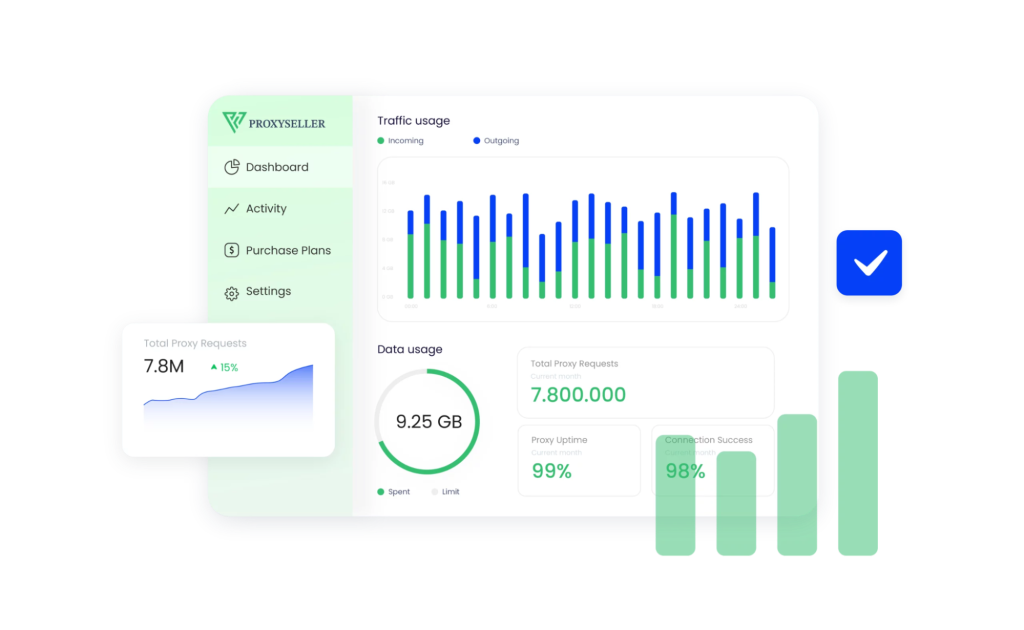
Bright Data bundles proxies with scraping APIs, unlockers, and datasets built for complex, multi-team setups. Proxy-Seller, on the other hand, is a focused proxy provider with a broad IP catalogue — residential, ISP, datacenter IPv4/IPv6, rotating mobile proxies, all managed from a straightforward dashboard with quick provisioning and clear configuration options
For teams that already own their scraping logic, and need a reliable premium proxy infrastructure, without the additional complex tools (which make it noticeable more expensive), that difference is huge. And that’s where Proxy-Seller becomes the top Bright Data alternative.
Source: Multilogin
Residential plans on Bright Data are priced competitively at bigger scales, but for smaller projects, it gets much more expensive.
Proxy-Seller, on the other hand, lets you start with very small residential bundles or a 3-day trial for just $1.99, then move into larger packages where the effective price per GB drops sharply (down to around 0.7/GB at higher tiers), while maintaining a high success rate on business targets.
Bright Data supports granular targeting across countries, cities, ASN, and carriers on its residential network. Proxy-Seller focuses on delivering deep targeting without forcing you into enterprise-style commitments: 200+ locations, with city-level and ISP-level targeting, plus support for both HTTP(S) and SOCKS5.
On reliability, Proxy-Seller is built around 99% uptime with unlimited threads per account within product limits. That’s crucial for SERP tracking, marketplace monitoring, and multi-account work where you need heavy parallelisation without any arbitrary caps.
Bright Data’s onboarding and KYC are tuned for enterprise buyers and higher-risk use cases, so expect more checks and, often, sales involvement once you go beyond basic usage. Proxy-Seller keeps the flow self-serve: choose the proxy type, location, and term, pay, and get your endpoints almost instantly.
On the governance side, Proxy-Seller’s operator (SSV IT PROVIDER ONLINE SERVICES LTD) holds ISO/IEC 27001:2022 for information-security management and ISO 9001:2015 for quality-management processes — both golden standards in compliance and security. For many companies, that lines up well with internal audit requirements and vendor due diligence.
All in all, if you’re looking for a Bright Data alternative that’s production-grade yet affordable and easy to start, deploy, and scale, Proxy-Seller fits that brief perfectly.
Run a 3-day Proxy-Seller pilot and measure uptime, success rate, and cost per successful request on your core targets.
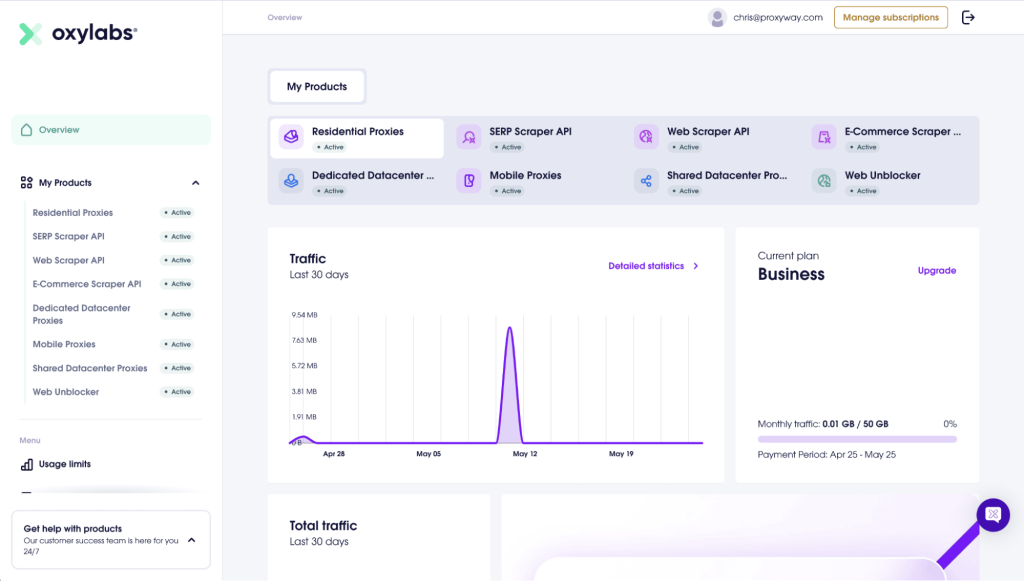
Both of these providers are often evaluated side by side by enterprises that already know they’ll be investing heavily in web data. This is the classic Oxylabs vs Bright Data comparison — both run very large residential and mobile IP pools, ship multiple scraping APIs, and emphasise high-touch support.
Source: Proxyway
Pricing and entry barrier
Oxylabs usually advertises pay-as-you-go residential proxies at roughly 8 USD per GB, with monthly plans and long-term contracts lowering that rate. BrightData’s public plans land in a similar bracket, with decent discounts on large bundles. Neither is built for occasional workloads — both expect ongoing, heavy usage.
Features and targeting
Core capabilities are broadly similar: rotating and sticky sessions, global coverage, fine-grained geo controls, and advanced APIs. Oxylabs highlights its SERP and Web Scraper API, while its counterpart leans on its unlocker products and wide dataset marketplace.
Setup and compliance
Both vendors offer solid dashboards and documentation, but their key strength is enterprise governance: abuse-prevention policies, SLAs, and detailed auditability. They’re built for teams that need to tick off a long internal checklist on security and compliance.
If you want a platform-grade provider and have the budget, Oxylabs is one of the strongest Bright Data competitors in that enterprise segment. In more cost-sensitive scenarios where you simply need a solid proxy infrastructure, a leaner provider is usually the better choice.
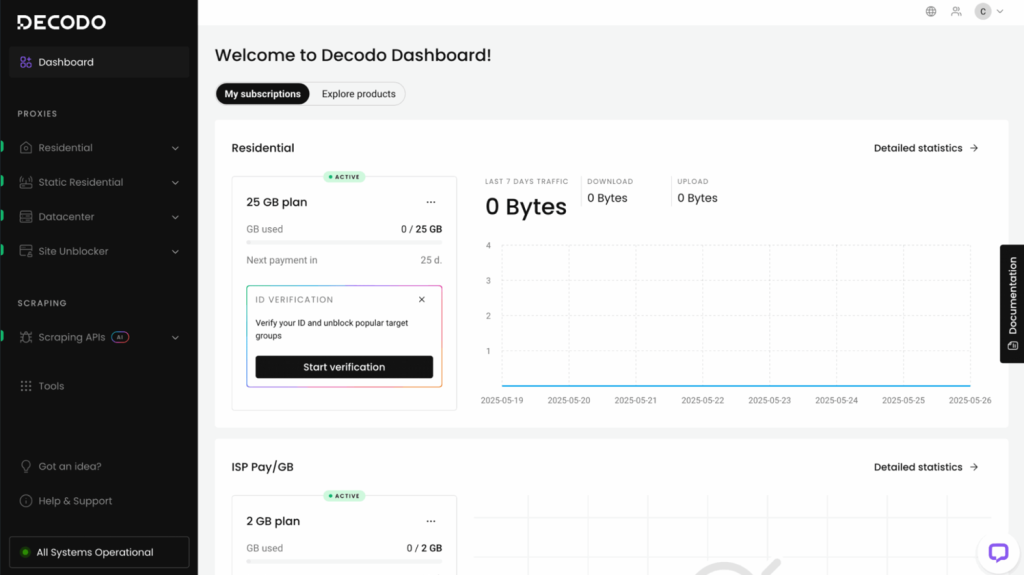
Among developer-led teams, Decodo vs Brightdata comes up quite often. Decodo combines proxy networks with a web scraping API and an “unblocker” product. The branding and docs clearly target engineers who want to go from signup to working code in as few steps as possible.
Source: Proxyway
Pricing and entry barrier
Decodo tends to sit in the mid-range for residential traffic, with GB-based plans at different volume tiers (and regular promotions, so keep an eye out). Some of its web extraction products come with limited free trials so teams can test success rates. BrightData’s residential pricing, on the other hand, is more complex and is typically more attractive at higher usage levels.
Features and targeting
Both providers offer large IP pools, global coverage, and standard rotation options. Decodo focuses on a tighter bundle of proxies and scraping APIs, supported by tutorials and quickstart guides, but its enterprise-built counterpart still has the broader suite of tools.
Setup and compliance
Onboarding, dashboard usage, and proxy API integration are intentionally straightforward on both sides. One leans towards more formal enterprise governance, while Decodo presents itself as a developer-friendly Bright Data alternative with an “ethical sourcing and compliance” docs.
For engineering-led teams that mainly want proxies plus well-documented scraping endpoints, Decodo can be a solid choice. If you also need datasets, unlockers, and a very wide toolset, it definitely falls short.
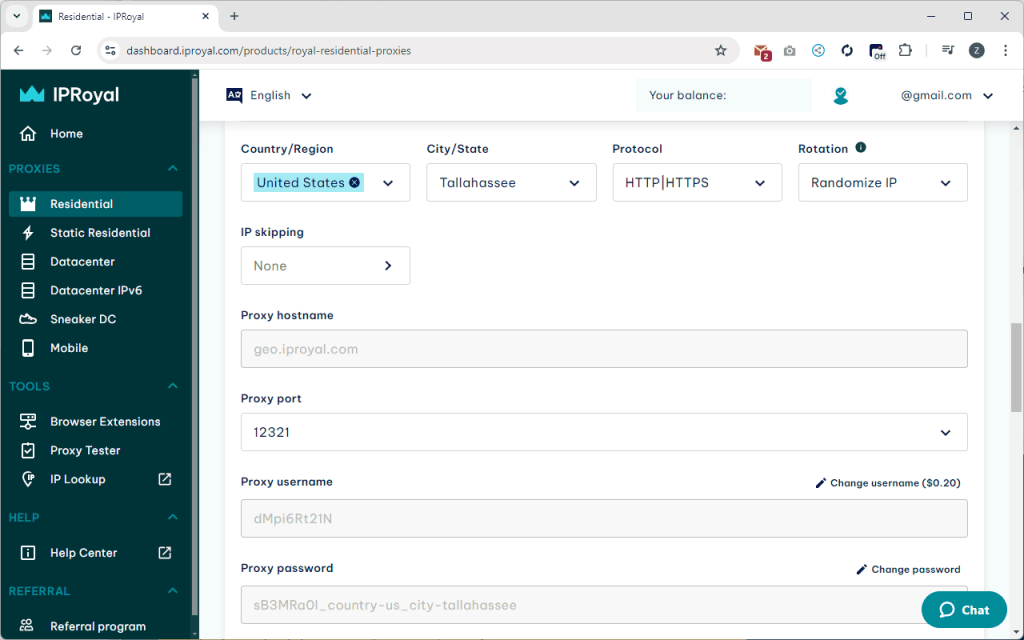
IPRoyal is often seen as one of the more budget-friendly solutions. It offers residential, ISP, and mobile proxies, with a residential proxy pool counted in tens of millions of IP addresses across nearly two hundred countries.
Source: IPRoyal
Pricing and entry barrier
IPRoyal’s residential traffic usually starts around $7/GB for 1 GB bundles, drops to roughly $5/GB at 50 GB packages, and can go lower on large, long-term plans. Traffic is marketed as non-expiring, which is convenient when your usage is irregular, whereas its enterprise-grade counterpart rarely focuses on this low-volume, long-duration pattern.
Features and targeting
Both support multiple proxy types and global coverage with rotation choices. Bright Data’s advantage is its massive network scale and toolset, and IPRoyal’s main advantage is simplicity and a clear budget focus.
Setup and compliance
IPRoyal’s dashboard is geared more towards individuals and small businesses, aiming for quick setup, while its counterpart’s onboarding is more structured and complex, aligned with bigger organisations and stricter internal processes.
If you’re running an IPRoyal vs Brightdata comparison for budget-constrained projects, IPRoyal will usually win on cost and simplicity, but it falls short if you’re after more advanced features, network scale, and volume rather than raw price.
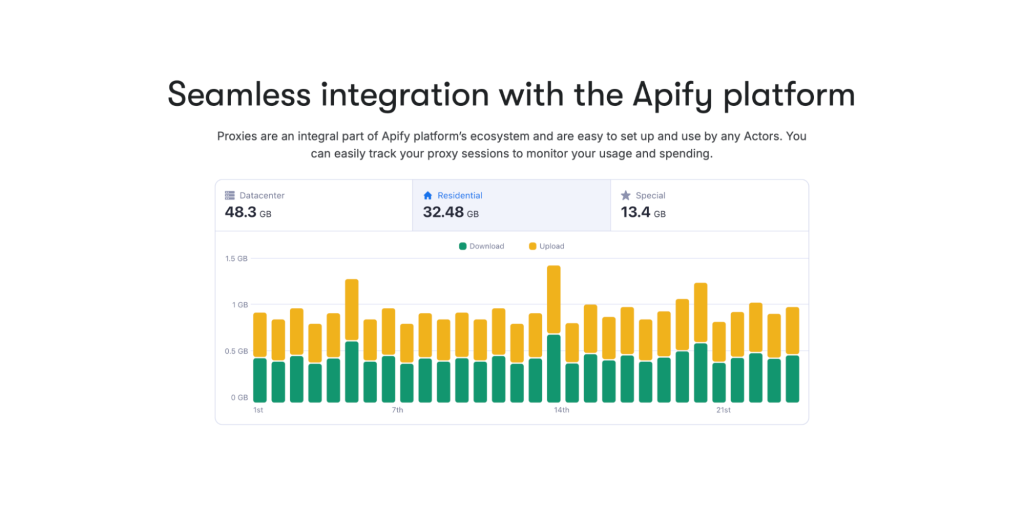
Searches for Apify vs Bright Data are typically about platforms, not just proxy vendors. Apify is a web automation and scraping platform built around “Actors”, which are reusable scripts you can run in the cloud or locally, many of them shared through a public marketplace.
Bright Data, on the other hand, is a proxy-centric platform that has added scraping APIs and datasets on top of its IP network services.
Source: Apify
Pricing and entry barrier
Apify uses a credit-based model with a free tier that includes a small allowance, plus paid plans that scale with total platform usage as you scale. Bright Data separates bandwidth, tools, and advanced features into their own plans.
Features and targeting
Apify shines at workflow automation: scheduling, concurrency control, integrations, and a marketplace of ready-made Actors for popular targets. BrightData is strongest in network scale, unlockers, and the breadth of its IP network pool. Both rely on mature proxy layers under the hood, and are often used alongside anti-detect tooling, session management, and fingerprint protection in more advanced setups.
Setup and compliance
Both offer capable dashboards and documentation. Apify feels like a developer platform with strong no-code support, whereas its counterpart feels like an enterprise proxy service with heavy focus on governance.
If you primarily want advanced web automation with minimal coding, Apify is a compelling Bright Data alternative. If you want to control scraping logic yourself and point it at a powerful proxy network, it’s just not as powerful.
There’s no single winner across all scenarios, but you can narrow down Brightdata alternatives quickly by grouping them based on what they’re best at:
Proxy-Seller combines low-risk trials, competitive per-GB pricing at scale, deep geo/ISP options, and ISO-backed processes. That makes it a strong default Bright Data alternative for ongoing web workflows, SEO, marketplace, and multi-account projects.
Both are great for high-volume, compliance-heavy environments that need multiple APIs, SLAs, and consultative customer support from day one, especially for large scale web extraction across many regions and websites.
If you value unlockers, datasets, or a marketplace of reusable scrapers, both stand out with their platform-level features layered on top of proxies.
Proxy-Seller and IPRoyal both make it easy to start with small bundles and scale gradually, with pricing models and dashboards that work well for smaller, fast-moving teams.
Across these groups, Proxy-Seller is often the best alternative to Bright Data for teams that want a reliable proxy infrastructure that’s fast, configurable, and auditable without any extra platform overhead.
Start a short Proxy-Seller trial and see how it handles your real scraping and automation workloads.
The quickest way to cut through marketing claims is to run a focused pilot. Define your target sites, required locations, and acceptable success rate, pick two or three providers from this list, and send identical traffic through each one. Track valid responses per dollar, implementation effort, and day-to-day stability.
For most teams, starting with Proxy-Seller as the primary Bright Data alternative is the strongest move: you get an affordable pilot, a clean, straightforward setup, and access to a broad mix of IP types with robust geo and ISP-level targeting that can scale with any serious workload.
If you want one provider to handle most of your day-to-day work, Proxy-Seller is usually the easiest alternative to live with. It scales cleanly from solo use to big teams, covers multiple proxy types and locations, and has pricing tiers that don’t punish small projects.
Price per GB matters, but it is only one piece. Look at targeting options (city, ASN, ISP), success rate on your real targets, latency, uptime guarantees, rotation modes, dashboard quality, and whether the provider meets your internal compliance standards. In long-running projects, these factors usually matter more than small price differences.
Yes. Proxy-Seller is built around everyday business workflows: SEO, SERP tracking, marketplaces, social media, ads, local SEO, general scraping. Wide geographic coverage, city / ISP targeting, unlimited bandwidth, and 24/7 availability make it an ideal Bright Data alternative for the kind of jobs you run all the time.
Yes, if you pick the right one. Some competitors race to the bottom on price. Others, like Proxy-Seller, aim for 99% uptime, constant monitoring, and ISO-aligned processes, so they can sit comfortably in environments where both reliability and compliance actually matter.
Start with a small pilot instead of a full migration. Take one or two alternative solutions, replay the same traffic, then compare three things: success rate, speed, and cost per successful request. Cheap trials from providers like Proxy-Seller make this kind of A/B test painless.

 PHP
PHP Node.js
 Python
 Java
Java Golang
 en
en  Español
  中國人
中國人  Tiếng Việt
  Deutsch
  Українська
  Português
  Français
  भारतीय
  Türkçe
  한국인
한국인  Italiano
  Indonesia
  Polski
Comments: 0