 Proxy for Telegram
 Proxy for LinkedIn
 Proxy for Google
 Proxy for Ebay
 Proxy for Twitter
 Proxy for TikTok
Best IPRoyal Alternatives in 2026 (Reliable Proxy Services Compared)

Most teams that start looking for an IPRoyal alternative in 2026 will already be familiar with the basics. They’ve probably run proxies before, have SEO monitoring or data collection flows in place, and maybe even juggle a few multi-account setups on the side.
What they don’t always have is a clear view of how the top proxy providers compare to one another, especially when it comes to price, geo depth, stability, and compliance, and why many teams choose Proxy-Seller as their main choice.
Businesses often rely on quality proxies for web scraping, multi-region testing, and countless other activities, while individual users use them for gaming, social media, and other personal use. IPRoyal is one of the most-marketed solutions out there — a great tool, no doubt, but the real question is whether some of the best IPRoyal alternatives may be a better fit.
Proxyway’s 2025 Market Research reports that IPRoyal’s revenue grew by about 50% in 2024 in a landscape with more than 250 proxy providers competing for the same demand.
If you’re at that stage, this guide will make your life easier.
We’ll quickly explore the 11 best IPRoyal alternatives with factual, up-to-date information on key features, pricing, and more, so you can pick a proxy stack that best fits your actual workload and budget.
IPRoyal overview (what it offers today)
IPRoyal is a fairly well-rounded platform. Much like with other best IPRoyal alternatives, users get multiple IP types under one roof, such as residential proxies (rotating and sticky), datacenter (shared and private), mobile proxies, ISP, and several other more specialized ones.
They offer a flexible pay-as-you-go billing structure, so for most cases, you won’t be overpaying for features or volume you don’t need. Traffic on standard plans starts around $7/GB, while promo bundles can go as low as $1.75/GB if buying in bulk.
Coverage-wise, they’re in 195+ countries with country, state, and city targeting. Finally, it offers unlimited concurrent sessions, which is perhaps the biggest factor why a lot of smaller teams choose for their residential and 3G/4G proxies, without needing to overthink it.

IPRoyal limitations
No tool is perfect, so while we’ve given it its praise, let’s take an objective look at why many people and teams may look for the best IPRoyal alternatives sooner or later.
In the case of IPRoyal’s, the main friction points are less about raw IP volume and more about pricing, testing options, and the broader tooling ecosystem:
- No true self-service free trial for users to test out the product before committing (though, it does provide a low-cost 1-day test option and limited trials for some proxies via the sales team).
- Mixed customer reviews on reputable platforms like TrustPilot, especially regarding support responsiveness and issue resolution time.
- The starting price of $7/GB is quite steep compared to some of the alternative providers out there.
- More limited feature stack compared to other platforms, with fewer native web-unlocking tools, no-code scraping, and specialized IPs for teams that want a true all-in-one solution.
Taking all this into account, this combo makes other providers much more enticing for many teams, especially those that prioritise sharper pricing, richer built-in tooling, or more responsive support.
Why teams start looking for an IPRoyal alternative
The reasons teams start hunting for an IPRoyal alternative usually fall into a few categories:
- Cheaper, lower-risk pilots → some companies want small tests and bundles with almost no commitment to validate targets, flows, and success rates.
- More aggressive default targeting → local SEO, hyper-local ads, and compliance checks often need richer city / ISP targeting, at times with near ZIP-level granularity.
- Smoother onboarding → some teams just want to avoid endless back-and-forth, manual reviews, and extra calls to start sending modest volumes of traffic.
- Stronger formal compliance → security-minded teams that need documented processes, references to ISO-aligned controls, and a governance story they can present to internal security reviews.
That’s usually where Proxy-Seller and a few other notable IPRoyal alternatives step in.
Proxy-Seller vs IPRoyal: top IPRoyal alternative
Both of these platforms run multi-type proxy networks, but the main difference is what they are optimized for. IPRoyal is positioned as a straightforward, budget-friendly option, especially around rotating residential proxies and simple, self-serve use cases.
Proxy-Seller, on the other hand, is positioned as a more advanced proxy infrastructure with versatile plans for solo developers, growing teams, and larger enterprises.
Alongside residential proxies, it offers ISP, 4G/5G mobile, and IPv4/IPv6 datacenter IPs, up to 1 Gbps speeds, more precise geo targeting, stricter compliance, HTTP(S) and SOCKS5 support, and multiple authentication modes.
For technical and business teams that want a provider they can grow with, that combination makes Proxy-Seller a very strong, infrastructure-first IPRoyal alternative in its own right.
Pricing and Entry Barrier
IPRoyal’s residential plans start with smaller bandwidth bundles in the $7/GB range, dropping as you scale traffic. Some traffic is non-expiring, which is handy if your workload involves one-off projects.
Proxy-Seller offers affordable packages, giving you more than enough residential traffic to test real targets, validate your setup, and check success rates. Per-GB pricing becomes very competitive at higher volumes, dropping to as low as $1.45/GB at higher tiers.
For a lot of teams, that’s a lower-risk, lower-cost path to testing their potential proxy infrastructure.
Targeting, Protocols, and Pool Depth
IPRoyal offers broad residential coverage across most major regions, plus country, state, and city targeting, while longer-lived sessions can be pushed to ISP/static residential proxies.
Proxy-Seller pushes targeting a bit further — you can pick country, region, city, and ISP on residential proxies, with automatic proxy rotation and support for HTTP(S) and SOCKS5 everywhere.
So if your work depends on precise local SEO, multiple account clusters per geo/ISP, or accessing country-specific sites and SERP tracking exactly as local users see them, that extra targeting control is often worth a lot.
Set-up and Management Experience
IPRoyal keeps the panel simple: sign up, top up, or pick a package, generate endpoints, and plug them into your tools. Residential plans support unlimited concurrent sessions, so scaling is more about your own infrastructure.
Proxy-Seller follows the same general flow but trims friction where it can. You pick proxy type, geo, and term, pay, and get network endpoints right away, and you can either use username/password or IP whitelisting.
Trust, Security, and Compliance
IPRoyal has carved out a spot as a cost-effective vendor with decent support and stable, reliable performance for its price bracket.
Proxy-Seller layers a more formal governance story on top — aligning processes with ISO/IEC 27001:2022 and ISO 9001:2015, signalling structured and enterprise-grade information security and quality management.
Combined with strong public reviews and independent benchmarks calling out stability and support, that makes it a very attractive option when your IPRoyal alternative has to get past security and compliance reviews.
Stability, Scaling, and Best-Fit Use Cases
IPRoyal aims to handle high concurrency with solid success rates on common targets, which fits tasks like SEO tracking, price monitoring, large-scale web scraping, and multi-account operations.
Proxy-Seller targets the same kind of workloads with unlimited bandwidth on IPv4, IPv6, and ISP proxies, plus monitoring and troubleshooting guidance for large parallel jobs.
For small and mid-size teams, that mix of stability, low entry cost, and governance is often exactly what they expect from a primary IPRoyal alternative.
11 best IPRoyal alternatives in 2026
The top providers usually offer one (or more) of the following: larger and/or more diverse IP pools; more affordable and/or flexible pricing models; stronger additional features, such as APIs, dashboards, logs, scrapers, unblockers, etc.
We’ve researched the top reputable review platforms such as G2, Trustpilot, and more, to gather the 11 best IPRoyal alternatives for all kinds of use cases in 2026, according to real, verified users.
Comparison table: 11 best IPRoyal alternatives in 2026
| Provider | Residential price from | IP pool & coverage | G2 rating | Key strength |
|---|---|---|---|---|
| Proxy-Seller | $1.45/GB | 47M+ / 220+ locations | 4.8/5 | Low entry $/GB, very wide GEO coverage |
| ProxyEmpire | $1.50/GB | 30M+ / 170+ countries | 5.0/5 | Non-expiring bandwidth, 4M+ mobile IPs, 24/7 support |
| Bright Data | $5.88/GB | 150M+ / 195 countries | 4.6/5 | Huge pool, premium feature stack |
| Oxylabs | $8.00/GB | 175M+ / 195+countries | 4.5/5 | Enterprise focus, very large network |
| Decodo | $3.50/GB | 125M+ / 195+ locations | 4.6/5 | Big pool, good value + tooling |
| SOAX | $3.60/GB | 155M+ / 195+locations | 4.8/5 | Precise geo-targeting, strong 4G/5G |
| NetNut | $3.53/GB | 85M+ / 195+countries | 4.9/5 | ISP-based network, stability at scale |
| Webshare | $2.80/GB | 80M+ / 195countries | 4.8/5 | Cheap at scale + permanent free tier |
| Proxy-Cheap | $4.99/GB | 85M+ rotating / 130+ countries | 4.9/5 | Budget-friendly rotating res + IPv6 |
| Rayobyte | $3.50/GB | 40M+ (global coverage) | 4.8/5 | Ethically sourced res IPs, volume discounts |
| PacketStream | $1.00/GB | Pool size not disclosed / 190+countries | N/A | Simplest + cheapest flat $/GB |
Note: Prices are approximate “from” values for proxies as of late 2026. Always confirm current pricing on each provider’s site.
1. Proxy-Seller
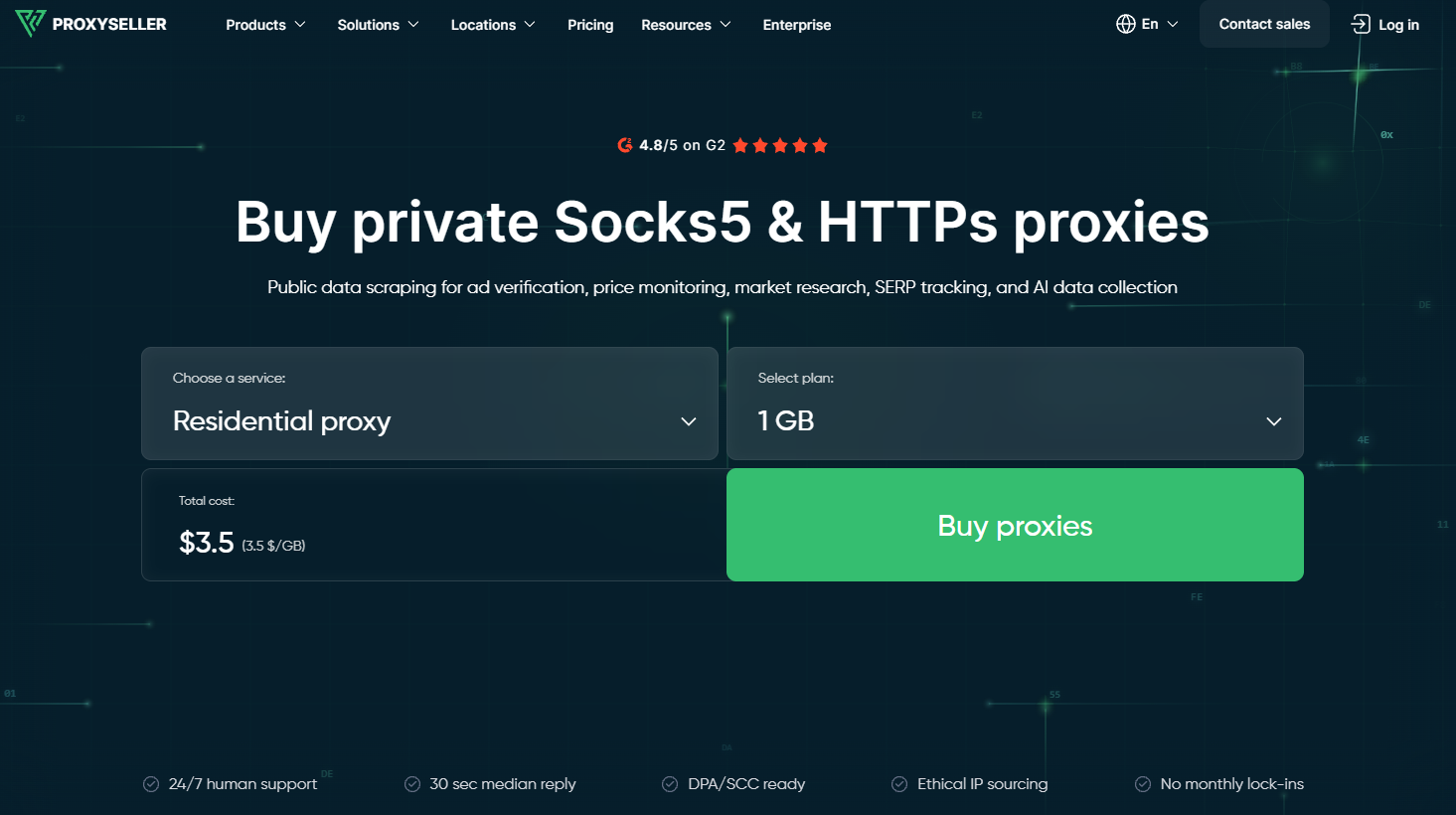
Proxy-Seller is built for teams that want pretty much everything in one place — residential, ISP, mobile, and datacenter proxies (IPv4 and IPv6). As a neat addition, it also offers more specialized IPs dedicated for gaming, social media, marketplaces, and more. In a nutshell, this solution is undoubtedly one of the best IPRoyal alternatives on the market.
You’re looking at 47M+ residential IPs per month across 220+ locations with country, region, city, and ISP targeting.On the datacenter side, Proxy-Seller offers 600+ Class C subnets and 200+ Class B subnets, which gives you pretty decent diversity and stability.
Plans start at $3.5/GB and drop to $1.45/GB at 1 TB. You’re not stuck in some rigid tier system either, as you can adjust bandwidth as you go.
With Proxy-Seller, users get 99.7% uptime and can choose how rotation works (time interval, each request, or sticky) directly in the dashboard. On the tech side, you get SOCKS5 and HTTP(S), username/password auth or IP allowlisting, plus detailed stats and a solid API so your team can handle provisioning, rotation, and all the wiring from your own tools.
Since you can run virtually all kinds of proxies under one roof, all with top-notch compliance and policy controls, Proxy-Seller keeps showing up on shortlists of the best IPRoyal alternatives for teams that move a lot of data and just want one serious vendor instead of a messy mix of providers.
Key features:
- 47M+ rotating residential IPs per month across 220+ locations with location targeting and three rotation modes.
- Datacenter IPv4/IPv6, ISP, and mobile proxies with a 1 Gbps channel, 99.7% uptime, and 600+ Class C subnets plus 200+ Class B subnets.
- Flexible pricing (including high-volume per-GB deals) plus same-day sandbox access for faster testing before committing.
- Central dashboard and API for analytics, rotation control, and integrations.
Looking for a stronger alternative to IPRoyal? Make Proxy-Seller your primary IP network provider and consolidate residential, ISP, mobile, and datacenter traffic in one faster, more stable stack.
2. ProxyEmpire
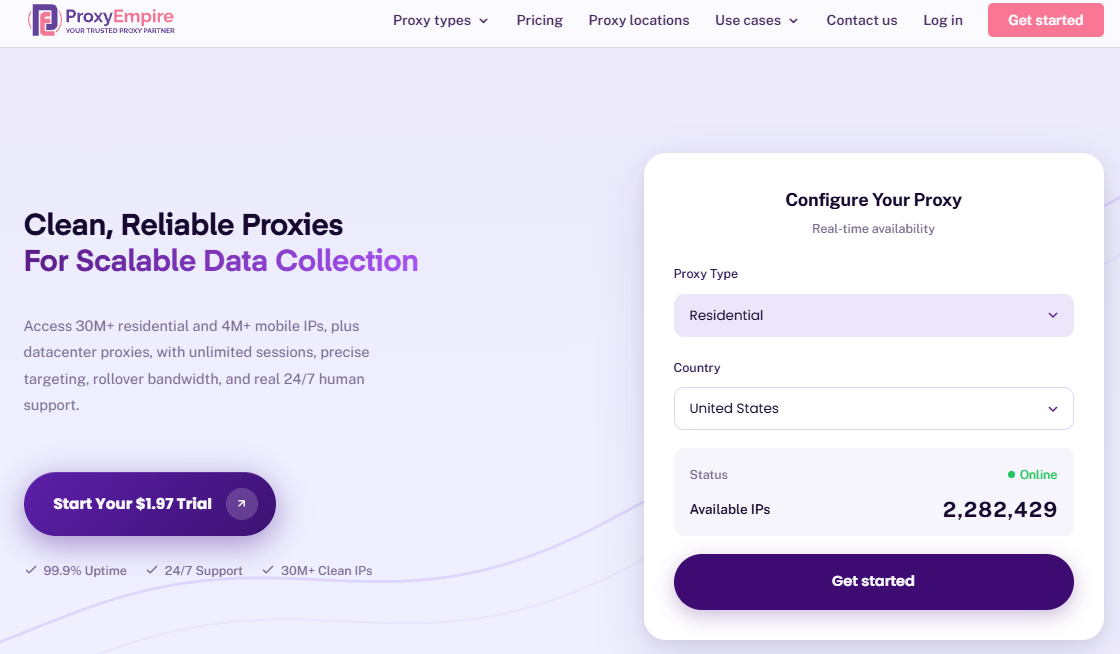
ProxyEmpire is a strong IPRoyal alternative for teams that like IPRoyal's non-expiring traffic but want a bigger mobile layer and round-the-clock support. Its network covers 30M+ residential IPs and 4M+ mobile IPs across 170+ countries, with country, region, city, and ISP targeting included at no extra cost.
Bandwidth works much like IPRoyal's: unused traffic rolls over to the next billing cycle, so irregular projects don't waste paid GBs. Residential traffic starts at $3.50/GB pay as you go and falls to $1.50/GB on the 1,000 GB plan, while rotating mobile starts at $4.50/GB.
Where IPRoyal gets mixed reviews on support responsiveness, ProxyEmpire runs 24/7 live chat with human agents and assigns dedicated account managers to corporate clients. A $1.97 trial covers both residential and mobile traffic, which closes another IPRoyal gap: the lack of an easy self-serve test.
Key features:
- 30M+ residential and 4M+ mobile IPs across 170+ countries
- Non-expiring bandwidth with rollover to the next billing cycle
- HTTP, HTTPS, and SOCKS5 support with rotating and sticky sessions
- 24/7 live chat support and a $1.97 trial for residential and mobile traffic
3. Bright Data

Bright Data is one of the giants in this space. Think 150M+ IPs (all kinds) across 195 countries.
Proxies are billed by bandwidth, and with certain promos, pay-as-you-go can start around $4/GB, depending on plan and billing model.
More serious usage usually goes via monthly plans, for example, roughly $499/month for ~141GB on some tiers. Bright Data also brings a lot of built-in tooling, such as Web Unlocker, Web Scraper, SERP APIs, and even direct datasets.
So if you are looking for more than just raw endpoint networks, Bright Data is also one of the best IPRoyal alternatives for businesses that want both infrastructure and higher-level data tools, though its higher pricing and added complexity tend to make it a better fit for larger, well-resourced teams.
Key features:
- 150M+ IPs (7M+ 3G/4G) in 195 countries.
- All major proxy types under one dashboard.
- Strong scraping suite with Web Unlocker, Web Scraper API, SERP API, plus a dataset marketplace.
- Pay-as-you-go and subscription pricing with granular geo-targeting and lots of documentation.
4. Oxylabs

Oxylabs is a Lithuania-based provider that leans heavily into enterprise-grade data collection. The network covers 175M+ address networks in 195 countries, plus a Web Unblocker and various scraping APIs.
All proxy types are offered as both plans and pay-as-you-go. Self-service tiers often start around $8/GB, and larger deals bring that number down quite significantly (roughly to $3.5–5/GB).
If you’re interested in IP volume and reliability for long-term, high-volume operations, Oxylabs is another frequent member of the top IPRoyal competitors, though its enterprise-focused pricing and stack may be excessive for smaller or simpler projects.
Key features:
- 175M+ IPs (all kinds) across 195 countries.
- Pay-as-you-go and subscription pricing, with 7-day trials on certain products.
- Advanced scraping stack (Web Unblocker, dedicated APIs) plus SOCKS5/HTTP(S) support.
- Enterprise focus with its account management, SLAs, and strong docs for automation-heavy use cases.
5. Decodo

Decodo targets the mid-market sweet spot. It’s easy to use, has a large enough pool, and is reasonably priced.
It runs 125M+ endpoints in 195 countries across diverse network types. Setup is pretty simple, which is why smaller and mid-sized teams like it. Dashboards are clean, APIs are straightforward, and rotating vs sticky is easy to flip.
On pricing, pay-as-you-go sits roughly at around $8.50/GB, but once you move to monthly plans and higher usage, effective rates can slide into the $3-4/GB range.
For growing teams that want to get started quickly without committing to enterprise-level contracts, Decodo often appears on lists of the best IPRoyal alternatives, even if its feature set is still more mid-market than fully enterprise-grade.
Key features:
- 125M+ IPs (all kinds) across 195 countries.
- User-friendly dashboard and APIs with automatic and sticky rotation modes.
- Flexible pricing with pay-as-you-go and custom bundles that drop the per-GB cost.
- Money-back options and support for main HTTP/SOCKS protocols.
6. SOAX

SOAX focuses almost entirely on quality residential and cellular proxies with very granular targeting.
Their 155M+ network pool is with 195+ locations and fine-grained filters like city and ASN, which is great if your use case needs very localized testing or segmented scraping.
Pricing is tiered, but the rough overview is: 25GB at about $3.60/GB, bigger bundles dropping toward $2/GB, and very high volume is where you can get down to ~$0.32/GB
So if you care a lot about precise geo/ASN targeting and you’re pushing substantial bandwidth, SOAX also sits comfortably among the best IPRoyal alternatives. However, given its focus is mainly on core proxy delivery, you may still need separate tools for more advanced automation or scraping workflows.
Key features:
- 155M+ IPs plus mobile proxies with city/ASN filters.
- Tiered bundles with effective rates from ~$3.6/GB down to ~$0.32/GB at volume.
- Rotating and sticky sessions suitable for always-on or session-based tasks.
- Short trials so you can benchmark performance before committing to serious traffic.
7. NetNut

NetNut also combines the main network types, and places a big focus on hybrid static + rotating residential networks.
They advertise tens of millions of rotating and over a million static address networks worldwide, with city/state targeting and support for HTTP/HTTPS/SOCKS5. That static-residential angle is extra useful for certain long-lived sessions and anti-fraud checks.
Their pricing is package-based, with effective rates usually around $3.53/GB on smaller bundles and sliding down toward $1.87/GB with more volume.
Key features:
- 52M rotating and 1M static IPs with global coverage and city/state targeting.
- Plans from roughly $3.5/GB down to ~low-$2/GB range for bigger contracts.
- Diverse and custom 4G/5G proxies all in one platform.
- HTTP, HTTPS, and SOCKS5 support plus 7-day trials on select tiers.
It remains one of the best IPRoyal alternatives for many use cases, but teams that need very advanced automation, built-in unlockers, or no-code scraping may still prefer more feature-dense platforms like Proxy-Seller.
Looking for the best IPRoyal alternative? Run your numbers against Proxy-Seller and see whether consolidating residential, ISP, mobile and datacenter proxies on one platform can reduce your costs and simplify how you manage traffic.
8. Webshare

Moving on to the next contender, Webshare offers a combination of datacenter servers, as well as static and rotating residential proxies.
The platform runs 80M+ static and rotating nodes across all 195 UN-recognized countries, handling ~650B requests per month. On top of that, they have a free tier (said to be 10 proxies and around 1GB/month) which is enough to validate basic performance and integration.
Static residential pricing usually starts at around $3.5/GB if you are just getting in, and drops as you push more traffic. For solo users or small teams that want global coverage without locking a big chunk of budget up front, Webshare is at times brought up as one of the best IPRoyal alternatives.
Key features:
- Roughly 80M proxies across 195 countries, plus their own high-speed servers when you need extra throughput.
- A permanent free tier with 10 proxies and limited bandwidth so you can spin up a quick test before paying for anything serious.
- Static and rotating network options priced competitively, with the per-GB cost going down once your volume goes up.
- A simple, no-drama dashboard and API to plug into your stack, with support handled mainly over email.
9. Proxy-Cheap

Proxy-Cheap is pretty much what the name tells you — a budget-friendly provider that still gives you all the main network options to work with, though more limited than other IPRoyal competitors mentioned in this guide.
They run a pool of multi-million network endpoints across 127 countries, plus datacenter and cellular networks in 130+ locations, so even if it is not as massive as some of the big enterprise vendors, it’s still more than enough for most projects that need a solid geographic spread.
Piercing plans start at about $2.99/GB, with separate buckets for static vs rotating, depending on your team’s exact needs.
If your number-one priority is getting the lowest possible cost per GB (within reason), this solution is perhaps one of the top IPRoyal alternatives, but only if you’re okay with not having the more premium features, which are often crucial for businesses and high-volume operations.
Key features:
- Multi-million IPs in 120+ countries plus 4G/5G pools.
- Traffic bandwidth from around $2.99/GB depending on plan and usage.
- Diverse catalog including rotating/static residential, LTE, datacenter IPv4/IPv6.
- API access and multiple payment methods for cost-conscious teams.
10. Rayobyte

Rayobyte offers the main types of proxies, and puts a lot of emphasis on ethical sourcing and long-lived/static options.
Their 40M+ network pool spans 100+ locations, with unlimited threads, sticky sessions, and bandwidth-based pricing.
The pricing curve is pretty friendly at scale, starting at ~ $3.50/GB for smaller usage, and going down to roughly $0.90/GB for multi-TB usage.
So if you know you’ll be moving a lot of traffic every month and you want predictable, volume-based billing, Rayobyte is also a great provider to look at, though its structure and pricing tiers are less attractive for smaller, low-volume projects.
Key features:
- 40M+ IPs in 100+ GEOs, plus ISP and datacenter options.
- Volume-based pricing from ~$3.5/GB down to ~$0.90/GB for multi-TB contracts.
- Unlimited threads, sticky sessions, and clear ethical sourcing policies.
- Static and rotating datacenter proxies for both persistent and high-throughput jobs.
11. PacketStream

PacketStream is a P2P network with a very simple pitch: low price, straightforward model.
They get real-life address endpoints from users who opt in to share their bandwidth and resell that as metered residential traffic. You get HTTP, HTTPS, and SOCKS support with IPs in 190+ countries.
Pricing is almost too easy to remember — $1.00/GB on pay-as-you-go, with a usual minimum purchase of around 50GB. That minimum is worth noting, as it can definitely be overkill for very small tests and teams.
Because of that flat $1/GB and a clean interface, PacketStream typically shows up among the best IPRoyal alternatives for folks who care more about cost than about advanced tooling, support, or enterprise-grade controls.
Key features:
- Residential coverage via a P2P network in 190+ countries.
- Flat $1/GB pricing with no long-term contracts (but a 50GB-ish minimum buy).
- Rotating and static options with HTTP/HTTPS/SOCKS support.
- Users can sell unused bandwidth at $0.10/GB, which helps grow the network.
Top IPRoyal alternatives by category in 2026
No single IPRoyal alternative wins every scenario, so it’s best to group them by what they’re best at and narrow your shortlist from there. Within each group, your top picks will depend on budget, acceptable risk, and how much tooling you want your provider to handle.
Balanced price, targeting, and compliance: Proxy-Seller and IPRoyal. For most small and mid-size teams, these two are the best starting solutions. Proxy-Seller brings same-day sandbox access, granular geo/ISP targeting, and rock-solid compliance, while IPRoyal offers simple proxies, competitive pricing, and an accessible dashboard.
Enterprise platforms and advanced tooling: Bright Data and Oxylabs. If you need deep APIs, managed data products, and formal SLAs, these IP Royal competitors sit at the top. They’re more expensive but provide the additional built-in tools and features that many organizations usually require.
Best overall starting point for 2026: Proxy-Seller. For many teams looking for the best IPRoyal alternative, Proxy-Seller combines top-quality residential, mobile, ISP, and dedicated datacenter proxies with precise geo and ISP targeting, competitive pricing, and enterprise-grade compliance. That mix makes it a robust default choice for both small pilots and long-term, large-scale workloads, including high-speed scraping for LLM pipelines.
Try Proxy-Seller with same-day sandbox access and see how it handles your real scraping and automation workloads.
Choosing among the best IPRoyal alternatives
When you stack IPRoyal against the best IPRoyal alternatives, it’s safe and objective to say that there’s no universal “winner.” It all comes down to your unique personal or business needs, whether you want the most IPs or the most filtered locations, whether you need proxies for web scraping, custom proxies for social media, and so on.
So how do you choose the right one? For starters, you conduct thorough research by exploring articles such as this one, and then evaluate the finalists based on the following key factors:
- Network size & diversity → do you need residential + mobile + ISP + datacenter? How big of an IP pool do you need? Which countries or cities actually matter most to you?
- Targeting & rotation controls → can you target by country/city/ASN? Do you control rotation (per request, time-based, sticky sessions)? How predictable are the sessions?
- Pricing model → are you better off with a pure pay-as-you-go structure, or do bundles and long-term contracts make more sense? Any trials or refunds available?
- Tooling & automation → how intuitive is the dashboard? Are the APIs robust? Do you get logs, stats, web unlockers/scrapers, or other higher-level tools you may need later?
- Compliance & sourcing → how transparent is the provider about IP sourcing and data protection? Do their policies align with your legal and governance requirements?
Once you’ve shortlisted the top IPRoyal alternatives for your needs and budget, simply score them against these criteria, and your list will narrow down pretty fast.
Conclusion
IPRoyal is a competitive provider, especially for teams that are just looking for a simple start. But it’s far from your only option, and some alternatives may very well be a better fit for your team.
The best IPRoyal alternatives in 2026 may come with larger and more diverse IP pools, better pricing structures (especially at higher volumes), and more specialized tooling for scraping, data collection, and so on.
Testing at least a couple of these IPRoyal competitors side by side is the safest way to avoid getting locked into a stack that’s hard to scale or optimize down the line.
If you’re looking for a balanced option that covers residential, ISP, mobile, datacenter, and more specialized proxies with strong global coverage and enterprise-ready controls, Proxy-Seller is a very strong contender among the best IPRoyal alternatives. Give it a try and see for yourself!
FAQ
When you compare IPRoyal vs Brightdata and other IP Royal competitors, line them up on a few basics: entry pricing, geo/ISP targeting depth, ease of integration, compliance story, and how they behave under load. Enterprise platforms like Bright Data and Oxylabs tend to win on tooling and governance, while providers like Proxy-Seller come out ahead on cost and flexibility.
For small teams, the best IPRoyal alternatives are the ones that let you start with low spend, a clear dashboard, and support that actually responds. In most cases, that means shortlisting IPRoyal, Proxy-Seller, and maybe one of Soax or Smartproxy (Decodo), then running a quick side-by-side test to see who performs best on your real workload.
You’ll find plenty of “free” proxies, but they’re not realistic for production: unstable, slow, overused, and usually sketchy from a compliance standpoint. The smarter move is to use cheap trials or tiny pay-as-you-go plans from serious providers instead of gambling your stack on a free IPRoyal alternative.
PROXIES FROM $0.02/IP
Ready to put this into practice?
Pick a proxy type and location, and start using it within minutes.
Instant delivery
24/7 support
Refund policy
About the author