 Proxy for Telegram
 Proxy for LinkedIn
 Proxy for Google
 Proxy for Ebay
 Proxy for Twitter
 Proxy for TikTok
Best SERP API 2026: Top Google & Bing SERP API Providers Compared

Picking the best SERP API in 2026 looks different from just a few years ago. In September 2025, Google killed the num=100 parameter which forced every provider to use paginated pulls. In August, Microsoft then retired the Bing Search APIs, pushing teams to use Azure-bundled replacements that cost 40–483% more. And in December, Google filed suit against SerpApi over alleged DMCA violations. The shortlist of the best SERP API tools a team would have picked 18 months ago is now out-of-date.
On top of that, AI Overviews now trigger on roughly 48% of tracked queries, in comparison to just 30% last year. A SERP API that cannot parse AIO presence, citations and positions is tracking only half of the total visibility for those keywords.
What is SERP API?
A Search Engine Results Page (SERP) API is a developer endpoint that returns parsed Google or Bing search results as structured data, most commonly JSON. To use the API, the user first sends a set of parameters (keywords, engine, location, device). The API runs the search on its own scraping infrastructure and returns the SERP as fields the user can employ directly within their script or dashboard.
In 2026, there are more than just 10 or even 100 blue links in a Google SERP. APIs now paginate at 10 results per page. AI Overviews account for about 48% of the tracked queries, and ads, ‘People Also Ask’, shopping, and Knowledge Graph are all placed above the organic block. The best SERP API tools parse all of these elements as structured JSON.
As a result, the best SERP API tools offer real value to modern teams. Engineers get cleaner integrations, SEO teams get stronger data quality and more consistent search result rankings, and SaaS companies can feed the outputs directly into their products and reporting systems.
Why teams use SERP APIs instead of raw scrapers
When raw web scraping starts creating more work than value, that’s when most teams start moving toward APIs. Although collecting data as raw HTML may seem cheaper at first, parser maintenance, higher failure rates, and more engineering overhead become real extra costs.
Google also starts throwing IP blocks and CAPTCHAs after the first few hundred search requests coming from the same IP. To combat this, teams have to layer in rotating proxies, CAPTCHA solvers, and a parser that requires manual rewrites every time Google ships a SERP layout change.
The best SERP API solutions absorb that work into the product:
- Proxy rotation and CAPTCHA handling are built into the API, without needing any additional vendor management
- JavaScript rendering is handled by the use of headless browsers by the API provider
- Parsed structured output is provided as JSON fields for organic positions, AI Overviews, ads, shopping, local packs, PAA boxes, etc., not raw HTML
- Layout-change resilience, so if Google performs a SERP redesign, the provider adjusts the parsing logic
- Geo-targeting can be specified for country, city, and even ZIP-level routing as a request parameter
- Multi-engine coverage, resulting in one interface for Google, Bing, and others, rather than a different codebase for each source
Regardless of the API chosen, a proxy layer underneath is just as important. SERP APIs have rate caps, per-call pricing, and run the risk of their own scraping IPs getting flagged. With a dedicated proxy alongside, teams are in control of how their requests actually reach Google, while the API absorbs overflow and runs as a backup when the vendor scrapers degrade.
Proxy-Seller is a proxy infrastructure provider that supplies residential, ISP, datacenter, and mobile proxies across 220+ locations, all in one stack. The platform covers SERP scraping, product pages, marketplaces, and other web data workflows with residential, ISP, datacenter, and mobile proxies across 220+ locations.
Top SERP API providers 2026
To evaluate the best SERP APIs, we assessed each provider against five key factors that determine the functionality at production scale, including:
- Pricing models: how transparent the per-call and subscription pricing are, considering the post-num=100 reality
- SERP feature parsing: parsing of AI Overviews, featured snippets, PAA, shopping, local packs into JSON, not raw HTML
- Geo and device targeting: requests parsing by country, city, ZIP, desktop vs mobile
- Refresh model: real-time vs queued, and the costs for each at scale
- Procurement risk: documentation, SDK quality, and a 2026 legal exposure evaluation
Below is our SERP API providers comparison: top choices for 2026, scored against the criteria above.
SerpApi: best SERP API for rich Google and Bing coverage
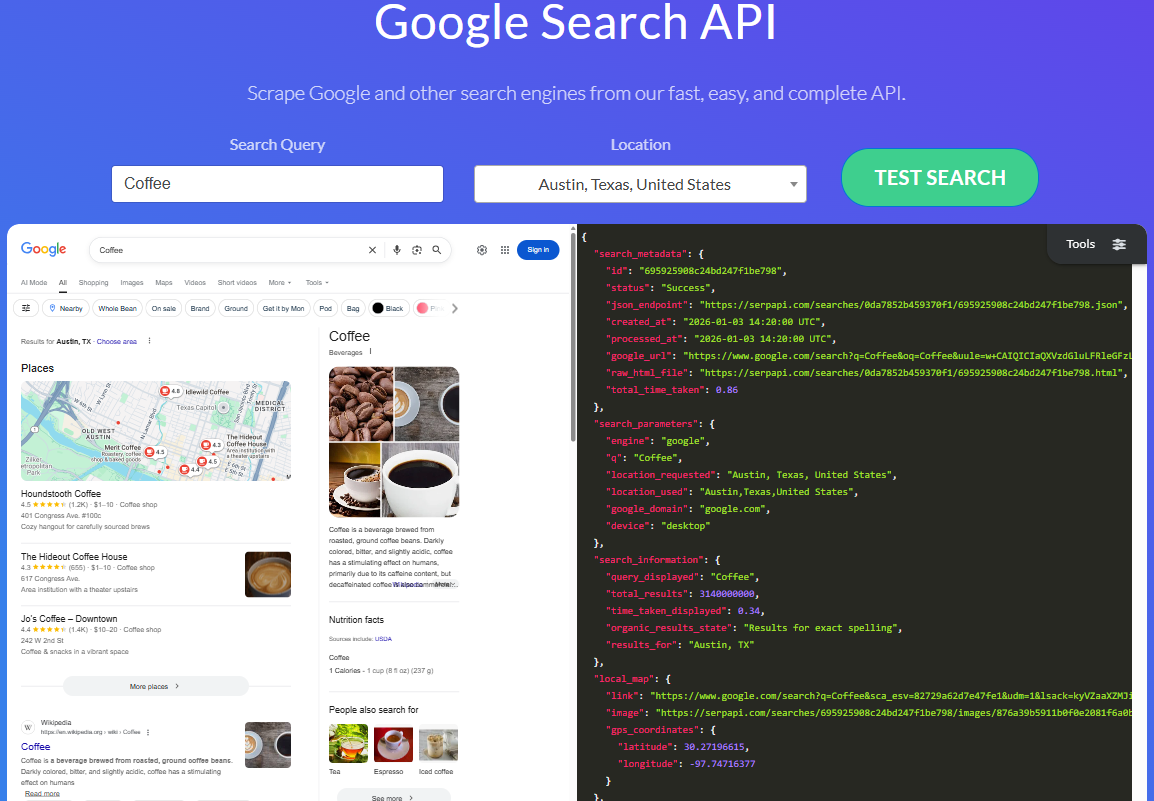
SerpApi is built for scraping SERP scraping in real-time with parsed JSON output across Google, Bing, Baidu, Yahoo, Yandex, and 75+ additional search engines. Built to work with the toughest scraping challenges, SerpApi handles CAPTCHA, JavaScript rendering, as well as proxy rotation.
It returns organic results, AI Overviews, Knowledge Graph, Shopping, local packs, and PAA as structured data. The platform runs on a 99.95% SLA with a 100% credit-back penalty.
Pricing is divided into tiers, beginning with the Starter plan at $25/month for 1,000 searches. The subsequent tiers are Developer ($75/month for 5,000 searches), Production ($150/month for 15,000 searches), Big Data ($275/month for 30,000 searches), with Enterprise plans for custom limits and pricing. Only completed searches count towards the limit, while unused searches do not roll over.
Pros: broad multi-engine coverage, real-time results, 99.95% SLA with credit-back protection, well-documented and mature SDKs.
Cons: currently a vendor-continuity risk due to the active Google vs SerpApi lawsuit from December 2025 (as well as the Reddit vs SerpApi lawsuit from March 2026), and per-search pricing becomes steep after 100K searches per month.
Best for: scraping real-time data across multiple search engines for web intelligence workflows and building web products, but less ideal for long-term commercial contracts while the ongoing lawsuit makes vendor-continuity risk hard to accept.
DataForSEO as a SERP analysis API
DataForSEO targets engineering teams and offers a structured pay-as-you-go SERP API for data from Google, Bing, Yahoo, Baidu, Naver, YouTube, and Seznam. It offers three speed tiers (Standard, Priority, Live), so teams can choose their preferred latency and pay accordingly. TAI Overviews, featured snippets, PAA, local packs, and shopping results all come back as explicit JSON fields across the endpoints.
DataForSEO adopts a pay-as-you-go model with no fixed subscription. Standard Queue costs $0.60 for 1,000 queries, with a typical turnaround time of about 5 minutes, and Priority Queue costs $1.20 for 1,000 queries, with a turnaround time of about 1 minute. Live Mode costs $2.00 for 1,000 queries, with results returned in real-time.
There’s a minimum $50 deposit requirement and $1 in free credits on account creation. The base price covers 10 results per query, while the cost per-call increases fast if you start requesting 100s of results or layering in additional parameters.
Pros: No subscription lock-in, predictable cost per-call, three speed tiers for cost vs latency trade-offs, explicit JSON for modern SERP features, and broad engine support.
Cons: no built-in dashboard or reporting layer, so teams have to build that part themselves. Costs also climb faster than the headline pricing suggests once you add parameters or go deeper than 10 results, so engineering is required for cost management.
Best for: engineering teams with predictable per-call volume that want raw SERP data through a pay-as-you-go API, without paying for a subscription or relying on a built-in dashboard.
Scrapingdog: best scraper API Google SERP platform
Scrapingdog is a SERP API provider with separate endpoints for both Google Search and Bing Search, plus a broader scraping platform for B2B, e-commerce and social media. Its Google SERP API returns structured JSON for organic results, People Also Ask, related searches, and featured snippets. The company also reports an average request time of 1.83 seconds.
It primarily focuses on large-scale data extraction, structured JSON data, competitor analysis, and other output-heavy web tasks.
Monthly plans start at $40/month for Lite, and annual billing cuts about 17% off across plans. There’s also a pay-as-you-go option at 5 credits per Google SERP API call, with per-scrape pricing starting at $0.001 and dropping below $0.0003 at higher volumes. A free trial to test out the product includes 1,000 credits and doesn’t require a credit card.
Pros: very low per-call cost at scale, pay-as-you-go without monthly commitment, separate endpoints for multiple scraping targets beyond just SERPs, and 1,000 free credits for testing.
Cons: SerpApi and DataForSEO offer more in-depth parsing of complex elements, such as interactive widgets or advanced Knowledge Graphs, compared to Scrapingdog. There’s no clearly documented enterprise SLA on lower plans.
Best for: high-volume teams that care more about low cost and fast throughput than maximum SERP feature depth.
Apify search actors for custom automation workflows
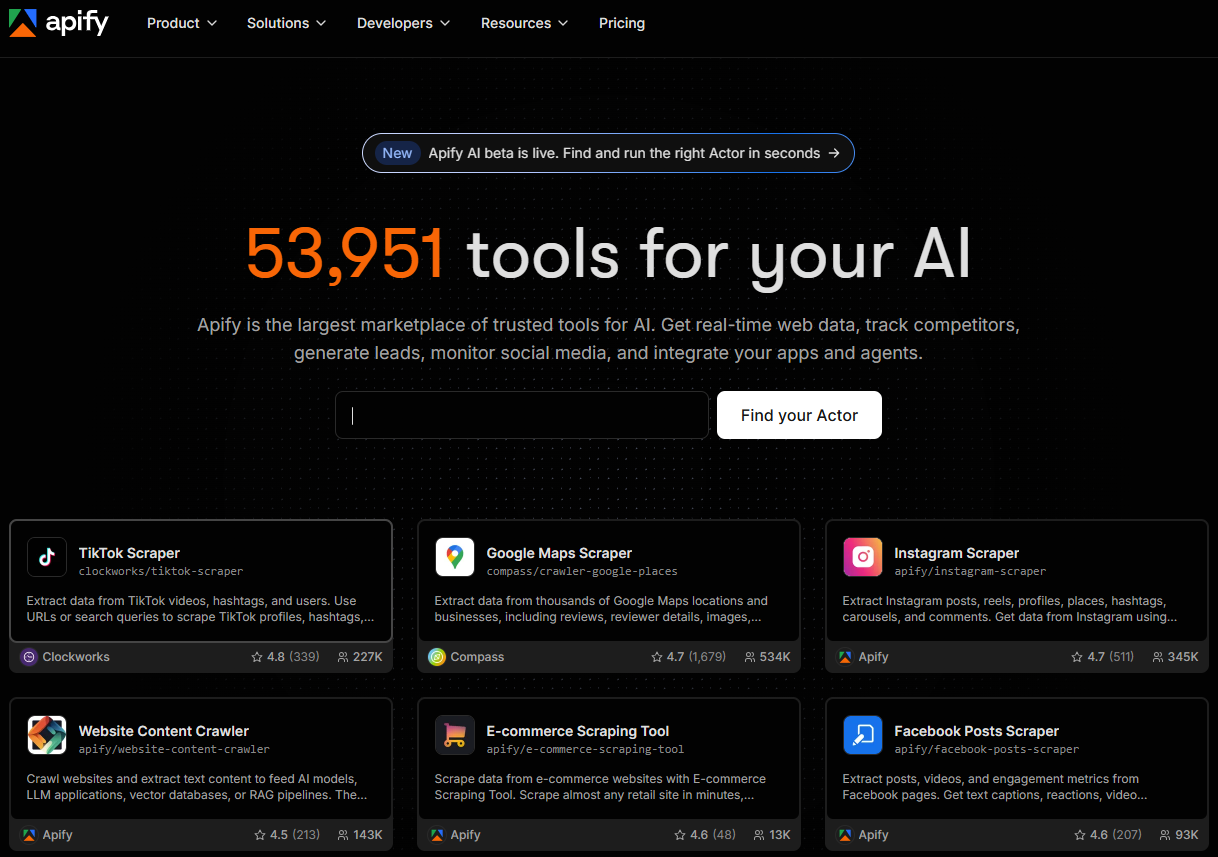
Apify is more of a scraping and automation platform than a pure SERP API. It runs on an Actor marketplace, where each Actor is basically a custom-built scraper for a specific source, covering virtually all search engines and social media platforms.
For SERP work, that means multiple Google and Bing Search Actors, depending on which one you pick. They return structured JSON across organic results, ads, related queries, PAA, Knowledge Graph, and sometimes AI Overviews too.
There’s a free tier with $5 in monthly platform usage included. Starter plan starts at $29/month and Scale at $199/month; both grant prepaid usage credits, with any usage beyond that billed automatically as pay-as-you-go.
Google Search Actors are priced based on system resources (Compute Units) and custom developer fees. Top-tier community and optimized HTTP Search Actors are highly cost-effective, ranging from $0.13 to $1.00 per 1,000 searches, depending on feature depth.
Pros: the marketplace setup gives you multiple SERP Actors at different price and feature levels to choose from. Also, the platform goes way beyond SERPs into e-commerce, social, and lead-gen scraping. Python and JavaScript SDKs are available too for custom automation.
Cons: You have to sort through multiple competing Actors and check feature coverage yourself. And AI Overview plus general SERP parsing depth depends heavily on the specific Actor, so quality is not equally consistent across the board.
Best for: teams running broader automation workflows where SERP scraping is just one part of the stack, and where having a marketplace of ready-made Actors plus custom Python or JavaScript orchestration is actually useful.
ScrapingBee for parsed SERP feature depth
ScrapingBee is another SERP API provider with a Google Search endpoint that returns parsed organic results, sitelinks, publication dates, PAA answers with full text, and AI Overviews. Two main request types are available: light requests at 10 credits (the default) and regular requests at 15 credits, which returns more organic results and adds AI Overview detection.
Monthly plans start at $49.99/month for 250,000 credits. Since each Google Search API call costs a flat rate of 25 credits, the starter plan yields 10,000 queries (roughly $4.90 per 1,000 requests).
Rates drop significantly on higher tiers, which scale up to $599.99/month. You can find the complete list of credit multipliers and subscription levels on the official ScrapingBee Pricing page.
Pros: self-reported 100% success rate and 3.70-second average response time. The two request modes also make cost control easier, since teams can choose depth per query instead of paying the same rate every time.
Cons: coverage is still very Google-first, so it does not have the same multi-engine breadth as SerpApi or DataForSEO. The credit model also needs a bit of attention, because light and regular mode are priced differently.
Best for: Google-first workflows where parsed SERP depth matters more than engine breadth, especially when teams want some control over cost by switching between light and regular request modes.
SearchAPI.io: best for compliance-conscious commercial workflows
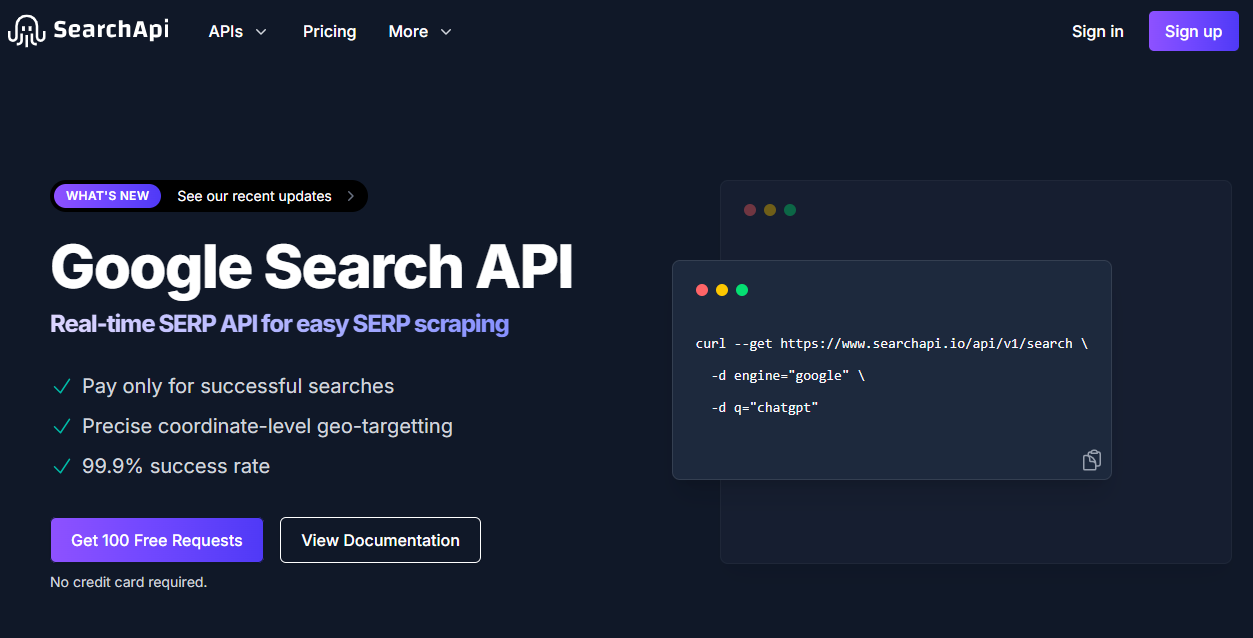
SearchAPI.io provides coverage across 20+ search engines, including Google, Bing, Baidu, Yandex, and YouTube. It also returns parsed JSON output, along with AI Overview extracts. The platform boasts a 99.9% SLA, and for compliance-focused teams, their plans offer legal protection coverage of up to $2 million.
Your first 100 requests are free. After that, the Developer plan costs $40/month for 10,000 searches and $4 per 1,000. Production is $100/month at $3 per 1,000. At 5 million searches a month, costs go down to the range of $1 per 1,000, but each plan puts a cap of 20% of the monthly credits to be used per hour, so burst-heavy workloads are limited.
Pros: legal protection of up to $2M (Production tier and above), a reported 99.9% SLA, broad search engine coverage, and clean documentation.
Cons: The hourly credit limit can restrict burst usage and the Legal Protection Guarantee is only available on higher plans, along with extra features like Search Analytics.
Best for: Compliance-heavy enterprises that need legal protection and reliable SLAs, and have consistent search requests rather than sudden traffic bursts.
Serper for high-volume, low-cost Google SERP retrieval
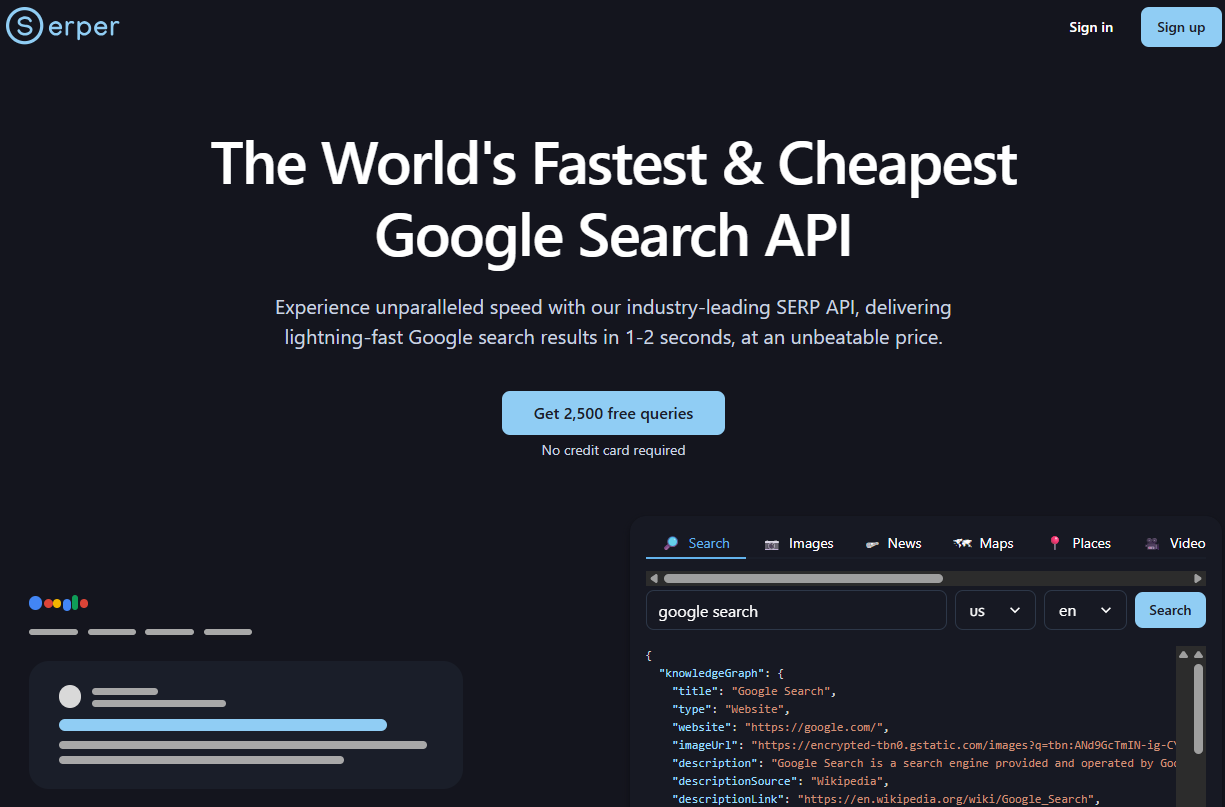
Serper is a great Google-focused choice for teams that need a cheap, fast solution for retrieval at scale. It parses organic results, featured snippets, People Also Ask (PAAs), and Knowledge Graph panels, and returns output in JSON format for all of these elements.
High-volume usage makes the per-call cost drop as low as $0.30 per 1,000 calls, while keeping latency fast at around 1–2 seconds. However, Serper does not extract page content or synthesize AI answers.
Their credit packs offer discounts based on volume. Starter costs $50 for 50,000 credits ($1.00 per 1,000), and the price drops as you buy larger packs. For the Standard, Scale, and Ultimate packs, you pay $375 ($0.75 per 1,000), $1,250 ($0.50 per 1,000), and $3,750 ($0.30 per 1,000), respectively. New users are also given 2,500 free credits and the credits are valid for 6 months.
Pros: very low per-call cost at high volume, fast latency, solid basic SERP parsing, and credits that last 6 months instead of expiring monthly.
Cons: no support for engines beyond Google, no content extraction from pages, no native AI answer parsing, and if more than 10 results are requested, the credit cost per call doubles. The lowest pricing rates require a large upfront financial commitment.
Best for: Google-centric setups running lots of queries, with fast responses, low cost, and volume-based calls prioritized over broader engine support.
Zenserp: best Bing SERP API for leaner developer workflows
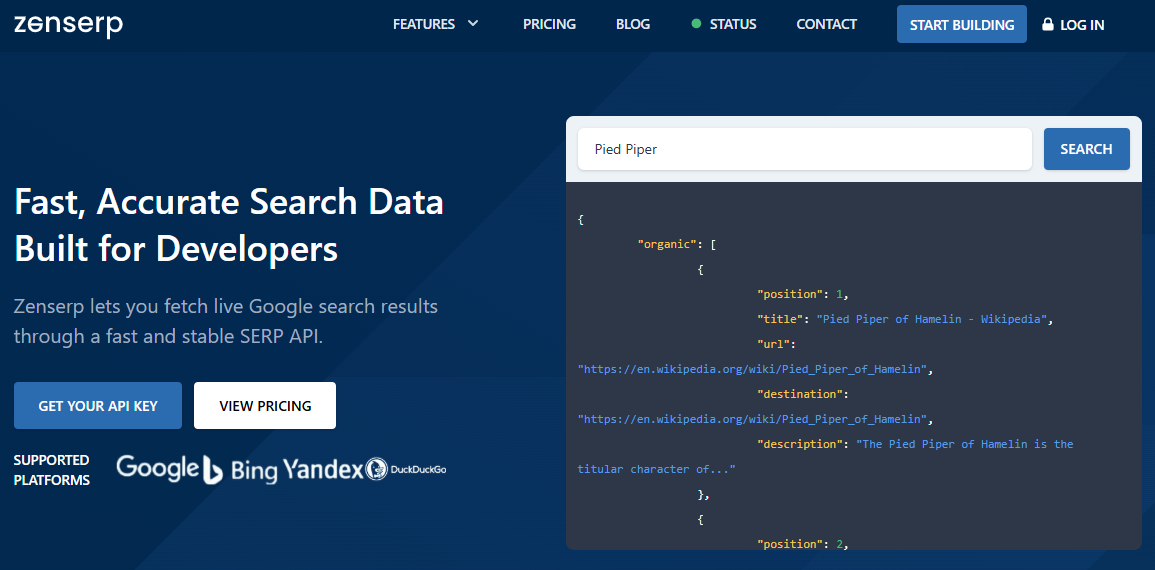
Zenserp is a SERP API geared more toward lean developer workflows. The entry price is lower than most of the bigger names, there’s a free tier with 50 searches a month, and the overall feature set stays pretty focused.
It covers Google, Bing, Yandex, Baidu, Yahoo, DuckDuckGo, and Naver, with separate endpoints for Google Trends, Images, Maps, Shopping, News, and even YouTube. Only successful responses count against the quota.
It also offers a pretty appealing freemium plan with 50 requests per month, so it’s really easy to check it out before committing to larger-volume plans.
Paid plans start at $49.99/month for Small (25,000 searches) and scale from there up to $899.99/month for higher-volume tiers. Annual billing cuts the price by 20%, and it’s worth noting that SLA-backed support only shows up on the higher plans.
Pros: low entry price, a genuinely usable free tier, broad engine coverage across 7+ search engines, simple HTTP-client integration in most languages, and billing only for successful responses.
Cons: parsing depth is lighter than SerpApi or DataForSEO, especially around AI Overviews and Knowledge Graph results. SLA coverage is only documented on the higher-volume tiers. The top plan also caps out lower than what you usually see from enterprise-focused competitors.
Best for: lean teams testing or prototyping SERP workflows at low volume across multiple engines and Google verticals (Trends, Images, Maps, Shopping, News).
Provider | Best for | Engines | AI Overview | Avg response | Starting price | Free tier |
SerpApi | Multi-engine + real-time | Google, Bing, Baidu, Yahoo, Yandex, DuckDuckGo, Naver, YouTube + others | Yes (dedicated endpoint) | Real-time | $25/mo (Starter, 1K searches) | 250 searches/mo |
DataForSEO | Pay-as-you-go engineering teams | Google, Bing, Yahoo, Baidu, Naver, YouTube, Seznam | Yes (parsed field) | Live up to 6 sec; Standard ~5 min | $0.60 per 1K (PAYG, $50 min deposit) | $1 credit on signup |
Scrapingdog | High-volume, low cost | Google + Bing | Limited | 1.83 sec (self-reported) | $40/mo (Lite) | 1,000 credits |
Apify | Custom automation workflows | Varies per Actor (Google + Bing) | Depends on Actor | Varies per Actor | $29/mo (Starter) | Free plan, $5 prepaid usage |
ScrapingBee | Parsed SERP feature depth | Google-focused | Yes (regular mode) | 3.70 sec (self-reported) | $49.99/mo (Freelance) | Free trial |
SearchAPI.io | Compliance-conscious commercial | 20+ (Google, Bing, Baidu, Yandex, YouTube, Yahoo, DuckDuckGo + more) | Yes (dedicated endpoint) | Not specified | $40/mo (Developer) | 100 free requests |
Serper | High-volume Google-only | Google only | Not specified | 1–2 sec | $50 (Starter, 50K credits) | 2,500 free credits |
Zenserp | Lean prototyping, broad engines | Google, Bing, Yandex, Baidu, Yahoo, DuckDuckGo, Naver | Limited | Not specified | $49.99/mo (Small) | 50 searches/mo |
The Importance of Proxy Infrastructure
Even the best Google SERP API tools don’t magically remove all the common challenges associated with scalable data collection. This is why any serious web workflow stack will always layer in a proxy infrastructure to the mix.
Request success rates, location precision, repeated checks, and the cost per successful query are all crucial factors for most teams. Even more so since search layouts keep changing and Google now surfaces richer modules such as AI Overviews and shopping-focused result pages.
With reliable proxies for SERP, teams can run their workflows with more control over geography, sessions, and rotation than any single platform can provide. In fact, proxies will often decide how well any of those workflows hold up once scale enters the picture.
Proxy-Seller: best proxy provider for SERP workflows
Proxy-Seller is one of the top proxy providers for SERP monitoring, data collection, and web automation workflows, with a 47M+ residential IP pool, along with mobile, ISP, and datacenter proxies.
We support geo-targeting across 220+ locations for teams that need tighter control over their SERP workflows.
Each proxy type fits a different kind of SERP workflow. Residential and mobile proxies work better for geo-sensitive search tasks, rotating sessions, and workflows that need IPs to be dynamic. ISP and datacenter proxies work better for repeatable requests, and workloads where speed and subnet diversity are more important than real-device IP identity.
It’s common for development, marketing, and SEO teams to outgrow standard, fixed-interface tools and start building their own custom monitoring systems and dashboards. SERP APIs handle the structured data outputs with this, but it’s proxy infrastructure that gives teams control over how their requests are routed and analyzed across Google, Bing, and other public web sources.
Best for (use cases):
- Custom SERP monitoring scripts
- Geo-specific Google and Bing search checks
- Rank tracking across multiple locations
- Monitoring shopping results and competitors
- Large-scale public web data collection
Choosing the best SERP API for your tasks is still crucial, but proxy infrastructure enhances the stability and cost-effectiveness of the API in a production environment
Beyond just SERP analysis, proxies are essential for nearly every web-related activity. They help teams track rankings, conduct market or competitor research, monitor shopping results, scrape Wikipedia, scrape GitHub repositories, and the list goes on.
Teams use Proxy-Seller to strengthen SERP workflows with residential, mobile, ISP, and datacenter proxies across 220+ locations.
Proxy-Seller gives teams clean proxy pools for production SERP workflows.Contact our sales team.
Key considerations for choosing the best SERP API
The easiest way to choose the best SERP API starts with your workflow, not the vendor or category. Here are a few simple criteria that usually narrow down your options quickly:
- Search engine coverage: which search engines do you need? If you need Bing, choose a vendor with a Bing API, like Zenserp. If your workflow is mostly Google, focus on Google SERP APIs.
- Result types: make sure you choose an API that covers the types of output you need, whether it’s organic results, ads, shopping, maps, news, images, or People Also Ask.
- Request model: live requests make sense for dashboards and quick spot checks, while Queued or async jobs are the better fit for large-scale requests.
- Geo-targeting: if local SERP is important, make sure the API can actually mirror the conditions you need, be it country, city, language, and/or device.
- Integration fit: prioritize docs your team can get through fast, response formats that don’t randomly change, and SDKs that fit the stack you already run.
- Production controls: choose a provider with favorable rate limits, error reporting, retry logic, logs, and pricing based on successful requests.
The best SERP scraping API is the one that matches the data source, result type, and request model your team needs. And whichever provider you go with, the next step is to support it with a reliable proxy layer that gives you clean pools, endpoint-level logs, error taxonomy data, and visibility into blocked vs retriable requests.
If your workflow also includes crawler-based audits, a Screaming Frog review can help your team compare where crawling tools stop and where SERP APIs become necessary.
Build a smarter stack in 2026
The best SERP API platform provides much more than simple search results. It gives your team structured data that feeds your workflows, be it rank tracking, market research, shopping intelligence, and so on.
The strongest setups then combine it with reliable proxy infrastructure that provides stable connections that use mobile, residential, or datacenter networks, with rotating IPs and extensive geo-targeting.
FAQ
Not always. For small API-only workflows, collection is usually handled by the SERP API provider. But once your team starts running custom SERP scripts, checking results independently, monitoring multiple locations, or collecting public web data outside the API, proxies start to become relevant again. In this case, they are crucial for maintaining clean proxy pools, endpoint-level logs, and error taxonomy data.
SERP API pricing usually comes down to request volume and the specific parameters of the request such as the search engine, the result type, and the location settings, as well as whether the request is processed live or queued. The lowest advertised price is not always the best offer. Incomplete data, poor location accuracy, and high request failure rates all contribute to increased costs through manual intervention, data validation, and retries. LSo compare cost per usable result, not just the number on the pricing page.
The Best SERP API for Google and Bing is one that takes both search engines seriously. Now that Microsoft's official Bing Search APIs are retired as of August 11, 2025, support for Bing has become more important. If Bing is a part of your reporting, make sure the provider you choose actually supports it properly, with dedicated endpoints, structured JSON, and controls for location, language, device, and result type.
The best SERP API for Google really depends on what you need from the data. If you only need organic listings to track rankings, a simpler provider will be enough. For more complex SEO workflows, you will need support for ads, shopping, maps, news, PAA, featured snippets, device/type targeting, and location-level results. The best provider is one that gives your team clean structured data without forcing a lot of extra parsing work.
PROXIES FROM $0.02/IP
Ready to put this into practice?
Pick a proxy type and location, and start using it within minutes.
Instant delivery
24/7 support
Refund policy
About the author