 Proxy for Telegram
 Proxy for LinkedIn
 Proxy for Google
 Proxy for Ebay
 Proxy for Twitter
 Proxy for TikTok
Best rank tracker with API: top Google rank solutions 2026

Choosing the best rank tracker with API in 2026 starts with the changes that shook up the game in 2025. In September, Google killed the num=100 parameter, and tools that fetched 100 positions in a single request suddenly started costing ~10× more.
That cost change has a different impact on different teams. An in-house SEO checking rankings on a dashboard and sending weekly reports just sees the monthly bill climb ~10×. An agency that reports on 50+ client domains, or an AI team that builds products based on SERP data, has to redesign an entire infrastructure.
And position tracking alone is now obsolete. BrightEdge data shows that AI Overviews trigger roughly 48% of tracked queries. So if the API fails to parse AI citations, it misses almost half of the visibility picture.
What changed in 2025 and what it means for 2026
The three big shifts in 2025 changed how we calculate the cost of rank tracker APIs. Google removed the num=100 parameter in September, which meant trackers that grouped the top 100 positions had to paginate their requests and increased the number of requests ~10×. For instance, to perform a 50,000-keyword top 100 search, the tracking job jumped from 50,000 to 500,000 requests.
Microsoft retired Bing Search APIs on August 11. The replacement, Grounding with Bing in Azure AI Agents, costs 40–483% more for equivalent volume, at $35 per 1,000 transactions.
Finally, on December 19, 2025, Google sued SerpApi over alleged DMCA violations and SearchGuard circumvention. SerpApi filed a motion to dismiss on February 20, 2026, arguing Google lacks DMCA standing because it doesn’t hold copyright over indexed content. The hearing on this motion took place on May 19, 2026, but the judge has not yet issued a final ruling. This ongoing legal uncertainty remains a critical factor for anyone planning to sign an annual contract this quarter.
What to look for in rank tracking API
Past the marketing pages, there are 5 key criteria you can assess when determining whether a rank tracker API scales up properly. When evaluating market leaders, use this as a rough checklist before purchase:
Geo-targeting depth: Can you specify requests at country, city, zip, device, and language levels? Country-only coverage is fine for global brand monitoring, while city and ZIP are required for local SEO, marketplace, and ad verification work.
SERP feature parsing: Do AI Overviews, featured snippets, video carousels, local packs and PAA boxes come as parsed fields in the JSON? If your API only returns position numbers for the ten blue links, it is only tracking 50% of the SERP.
Schema stability and integration: Are field names consistent across updates? Does the company provide SDKs in Python, Node, and Go along with webhooks and direct integration into Sheets, BigQuery, and Looker? Schema drift can destroy agency dashboards and AI pipelines the moment Google adds a new SERP feature.
Refresh cadence and history: How often does the API check a tracked keyword (daily, hourly, on request), and how far back does historical data go? Quarterly reviews are of little use if you’re missing data for the last 12 months. For marketplace tracking, the API should update in real-time.
Pricing model and rate limits: Is it a per-call or per-keyword pricing model? Are there concurrency caps or an overage policy? After the num=100 removal, virtually all per-call pricing has been adjusted, so check the new pricing against your actual volume.
Tracking AI Overviews
According to BrightEdge’s One-Year Mark study, AI Overviews have begun to trigger on roughly 48% of tracked queries. That’s why a website ranking API that doesn’t read AI Overviews as structured data is monitoring a much smaller and continuously shrinking part of the SERP.
When it comes to evaluating an API for AIO, three things are most important:
Presence detection: does the API flag when an AI Overview is triggered on a query?
Citation parsing: does it return the URLs cited inside the AIO as structured fields to help you analyze your citation and organic position?
Position within the AIO: does it show if your URL is the first cited source, the third, or not included at all?
For AI visibility workflows, teams can also use the ChatGPT API with Python to summarize citation changes, classify shifts in AIO, and convert SERP movements into easy-to-read reporting notes.
The all-in-one platforms on our list (AccuRanker, Semrush, SE Ranking) started rolling out AIO dashboards in 2025. Raw SERP APIs (DataForSEO, SerpApi) return AIO as a parsed JSON field that the team will use to interpret their own reports.
Best website ranking API solutions
Picking the best rank tracker with API in 2026 splits into one of two main architectures, mapped to the main buyer profiles:
All-in-one SEO platforms with API access include a dashboard, a project setup, a reporting feature, and the API as an add-on to help move data into BI and other internal tools. Best when your team wants reporting out of the box and views the API as an extension. The tools in this category are Semrush, SE Ranking, AccuRanker, and Keyword.com.
Raw SERP data APIs return parsed Google results as JSON and nothing more. No dashboard, no projects, no email digest. Best when your team is building its own reporting layer or feeding SERP data into a product. The tools in this category are DataForSEO, SerpApi, and GeoRanker API.
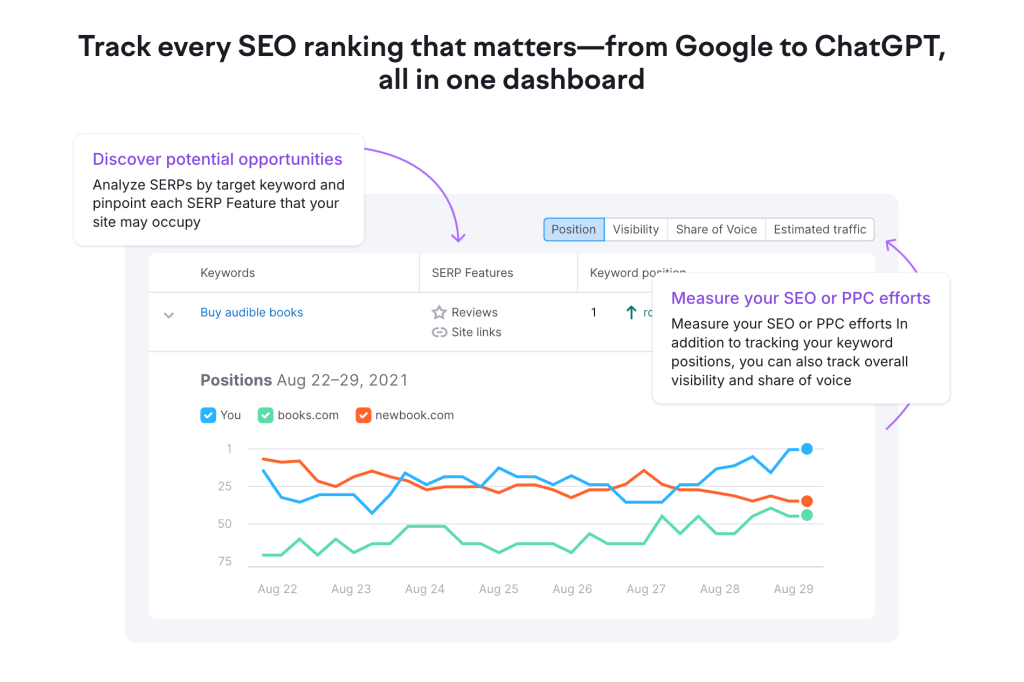
Semrush Position Tracking API
Semrush is the safest pick for teams that are already in the Semrush ecosystem and want to integrate their reporting into their tech stack. API access is locked behind the Advanced tier ($549/month) or the custom Enterprise tier. The SEO ($139.95) and Pro+ ($299) tiers don’t include it.
The Advanced tier opens up access to the Position Tracking API, supporting up to 5,000 tracked keywords across 40 projects inside the interface and providing historical data. However, it includes zero API units by default; all data requests require API unit packages to be purchased separately as an add-on. The ranking data is refreshed daily by default.
This is a great option for enterprise agencies who prioritize stable reporting and do not need extensive control over SERPs. So if you’re looking for the best rank tracker with API that leans more toward control than convenience, this is probably not the right choice for you.
Best for:
Teams that have already set up projects in Semrush and want the same data in other Business Intelligence (BI) or Looker Studio.
Workflows that integrate data from multiple sources, of which the SERP data is only one source.
Reporting against fixed keyword lists, not raw SERP exploration.
SE Ranking API
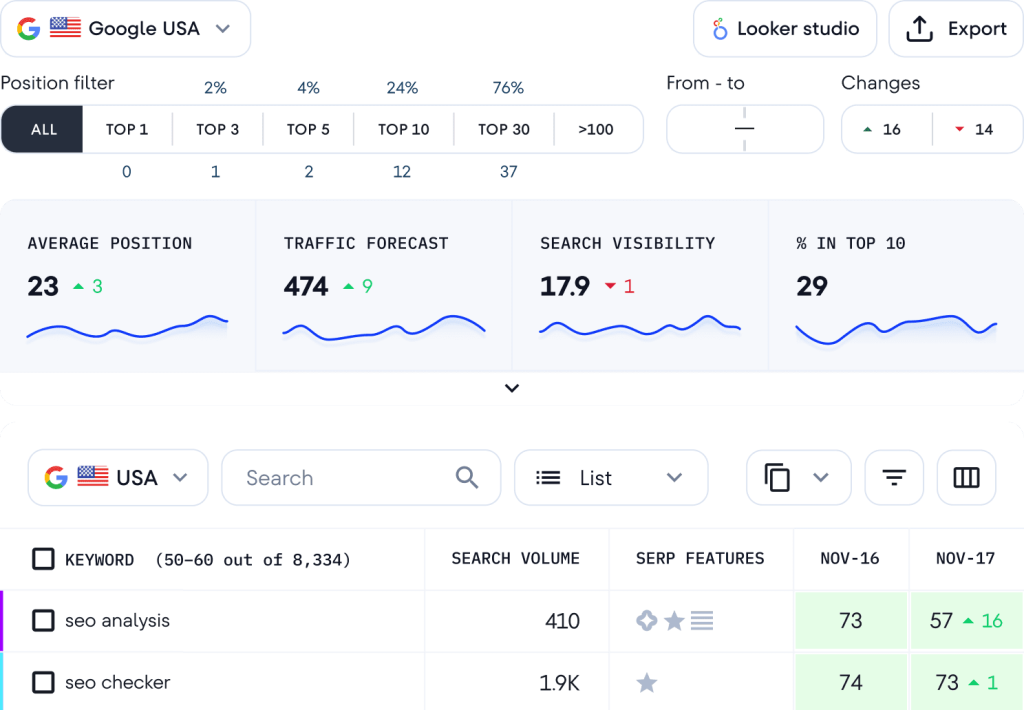
SE Ranking sits one rung below Semrush on both price and complexity, with a cleaner Core/Growth API add-on for teams that don’t need full enterprise solutions.
For most mid-market teams looking for the best rank tracker with API at agency-friendly pricing, this is often where the search ends. For $149/month (paid annually), the API add-on comes with 100,000 credits. SERP tasks, keyword data, backlinks, and on-page audits are each priced separately.
Daily refresh standard, on-demand available. Credits don’t expire, but overage rates aren’t publicly disclosed, so be mindful of your usage as volume grows.
For teams seeking a simpler, more straightforward SEO platform, this is an excellent choice. More structure than a standalone SERP feed and more flexibility than dashboard-only tools.
Best for:
Mid-market agencies running 10–50 client domains that need API access without enterprise procurement
In-house teams that want keyword grouping, competitor tracking, and audits in one platform
Reporting pipelines into Google Sheets or Looker Studio
AccuRanker
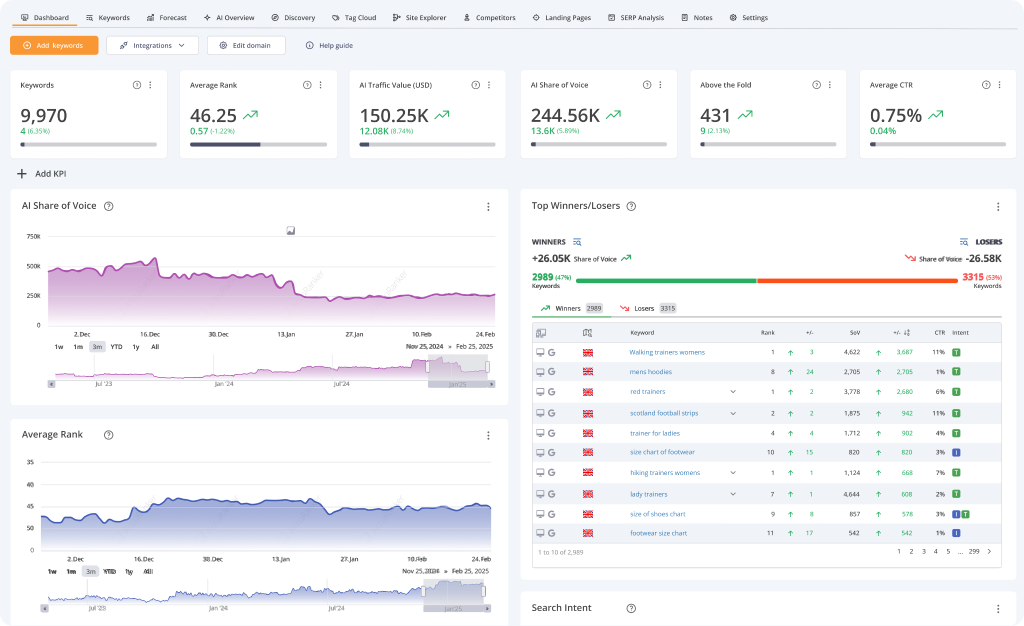
AccuRanker is the speed leader in the all-in-one category, with full domains set for re-checks every two hours, and individual keywords refreshing whenever a user requests it. AccuLLM ships in the same plan tier and tracks ChatGPT, Perplexity, Google AI Mode, and AI Overview citations.
API access requires the Expert tier (€764/month annually for 10,000 keywords), while the lower tiers (€224/month yearly for 2,000 keywords) cover the dashboard and reporting side, but not programmatic access.
There are direct integrations of BigQuery and Looker Studio, and white-label reporting included on agency plans.
Best for:
Agencies needing same-day reporting on rank changes for client campaigns
Daily reporting workflows where fresh data is more important than cost control
Multi-domain tracking with white-label client reports
Keyword.com
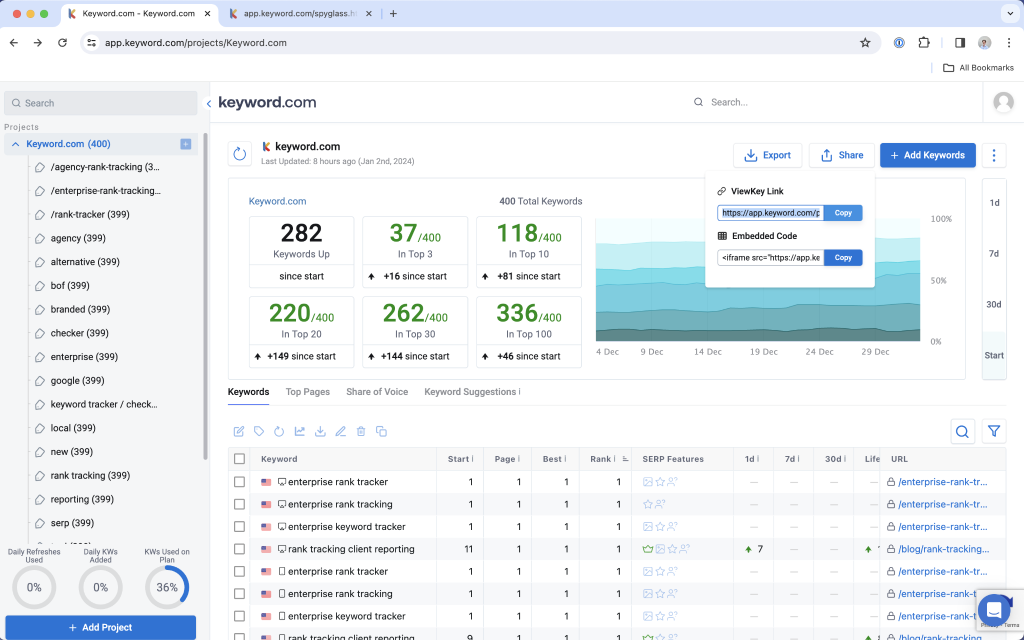
Keyword.com is the budget-friendly entry in this category, particularly for agencies that need to track numerous keywords for multiple clients.
The Rank Tracker API starts at just $46/month for 5,000 keywords. It comes with third-party verified accuracy down to city and ZIP-code level, offers unlimited website tracking, and gives users access to site’s SERPs for the last 30 days.
Users can test out the product with a 14-day free trial that comes with API access and 100 keywords per day as well as 20 AI Visibility credits.
Best for:
Agencies that bill per-keyword and need to scale headcount without cost increase
Local SEO workflows that need ZIP-level precision
Teams replacing a more expensive vendor without losing tracking depth
DataForSEO
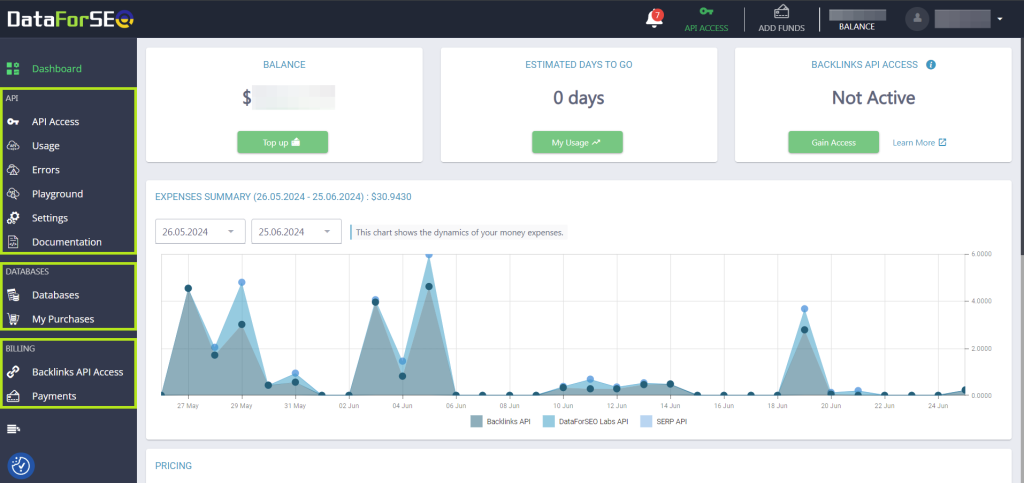
DataForSEO is the broadest raw-SERP API with a clear pay-as-you-go model.
Standard Queue starts at $0.60 for 1,000 queries (about 5-minute turnaround), Priority Queue at $1.20 for 1,000 (about 1 minute), and Live Mode at $2.00 for 1,000 (real-time).
You won’t find a subscription; there is a $50 minimum deposit, and the base cost covers only the first 10 results. Pulling deeper data or adding parameters further increases the cost. Across all endpoints, the output is normalized to JSON, with built-in schemas for AI Overview, AI Snippet, PAA Boxes, and Local Packs.
Teams building internal SEO tools can also connect this output to engineering workflows through the Python GitHub API, for example, by automatically creating issues on QA when the rankings, AI attributions, or SERP features have changed.
That flexibility is definitely an advantage, but it also invites complexity. To make it work, you’ll need more implementation and QA work, and a clearer data model on your side. But for technical teams looking for the best Google rank tracker API, this platform is absolutely in the conversation.
Best for:
Engineering teams that want to build an internal monitoring product with SERP data
Workloads with predictable per-call volumes (the math beats subscriptions above roughly 50K queries/month)
Teams that need parsed AI Overviews and modern SERP features as structured fields
SerpApi
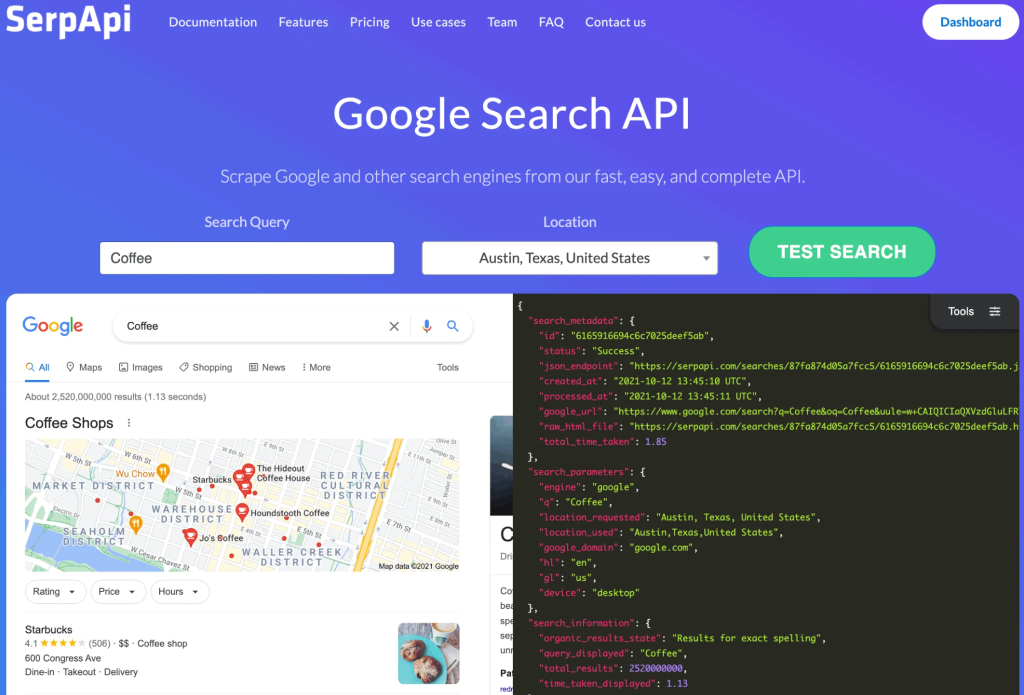
SerpApi specializes in live, real-time scraping with structured JSON across Google plus dozens of other search engines. Plans start at $75/month (Developer, 5,000 searches), scaling to $3,750/month (Enterprise, 100,000 baseline).
Costs only account for successful searches. Unused searches don’t roll over to the next month, while failed searches and cached requests do not count.
Procurement note: In December 2025, Google filed suit against SerpApi, alleging DMCA violations and circumvention of SearchGuard, Google’s anti-scraping technology deployed in January 2025. SerpApi filed a motion to dismiss in February 2026, and the case is still ongoing.
As a risk management strategy, you should have a backup vendor in mind, since Commercial contracts take into consideration the vendor-continuity risk.
Developers can pull fresh search results, identify domain positions, and feed the raw terminal output into custom dashboards, alerts, or reporting workflows. That said, for search-monitoring suite capabilities, your team will still need to manage storage, create comparison logic, determine trends, report them, and set monitoring alerts.
Best for:
Teams that need fresh, live SERP retrieval over the cached/queued model
Multi-engine workflows (Google, Bing, Baidu, Yandex, DuckDuckGo, etc.)
Rapid development requiring search engine data more than cost-per-query pricing
GeoRanker API
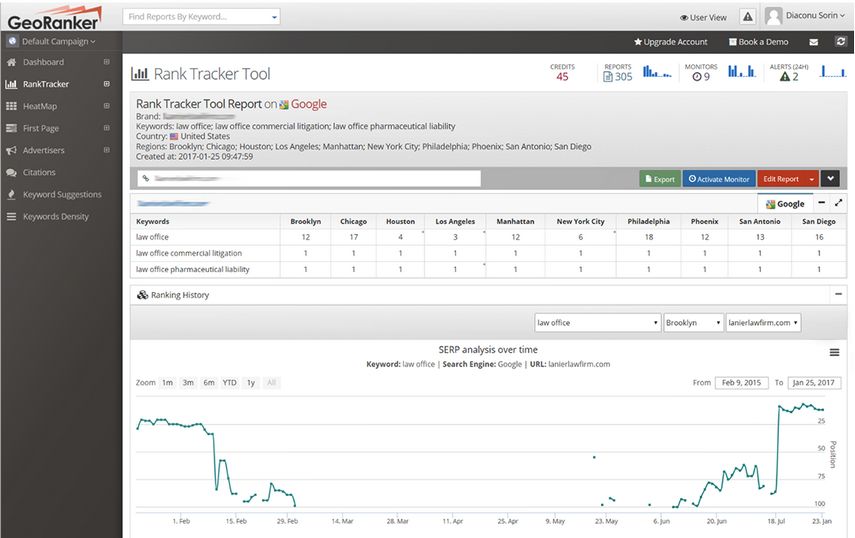
The GeoRanker API is designed specifically for SEO and geo-targeted rank tracking. Plans start at $99/month, with the Enterprise tier at $490/month covering 1,500 keywords, and there’s a 7-day free trial available.
The API operates on a credit basis, and the cost of reports vary based on keywords, locations, devices, and engines. For example, tracking 5 keywords in 5 cities on 2 engines consumes 50 credits. It’s also backed by 50,000+ local IPs for SERP location precision.
Best for:
Local SEO agencies tracking rankings across cities, ZIP codes, or hyper-local markets
Brands that want to monitor search results that differ across their different regions
Workflows that need device-specific rankings (mobile vs desktop) at city granularity
What proxies add on top of a rank tracker API
A rank tracker API’s reliability depends on how good the scraper pool beneath it is. If Google blocks the provider’s scraper IPs, the API continues to show normal responses, but the ranking data is either stale or missing, and the gap will not be flagged on the tool’s dashboard.
By running web tracking via a dedicated proxy infrastructure, the rank API can become more reliable for geo-targeting, session control, and rotation logic.
This won’t turn a proxy platform into a dedicated rank tracking API, of course. However, a dedicated proxy infrastructure supports all your web workflows with geo-targeting, session control, rotation logic, and stability over the long term, particularly with custom APIs and scripts.
Proxy-Seller: clean residential pools and endpoint-level logs for rank tracking
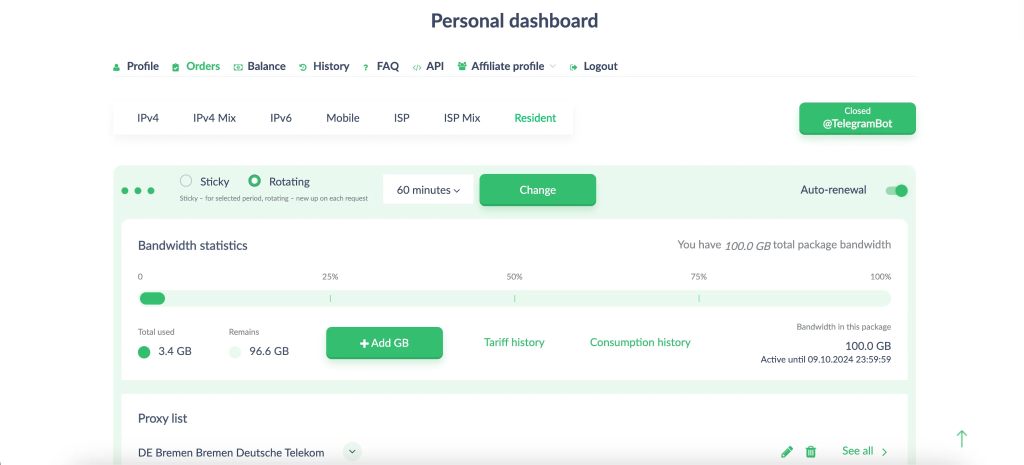
Proxy-Seller is a proxy infrastructure provider that supports data teams in rank tracking, SERP monitoring, ad verification, and AI/LLM data supply workflows. We cover residential, ISP, datacenter, and mobile 4G/5G/LTE proxies, with a residential pool of 47M+ IPs per month, HTTP, HTTPS, and SOCKS5 support, and all four networks billable under one account.
Once your rank tracking system is operational, sustaining it across locations, devices, and bulk requests is your next obstacle. Our API allows you to target residential proxies by country, region, city, and ISP, request IP rotations, and create sticky sessions for workflows that need the same IP across multiple requests.
Each network maps to a different rank tracking job. Residential IPs handle SERP queries that need consumer-grade trust (AI Overviews, local packs, geo-sensitive pages). ISP proxies are perfect for retaining a session to complete a multi-step workflow. Datacenter proxies support large SERP scraping jobs. Mobile proxies cover the toughest mobile SERP queries.
Best for:
Tracking SERPs across 10+ geos when the vendor API’s coverage is too shallow or too expensive
Running custom SERP scrapers that need stable IP rotation and in-house direct control
Verifying vendor rank data against an independent collection layer for QA or audit purposes
Increasing the number of rank check queries beyond the limitations of a subscription-based API
Run your rank tracking on proxies you control, not the vendor’s.Buy proxies from Proxy-Seller with a 24h sales response SLA and same-day sandbox access.
Which rank tracker API should you choose?
Choosing the best rank tracker with API depends on the structure you need, how often you need to refresh your workflow, and your upper spending. Here’s how the seven tools stack up:
Tool | Architecture | Refresh cadence | Starting price (API access) | Best for |
|---|---|---|---|---|
Semrush Position Tracking API | All-in-one platform | Daily | $549/mo (Advanced tier required) | Teams already in Semrush extending data into BI |
SE Ranking API | All-in-one platform | Daily, on-demand available | $149/mo (Core/Growth API add-on) | Mid-market agencies needing platform plus programmatic access |
AccuRanker | All-in-one platform | Daily, 2-hour full domain refresh, on-demand per keyword | €764/mo (Expert tier required) | Agencies needing swift rank alerts and white-label reporting |
Keyword.com | All-in-one platform | Daily and weekly | $46/mo (5K keywords, API access) | Per-keyword scaling at budget-friendly cost |
DataForSEO | Raw SERP API | Standard ~5 min, Priority ~1 min, Live real-time | $0.60 per 1K queries, $50 min deposit | Engineering teams with predictable per-call volumes |
SerpApi | Raw SERP API | Real-time | $75/mo (5K searches) | Live retrieval and multi-engine workflows (factor vendor risk) |
GeoRanker API | Raw SERP API | Per-query (credits) | $99/mo entry, $490/mo enterprise (1,500 kw) | Local SEO across cities, ZIPs, or multi-location brands |
Wrapping up
Quick read by buyer profile:
In-house SEO teams: SE Ranking and Semrush offer dashboards and API as an extension layer without going through enterprise procurement.
Agency tracking 10+ client domains: AccuRanker if reporting speed is a concern, Keyword.com for cost-effective options, and SE Ranking is the middle option.
AI or engineering team piping SERP data into a product: DataForSEO for pay-as-you-go raw data, and SerpApi if multi-engine support justifies the vendor-continuity risk.
Local SEO across cities or ZIP codes: GeoRanker API for geo-precision, or Keyword.com if the general SERPs are also a consideration.
Whichever you pick, remember that once volumes scale past the trial phase, stable proxy infrastructure becomes the layer that decides whether the data still makes it through.
In 2026, the best rank tracker with API does a lot more than simple reporting, and gives an overview of every market, device, and keyword set your teams are working with.
Your best course of action is to try a 30-day parallel pilot with your top two candidates against your actual keyword sets, rather than the vendor demo sets. Then measure the valid response rate per geo, refresh latency under load, AI Overview citation parsing completeness, and cost per 10,000 queries.
FAQ
Public Google results are not automatically off-limits under US law just because they’re scraped. The hiQ v. LinkedIn ruling helped narrow the scope of the Computer Fraud and Abuse Act as it pertains to scraping data available to the public, but scraping data from Google is not totally risk-free. It can still conflict with Google’s terms, and Google’s December 2025 suit against SerpApi shows that it’s willing to pursue providers it says bypass technical protections.
Pricing is based on the architecture of a product. All-in-one platforms with API access run from $46/month at the low end (Keyword.com, 5K keywords) up to €764/month for the AccuRanker Expert tier or $549/month for the Semrush Advanced tier. For raw SERP APIs, DataForSEO charges $0.60 for every 1,000 queries on a pay-as-you-go basis, with a minimum deposit of $50. SerpApi costs $75/month for 5,000 searches. For a high volume of queries (greater than 50,000 queries/month), the per-call pricing is more cost-effective compared to a subscription pricing model.
A rank tracker API works by sending a request including the keyword, search engine, desired location, and the device. The API then returns the keyword’s position in the search engine results page (SERP) in JSON format. Behind the scenes, the provider uses headless browsers or scrapers routed through proxy IPs to fetch the actual results from Google, parse them into structured fields (organic positions, AI Overviews, featured snippets, local packs), and hand them back to you.
The best rank tracker with API in 2026 depends on the architecture. For dashboards and report automation, teams often prefer all-in-one platforms such as Semrush, SE Ranking, AccuRanker, or Keyword.com. For teams that want to build a product that integrates SERP data in the backend, raw SERP APIs like DataForSEO, SerpApi, and GeoRanker are preferred.
PROXIES FROM $0.02/IP
Ready to put this into practice?
Pick a proxy type and location, and start using it within minutes.
Instant delivery
24/7 support
Refund policy
About the author