 Proxy for Telegram
 Proxy for LinkedIn
 Proxy for Google
 Proxy for Ebay
 Proxy for Twitter
 Proxy for TikTok
What is a private proxy? Definition, key uses, and benefits

One IP address can be the difference between a web workflow that runs smoothly and one that keeps getting slowed down by verification checks, blocked requests, or random drops in speed.
That’s why data engineers, SEO ops leads, and ad-verification teams keep landing on the same question after their first pool of shared IPs hits a 20–30% failure rate on SERP or price endpoints: what is a private proxy, and is it actually different from the shared pool they’re using today?
So what are private proxies in practice? Whether it’s data scraping at scale, managing a brand’s social media accounts, or running workflows across geographies, private proxies give one user exclusive control over a single IP.
What is a private proxy?
Let's define private proxy at the operational level. A private proxy, also called a dedicated, is an IP address assigned exclusively to one user, account, or team for a set period. Unlike shared or public proxies, no other users send traffic through that IP at the same time, so the IP’s reputation, behavior, and request pattern depend only on you.
Benefits over public proxies
Because no one else routes through the IP, you control its activity pattern, request volume, geolocation, and session behavior, so that you can predict how a target site will read it.
Private proxies reduce the risks associated with shared IPs, where other users and workflows can trigger blocks, CAPTCHAs, or suspicious traffic patterns, and harm the IP reputation. So if your account or automation process needs consistent access from the same address, that’s exactly the reputation problem a private proxy is built to fix.
Public proxies are open to anyone who uses them, shared proxies are used by several customers, semi-dedicated proxies are split across a smaller group, and private or dedicated proxies are kept for one user or team. The higher up you go, the more control you get over IP reputation, traffic behavior, and session stability.
Buying a private proxy isn’t just an IP-masking purchase: in A/B pilots, dedicated pools deliver +20–30% valid response rate and –20–35% cost per valid response vs shared pools on repeatable workflows.
How is a private proxy used?
To use a private proxy, you must first configure its connection details in your browser, software, or server environment, depending on how you will use it. These details usually include the host, port, protocol, and one of the supported authentication methods:
- The more common option is username + password authentication: you enter the credentials issued by the provider, and the proxy verifies them before routing each request. Rotate the password on a schedule, because it’s the only auth secret an attacker would need.
- The second option is IP allowlisting, where you add your device, office network, or server IP to the provider’s approved list. The proxy then accepts traffic from those IPs only, with no per-tool credentials to manage.
After that, your device or tool sends a request to the proxy server, which then sends the request to the destination website, and the response returns through the same connection path. The website you’re trying to reach sees the private proxy IP address, not yours.
You also need to pick the right protocol. It decides “how” your browser, script, or app sends traffic through the server. So what is a private proxy at the protocol level? It’s an IP plus one of three pipes:
- HTTP works for standard web requests, like opening websites, using SEO tools, or collecting public web data.
- HTTPS proxies handle encrypted traffic directly. HTTP proxies handle encrypted requests only via the CONNECT method. Without it, only plain HTTP works.
- SOCKS5 works on a lower level, so it supports a wider range of traffic, including apps, bots, games, and different kinds of software.
Note that a private proxy hides your IP address at the application layer; it does not encrypt your traffic. Your ISP or network admin can still see request metadata. For data-in-transit protection, rely on HTTPS/TLS or add a VPN alongside the proxy.
The different types of private proxies
Now that we’ve covered the private proxy meaning, it’s important to understand the different types of proxies out there. “Private” describes IP exclusivity. The proxy type describes where the IP comes from, which determines how target sites interpret it.
What is a private proxy at the IP-source level depends on which of these four origins you pick:
Private datacenter proxies
Datacenter proxies are IP addresses hosted in data centers, rather than uniquely assigned to home and mobile users. They run on commercial server infrastructure (typical p95 latency 30–80ms intra-region, multi-Gbps throughput), which is why they’re the cheapest per-IP option.
So what is a private proxy from a datacenter actually good for? Most consumer sites block known datacenter ASNs by default. Datacenter proxies are still okay for B2B endpoints, public SERP scraping, and tools that already allowlist datacenter ranges, but not platforms with mature anti-bot stacks.
Private ISP proxies
ISP proxies are IPs registered with real Internet Service Providers but hosted on stable server infrastructure. This way, they combine the reliability of datacenter networks with IPs registered under real ISP ASNs, the same ASN class target sites use to whitelist consumer traffic.
Private ISP proxies give one user or team exclusive use of such ISP-linked IP connections. Although they come with higher trust and more stable performance than pure datacenter networks, they’re also more expensive.
Worth noting that static and dedicated are not the same thing. Static IPs can stay fixed while still being shared, and a dedicated IP can rotate inside one user’s private pool. ISP proxies are usually both static and dedicated, which is why they work well for stable, long-running sessions.
Private residential proxies
Residential proxies use IP addresses assigned by internet service providers to real household devices. Websites read them as regular home-user traffic, which materially lowers block rates on consumer-facing platforms compared with datacenter IPs.
Residential works differently from datacenter or ISP when it comes to “private.” IPs come and go with the underlying user device, so long-term one-user dedication is unusual. What providers sell as “private residential” typically means one of three things: a sticky session with exclusive access to one IP for a set window (10 minutes to a few hours), a dedicated pool subset where you rotate within a segment reserved for your account, or a repackaged ISP proxy sold under the residential label.
Where residential shines is that the classic “noisy neighbor” penalty from shared IPs doesn't hit the same way. Pool sizes in the tens of millions dilute any single user’s footprint, and rotation swaps identity before target sites can build a behavioral profile. Pool cleanliness and rotation control matter more here than raw exclusivity.
Residential traffic costs more and needs stricter compliance review, so provider choice matters. Proxy-Seller’s residential pool uses consent-based sourcing with explicit opt-in and simple opt-out, plus a 12–24-month chain-of-custody audit trail. DPA and IP provenance documentation are available on request from day one.
Private mobile proxies
Mobile proxies route traffic through cellular networks (4G, 5G, LTE). The technical nuance is that mobile carriers usually share public IPs across many subscribers via CGNAT, so “private” mobile proxies are typically dedicated at the modem/SIM level, not at the public IP.
They fit workflows that need real mobile-carrier behavior, such as app testing, mobile-first SERP checks, and brand social-media management. The trade-off is speed and cost rather than pool size. In Proxyway’s 2026 benchmark, mobile pools posted a median infrastructure response time of 0.96 s against 0.43 s for datacenter, and on hard consumer targets like Amazon, Google, and Instagram mobile averaged 3.67 s per request vs 1.78 s for datacenter.
Mobile earns that latency back where it matters most: median success rate on the same consumer targets was 75.26 % for mobile vs 57.46 % for datacenter, which is why teams reach for mobile when carrier-level legitimacy is the whole point.
IPv4 and IPv6 private proxies
To avoid confusion, IPv4 and IPv6 are different IP address formats, not different privacy models. IPv4 private proxies are widely compatible with most websites and software, and they’re the safer default for most business workflows.
IPv6 private proxies are usually cheaper and easier to scale, but they’re not universally supported. However, if you’ve confirmed that your target websites and tools support it, the best IPv6 proxies can be a much better fit for scalable, high-volume workflows at a lower cost.
Operate stable proxy workflows at scale.Buy private proxies from Proxy-Seller to assign dedicated IPs by account, region, or tool without mixing traffic between projects.
What are the benefits of private proxies over public proxies?
Public proxies are cheaper at first glance, but they are known to create hidden costs through failed sessions, slow response times, blocked accounts, and unstable access. If you’re wondering what is a private proxy good for, the six benefits that matter for production workflows are throughput, ban-risk control, session consistency, access control, scaling, and IP freshness:
- Predictable throughput: public proxies split bandwidth across an unknown number of users; on a private IP, your throughput is bounded only by your own concurrency.
- Lower inherited ban risk: public IPs frequently arrive pre-flagged on commercial denylists (Spamhaus DROP, Project Honey Pot). A private IP starts from your reputation, not someone else’s.
- Better session consistency: account-based platforms watch for IP changes mid-session as a fraud signal. A private static IP keeps the same address across requests. So what is a private proxy actually solving here? Fewer random variables around the IP.
- Stronger access control: username + password or IP allowlisting means only your tools and team can route through the IP, which reduces unauthorized use.
- Easier scaling: teams can assign dedicated networks by account, region, software, and project, which helps isolate problems and match the right proxy type to each workflow.
- Fresh IPs: dedicated IPs in well-run pools haven’t been burned by previous renters, so target sites have no prior bad history to flag against.
So what is a private proxy ultimately giving you across all six? A clean reputation surface you control end-to-end, instead of one you inherit from strangers.
Note: “Private” guarantees exclusive access during your rental period, not that the IP is brand-new. Addresses may carry history from previous renters, so reputable providers vet and quarantine their pools between assignments. IPv6 proxies are the practical exception: the address space is large enough that fresh, unused IPs are the default rather than the exception, and Proxy-Seller offers IPv6 where many providers still don’t. IPv4 provenance documentation at Proxy-Seller is available on request.
Common usage examples of private proxies
What is a private proxy used for in production? Six recurring patterns:
- Web scraping and public data collection: they spread requests across dedicated IPs instead of pushing everything through one address, offering a much higher trust signal to host websites and platforms.
- SEO monitoring and SERP tracking: they let teams check search results and rankings across countries, cities, languages, and devices, keeping each session stable and secure.
- Social media management: agencies and in-house teams use one private proxy per brand or per platform they own, which keeps login behavior consistent and separates traffic across legitimate client accounts.
- Ad verification and affiliate marketing: marketers use them to check ads, redirects, landing pages, and localized offers from the exact regions that they target in campaigns.
- E-commerce and market research: teams track pricing, stock levels, delivery options, and regional storefront variation, including MAP (Minimum Advertised Price) monitoring across marketplaces.
- Corporate access control: companies can route certain workflows only through approved IPs with allowlisting to have more control and enhanced security.
- Fraud & threat intelligence: security teams route access to risky endpoints through separated IP identity, keeping corp egress off suspect lookups and preserving an auditable trail.
- AI/LLM data supply: research teams collect public web data at scale for model training, with documented sourcing and predictable per-IP unit economics.
These private proxy uses all have the same logic: when speed, account stability, or IP reputation directly affects business outcomes, the predictability of a dedicated IP pays for itself within the first month of a serious workflow. For low-volume browsing, private proxies are overkill.
Proxy-Seller private proxies: clean pools, named AM, DPA from day one
The best proxy providers do more than sell IPs, they directly affect six critical outcomes. Pool cleanliness (no traffic mixing), subnet diversity (so targets can’t pattern-match your traffic), geo accuracy, routing stability, support response time (hours vs days), and compliance documentation.
Proxy-Seller is a infrastructure partner for data engineering, SEO ops, and ad-verification teams in the $1K–$10K MRR band that need dedicated IP access, clean pools, geo-targeting, and stable routing.
It supports datacenter, residential, mobile, ISP, and IPv4/IPv6 proxies in one account.
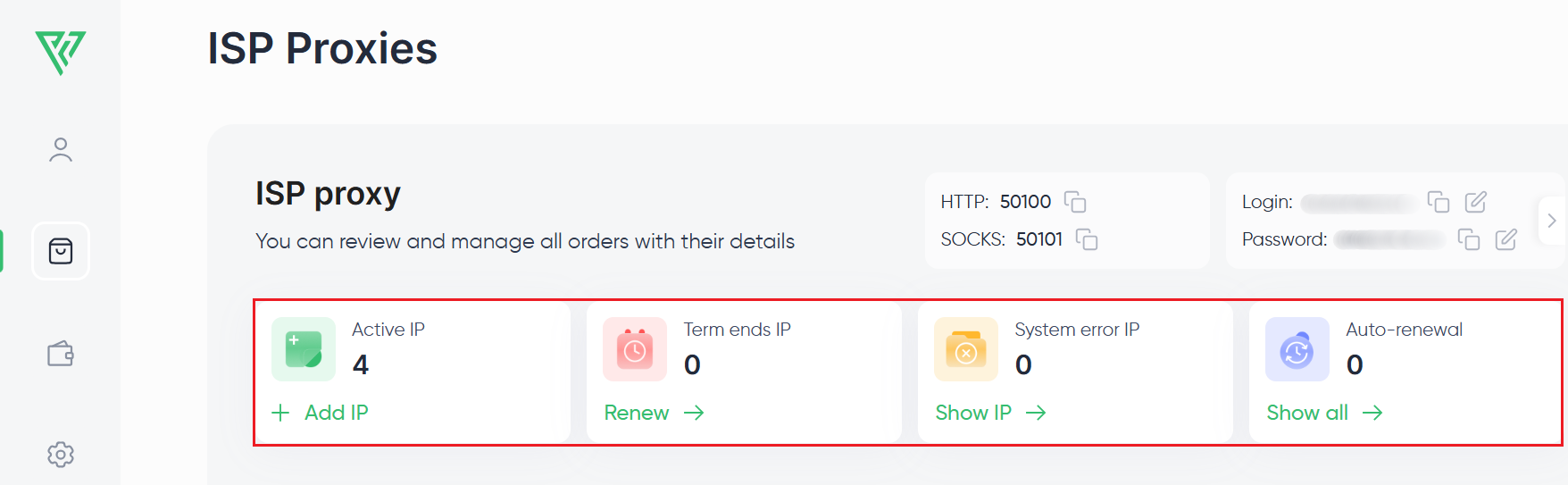
Setup supports both username + password and IP allowlisting, plus HTTP(S) and SOCKS5, covering everything from a Selenium-based scraper to a partner integration that requires an allowlisted egress IP.
Proxy-Seller provides DPA documentation and compliance materials, with IP provenance documentation available on request.
Proxy-Seller’s dedicated infrastructure is built for stable, high-volume workflows. It’s backed by a 24h sales support response SLA and a 4.8 / 5 rating on G2.
Teams from $1K MRR get a named account manager and direct Slack or Telegram access, not a ticket queue.
Stop losing requests to shared-pool noise.Proxy-Seller's private proxies run on dedicated pools with no mixed traffic, endpoint-level logs, and a 24h support SLA.
Choosing private proxies for stable workflows
If your current workflow is throwing CAPTCHAs, getting accounts flagged, or producing inconsistent SERP data, the next thing to test isn’t more rotation. It’s whether a private (dedicated) IP fixes the reputation problem the shared pool created. The private proxy meaning is operational, not philosophical: an IP whose history and behavior you control.
Run a 14-day A/B pilot against your highest-volume endpoint and compare the valid response rate before vs. after.
FAQ
Plan around one IP for each active session or task group. If you’re tracking SERPs in 10 regions with 3 live sessions in each, you’ll need about 30 IPs. For multi-account social management, one IP per account is usually the safer setup. If you buy fewer, sessions start overlapping on the same IP, and that cuts into the control you wanted in the first place.
Datacenter proxies are the best fit for speed and high-volume tasks, ISP for long sessions, residential for geo-sensitive research and local checks, and mobile for workflows that need carrier IPs. IPv4 versus IPv6 is a separate call, and it mostly comes down to compatibility and scale.
A private proxy is typically used to route requests through a dedicated IP for workflows that need stable IP reputation. Approved use cases include SERP monitoring, price and market intelligence, ad verification, brand-safety checks, corporate access control via allowlisted egress IPs, and AI/LLM training data collection from public web sources. Outside the approved list: scraping personal or login-gated data without consent, credential-based account farming, financial fraud, and any workflow whose success depends on bypassing a target's security systems. Always align use with the site’s Terms of Service and applicable data-protection law.
Yes. Using private proxies is legal in the US, EU, UK, and most other jurisdictions; the technology itself carries no restriction. What can become illegal is how you use them: intercepting other people’s traffic, collecting personal or login-gated data without consent, or accessing systems you’re not authorized to reach all remain unlawful whether or not a proxy sits in the path. Data-protection law (GDPR in the EU, CCPA in California) applies to the data you collect, not to the proxy itself.
A private proxy gives you better and more controlled IP reputation, which can affect certain web tasks. With a shared one, you have no idea who else used that same IP before and what it was used for, which can lead to slower speeds, more verification checks, or IP bans you didn’t cause.
You plug the proxy into whatever’s making the request (a browser, scraper, SEO platform, social media manager, or server), usually as a host + port + auth method (username/password or allowlisted IP). After that, every request routes through the private IP instead of your real one, which gives you a stable egress address from a specific location, consistent session behavior, and a request history tied only to your traffic.
A private proxy gives one user, team, or business its own exclusive IP. When you send a search request, it goes through that server first, and only then reaches the website. The website sees the proxy IP, not your real one, and you get full control over who uses it, how it gets used, and what kind of history it builds over time.
PROXIES FROM $0.02/IP
Ready to put this into practice?
Pick a proxy type and location, and start using it within minutes.
Instant delivery
24/7 support
Refund policy
About the author