 Proxy for Telegram
 Proxy for LinkedIn
 Proxy for Google
 Proxy for Ebay
 Proxy for Twitter
 Proxy for TikTok
What are the best ISP proxy providers: compare best ISP proxies

Datacenter proxies are fast, but their hosting ASNs (AWS, OVH, Hetzner) are easy for IP databases to classify. Rotating residential proxies offer a higher level of network trust but quickly lose their value if the IP changes in the middle of account sessions, SERP checks, and QA workflows. The best ISP proxies fill that gap because they keep the IP static but still use ISP-assigned network signals.
That only works if your provider delivers clean ISP pools, the locations you need, dedicated access, and SOCKS5 support. So I’ve compared the best ISP proxy providers 2026 has to offer on exactly those points.
What are ISP proxies, and how do they work?
ISP proxies are static IP addresses registered to internet service providers but hosted on a proxy provider’s datacenter servers. You get an ISP-assigned ASN with datacenter speed, so one IP can hold a consistent identity for hours or days: logged-in sessions, SERP checks from a fixed city, or checkout QA. Your proxy provider handles the infrastructure, authentication, endpoint routing, and IP allocation.
First, you set up the proxy credentials in your browser, scraper, automation tool, or app. Your requests are then routed through the provider’s proxy endpoint, and the target server sees the IP and ASN associated with the ISP, not your real one.
ISP proxies vs residential proxies: what’s the difference?
Regular residential proxies route requests through real user devices and generally rotate IPs by request, time, or session, depending on what your workflow requires. ISP proxies also use IPs assigned by internet service providers, but they’re hosted on provider-managed infrastructure rather than real home devices. Because of that, some providers market the best ISP proxies as static residential proxies.
Here’s how ISP proxies compare to the other types most teams already run:
Factor | ISP proxies | Residential proxies | Datacenter proxies |
Speed | Up to 1 Gbps (datacenter-hosted) | Varies by peer device | Up to 1 Gbps |
Allocation | Dedicated or shared, depending on provider | Shared pool | Dedicated or shared |
ASN trust | High, ISP-assigned | High, real user devices | Low, easy to classify |
Session stability | High, static IP | Medium, rotating or sticky sessions | High, static IP |
Block rate | Low | Low | High |
Cost | Per IP (from $0.98/IP at Proxy-Seller) | Per GB (from $1.45/GB at Proxy-Seller) | Per IP, lowest of the three (from $0.49/IP for IPv4 or $0.02/IP for IPv6 at Proxy-Seller) |
Best fit | Long sessions: SERP checks, QA, ad verification, account workflows | Large-scale rotation and broad geo coverage | High-volume, speed-first scraping where trust matters less |
What does that look like on real platforms? The best ISP proxies suit long sessions on a fixed identity:
- managing multiple accounts a brand owns on Instagram, LinkedIn, or Facebook through anti-detect browsers like AdsPower or GoLogin
- running multi-step QA on a checkout flow
- verifying how Google or Meta ads render in a target region, alongside trackers like RedTrack or Keitaro
- testing how ChatGPT or Gemini answers from a specific region across one session
Residential proxies are ideal for large-scale collection on protected targets: public product data on Amazon, eBay, or Walmart, or Google SERPs across dozens of cities. Datacenter proxies excel with targets that lack anti-bot protections: flight and hotel aggregators, weather services, and public datasets.
Pros and cons of the best ISP proxies
No proxy type is a universal fit, and even the best ISP proxies trade flexibility for stability. Here’s where that trade pays off, and where it doesn’t.
The main advantages of ISP proxies are:
- Higher ASN trust than datacenter proxies, since the IPs are registered to real-world ISPs.
- More predictable than rotating residential proxies, since the connection doesn’t rely on the availability and quality of user devices.
- Good fit for teams comparing the best ISP proxies for long sessions, especially when rotation causes retries, inconsistent location signals, or broken workflows.
- Easier to debug, since every failed request traces back to one known IP.
The trade-offs:
- Smaller pools: ISP pools are much smaller than residential or datacenter networks. Only a few ISPs lease their address ranges to proxy providers, and dedicated plans lock each IP to one customer. Bright Data, for example, advertises 1.3M+ ISP IPs against 400M+ monthly residential IPs.
- Limited geo-targeting: most ISP plans target by country only, and city-level targeting is rare or available on request.
- Higher price than other static proxies: ISP-registered ranges are scarce and require direct agreements with the ISPs. At volume, Proxy-Seller’s ISP proxies start at $0.98/IP, versus $0.49/IP for IPv4 and $0.02/IP for IPv6.
- Limited rotation: most ISP plans are static, and only a few providers (Oxylabs, Decodo) offer rotation on demand. Rotating through IPs you’ve bought gets expensive fast, and a small ISP pool lacks the diversity that makes rotation work on residential networks. It’s less a shortcoming than a design choice: ISP proxies just aren’t built for jobs that need a fresh IP on every request.
How to choose the best ISP proxy providers for your workflow
The best ISP proxies are the ones that match your workflow’s session length, location needs, ASN requirements, and concurrency. Cheap per-IP plans can end up costing more if the IPs are shared, locations are limited, or session controls don’t fit your toolchain.
Before comparing providers, check these points to pick the best ISP proxies for your stack:
- Location accuracy: compare the exact countries, regions, and cities, not “global” claims, and confirm city-level targeting before you buy, since most ISP plans stop at country level
- IP allocation: confirm whether IPs are dedicated, semi-dedicated, or shared, since other users’ traffic affects each IP’s reputation
- ASN quality: check whether the provider names the ISPs behind its IPs, and whether those ISPs are well-known, trusted networks such as AT&T, Comcast, or BT
- Subnet spread: ask how many distinct /24 subnets your allocation covers, since 100 IPs packed into 3 subnets carry more block risk than 30 IPs spread across 20
- Protocol support and authentication options: confirm HTTP(S), SOCKS5, username/password auth, and IP allowlisting, especially when the workflow involves web scraping with a proxy or browser automation
- Concurrency: check whether the provider supports enough concurrent sessions for crawlers and browser automation, especially when you need a proxy for Scrapy or similar tools that run many requests in parallel
- Pricing: compare the best ISP proxies’ cost by IP count, bandwidth, rental term, wholesale discounts, and cost per valid response, and run a short test on your own targets before committing
- Compliance: look for AUP, DPA, sourcing documentation, and procurement-ready invoices
Top ISP proxy providers in 2026 for stable workflows
The top ISP proxy providers in 2026 are Proxy-Seller, Bright Data, Oxylabs, Decodo, IPRoyal, and Webshare. I compared them on published ISP pool data, IP type, locations, protocols, minimum order, and starting price, taken from each provider’s pricing page in November 2026 rather than general residential pool claims.
The best proxy providers for static ISP workflows aren’t the ones with the most IPs, so here’s how the best ISP proxies from these six compare on the criteria above.
Proxy-Seller: best ISP proxies for SERP, ad, and account workflows
Proxy-Seller is an enterprise-grade proxy infrastructure provider that offers dedicated ISP proxies at mid-market prices. It runs at 99.7% uptime, is ISO/IEC 27001 certified, provides DPA and SCC from day one, and offers 24/7 human support. You can start with a single IP on a 1-week term, while Bright Data starts at 10 IPs and Oxylabs at a $30 monthly plan, both billed monthly.
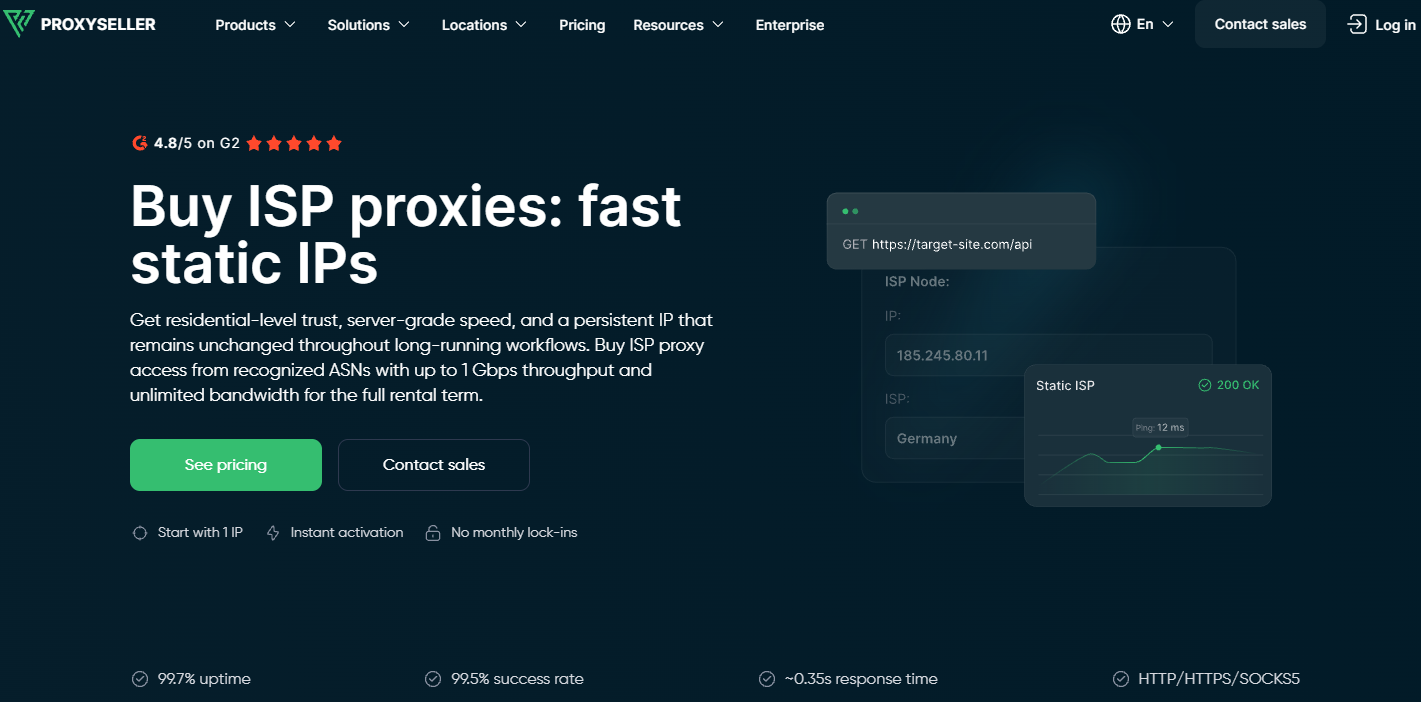
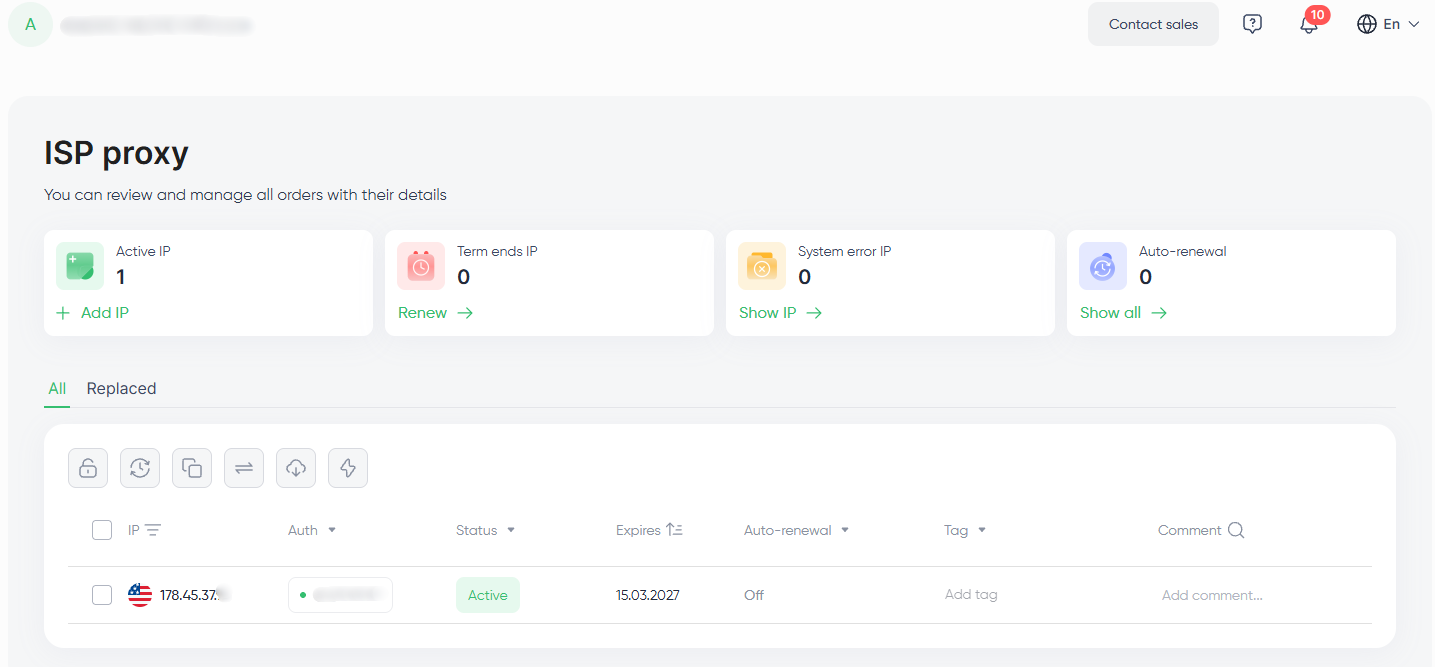
Every ISP proxy is dedicated to one customer for the whole rental term. The IPs come from AT&T, Windstream, Frontier, and other ISPs, spread across 600+ /24 subnets in 24 locations.
Rentals run from 1 week to 12 months. Prices start at $0.98/IP for 1,000 IPs on a 1-week term, with wholesale discounts of up to 30% on larger orders. Authentication works via username/password or IP allowlisting.
Key features:
- 99.5% success rate and ~0.35 s average response time
- 24 locations, with IPs spread across 600+ /24 subnets
- Up to 1 Gbps per IP
- 24/7 human support and a named account manager from $500 MRR
- Country targeting in the dashboard, city-level targeting on request
- Full range of ISP, residential, mobile, and datacenter IPv4 and IPv6 proxies
Best for: midsize data and marketing teams that want the best ISP proxies for search-result tracking, ad checks, QA, and brand account management, with a named account manager and no annual contract.
Stable ISP PROXIES
Stop losing sessions to rotating IPs
Proxy-Seller’s dedicated ISP proxies keep one IP per profile for the full rental term, with 99.7% uptime and DPA/SCC documentation from day one.
Bright Data: enterprise ISP proxies with large static pools
Bright Data sells some of the best ISP proxies for teams that need scale, formal procurement, and extra tooling around the proxy layer, such as its SERP and Scraper APIs. Its ISP proxies come from a shared and dedicated pool that Bright Data says spans 195 countries. Bright Data advertises 1.3M+ static residential IPs on its pricing page, while its dashboard lists 700K+ ISP IPs at checkout.
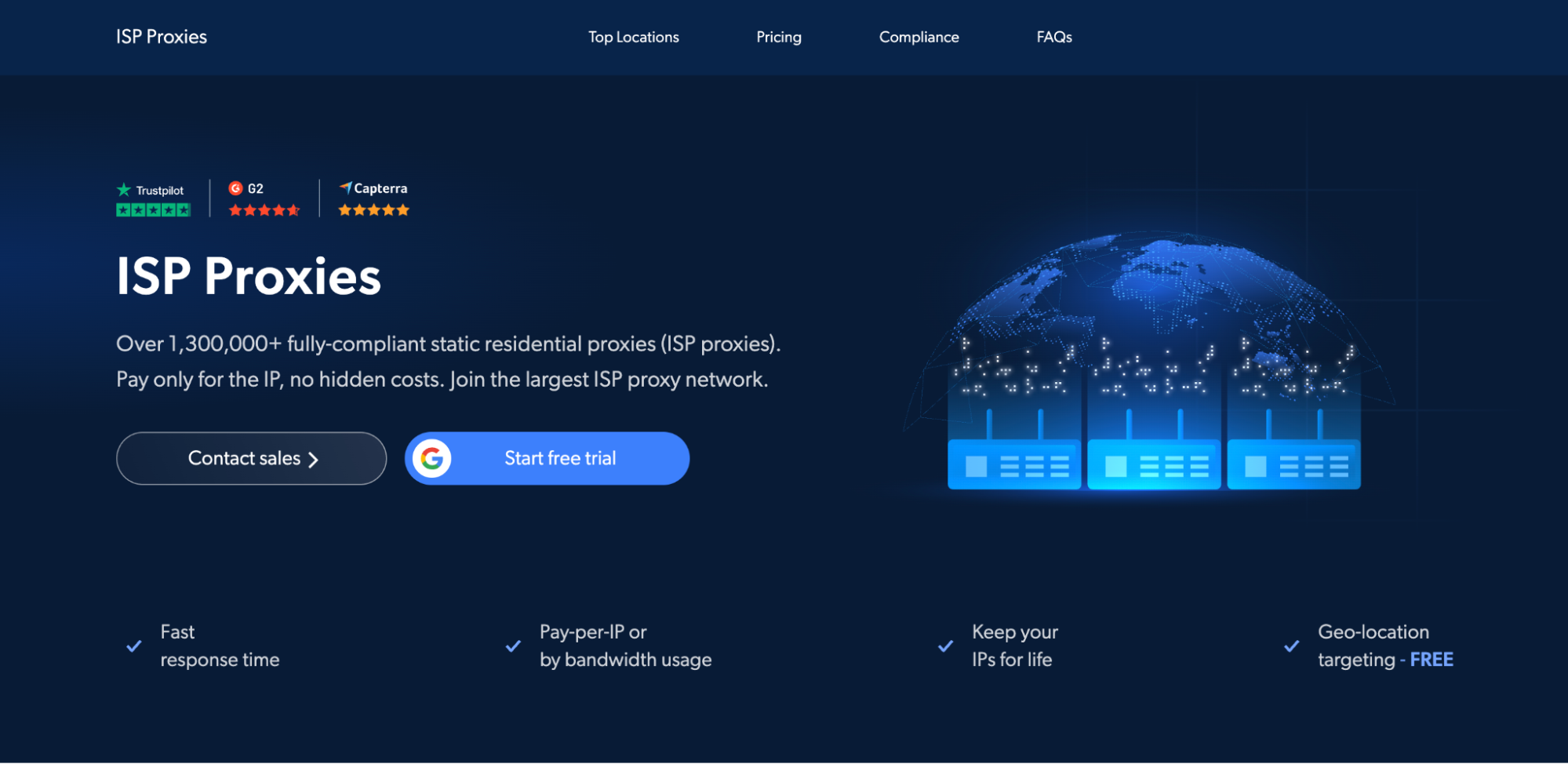
The trade-offs are complexity and price. Shared ISP plans start at $1.80/IP for 10 IPs and dedicated plans at $3.50/IP, both billed monthly. The same 10 dedicated ISP IPs cost $2.91/IP per month at Proxy-Seller, or $1.46/IP if you only need them for a week.
Each IP includes 100 GB of monthly traffic, pooled across all your IPs, and pay-per-GB access starts at $8/GB.
Key features:
- 195 countries, according to Bright Data’s documentation
- 700K+ ISP IPs in the dashboard (1.3M+ advertised)
- Shared, dedicated, and pay-per-GB ISP plans
- SOCKS5 via the free Proxy Manager
- Premium SLA and 99.99% network uptime on custom plans above 1,000 IPs
- Per-IP price drops to $1.30 (shared) and $2.50 (dedicated) at 1,000 IPs
Best for: large companies already using Bright Data’s scraping APIs that want a sizable pool of fixed IPs through a single purchasing agreement and can afford the higher cost per IP.
Oxylabs: semi-dedicated ISP proxies with premium ASNs for enterprise workflows
Oxylabs’s standard ISP proxies are semi-dedicated: each IP is shared with up to 3 users. Fully dedicated ISP proxies are a separate product, from $3/IP for up to 10 IPs down to $2.20/IP at 1,140+ IPs. The IPs are ISP-registered but hosted in datacenters, with optional custom rotation or unlimited-duration sessions.
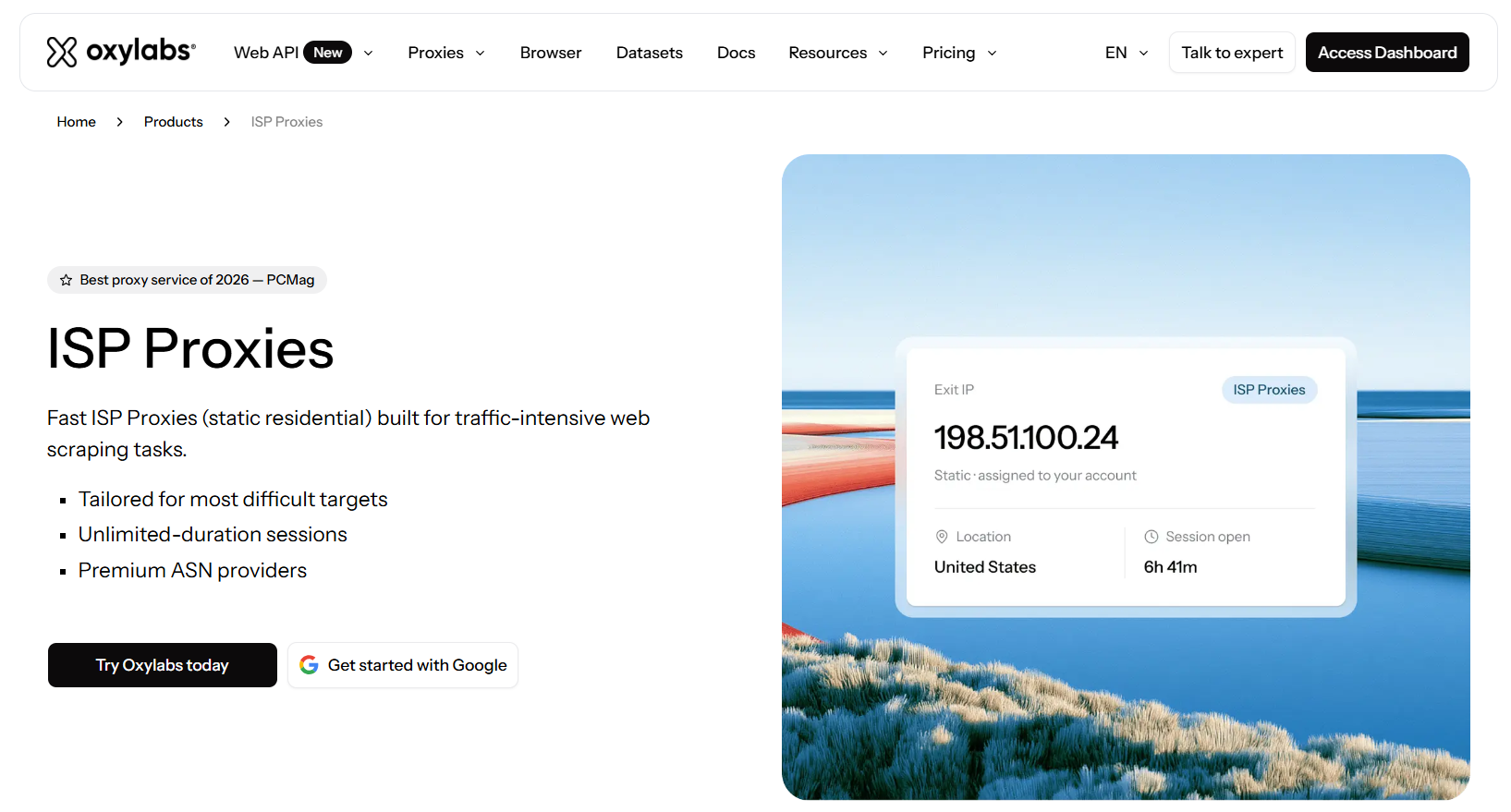
Oxylabs also lists premium ASN sourcing from providers such as Comcast, BT Group, Cox Communications, and Orange, a plus when a target scores traffic by ASN reputation. Its ISP pool spans 705K+ IPs across 28 countries, with the US alone at 393K.
Oxylabs sells ISP proxies through monthly subscriptions that provide access to its wider product suite. Starter costs $30 per month and covers up to 20 ISP IPs at $1.50 each, Basic ($100) covers up to 71 IPs at $1.40, and Flexible ($500) up to 416 IPs at $1.20. New accounts also get $5 in free credits, enough to test 3 IPs.
Key features:
- Optional IP rotation or unlimited-duration sessions
- Unlimited bandwidth under a fair usage policy
- 24/7 support; dedicated account manager on Enterprise plans from $2,500/month
- HTTP, HTTPS, and SOCKS5 support
Best for: enterprise teams that judge the best ISP proxies by ASN quality, such as Comcast or BT, and can accept semi-dedicated IPs or pay extra for the dedicated product.
Decodo: static residential proxies for self-serve teams
Decodo (formerly Smartproxy) offers some of the best ISP proxies for teams that want ISP-origin static residential IPs through a self-serve setup instead of a sales-led contract.
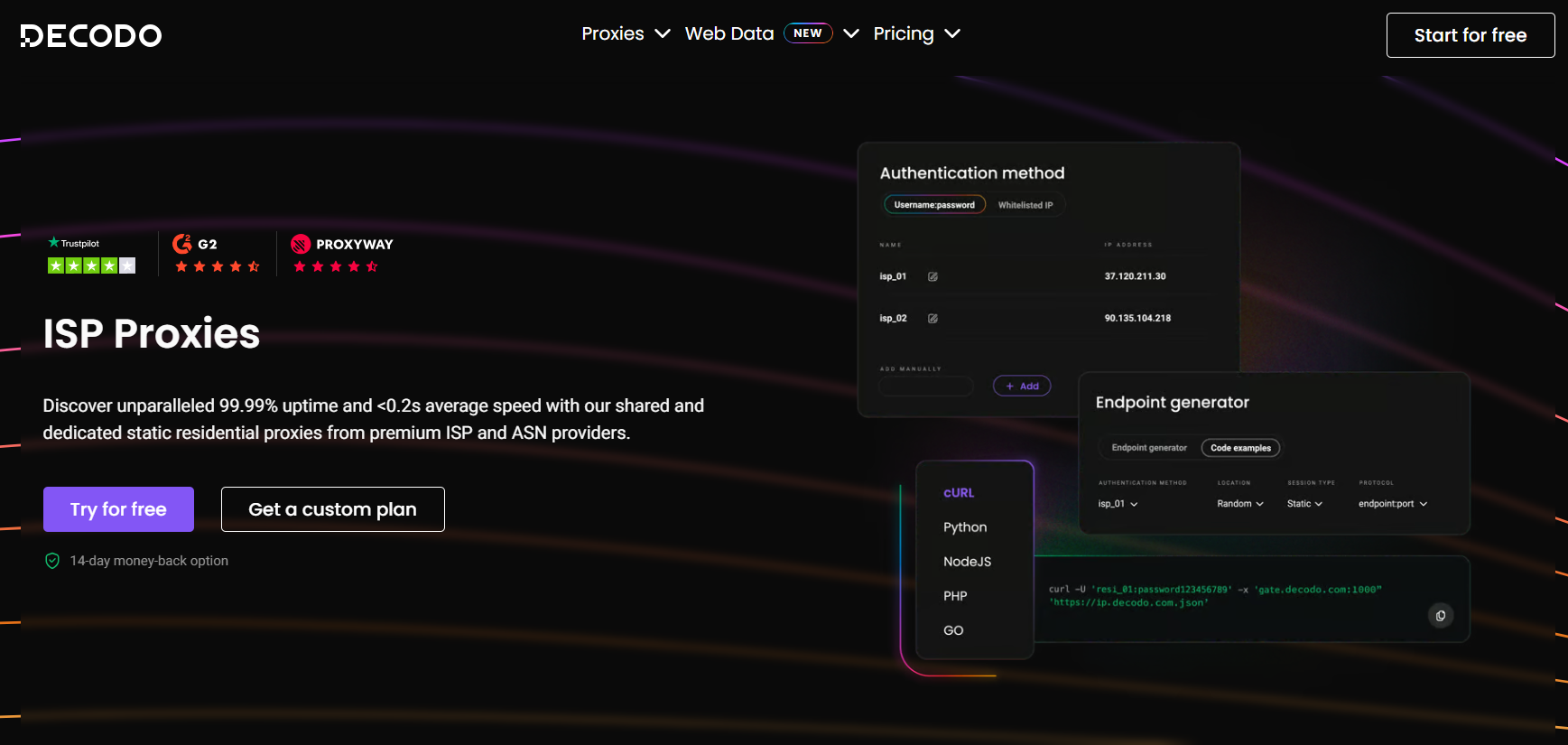
Decodo doesn’t publish its ISP pool size, but lists IPs from Sprint, Frontier, and GTT across 9 locations: the US, UK, Canada, Australia, Italy, Japan, the Netherlands, Hong Kong, and France. It claims 99.99% uptime and under 0.2 s response time. If you’re also comparing residential proxy providers, Decodo’s 115M+ residential network appears in our roundup of the best residential proxies.
Shared access is billed either per GB (from $3/GB) or per IP (from $0.47/IP). Dedicated plans start at $9.99 + VAT per month for 3 IPs ($3.33/IP) and drop to $2.50/IP at 200 IPs. Above that, Decodo builds a custom plan.
Key features:
- 100% dedicated IPs on dedicated plans
- Premium ASNs from Sprint, Frontier, and GTT
- HTTP(S) and SOCKS5 support
- 24/7 tech support via live chat
- Username/password and IP allowlisting authentication
- 3-day free trial with 100 MB on shared ISP plans; not available on dedicated plans
- 14-day money-back option (doesn’t apply after a free trial)
Best for: small and mid-size teams that want to self-serve and pick a billing model per workflow: shared pay-per-GB for small, bursty jobs, which they can test free for 3 days, and dedicated IPs for long sessions.
IPRoyal: budget-friendly ISP proxies with short plans
IPRoyal is a convenient pick among the best ISP proxies for low-commitment work, since it rents IPs for as little as 24 hours instead of locking you into monthly plans. A 24-hour rental costs $1.80/proxy, while monthly pricing falls from $2.70 on the 30-day plan to $2.55 (60-day) and $2.40 (90-day). For context, the shortest term at Proxy-Seller is one week, at $1.50 for a single US IP, which covers most short-term tasks too.
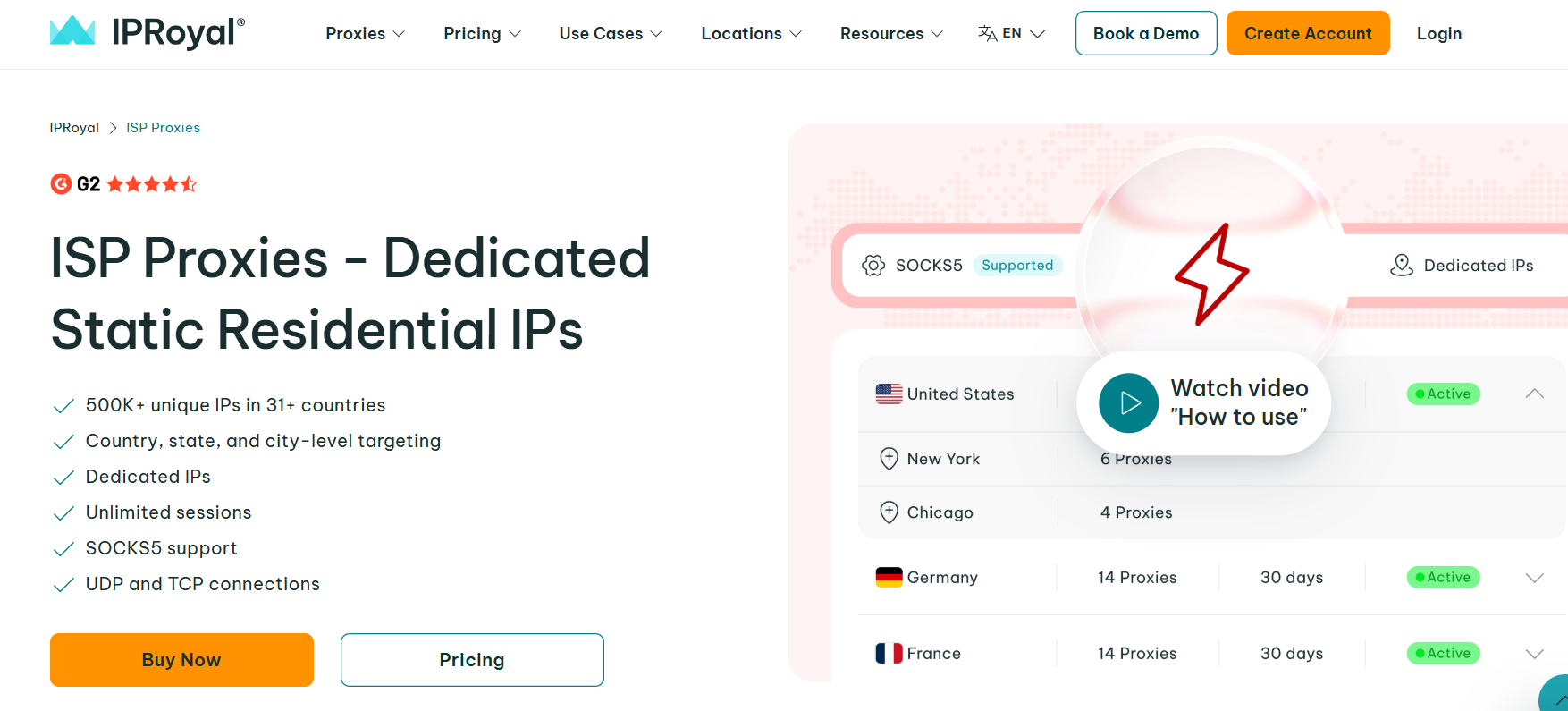
IPRoyal’s ISP product includes 500K+ unique IPs in over 31 countries, with country-, state-, and city-level targeting, dedicated IPs, unlimited sessions, SOCKS5 support, and UDP/TCP connections.
The strongest location pools listed on their ISP page include the US (135K+ IPs), the UK (77K+), France (45K+), Germany (45K+), and Australia (17K+).
Key features:
- Rental terms from 24 hours to 90 days
- HTTP(S), SOCKS5, UDP, and TCP support
- Country, state, and city-level targeting
- KYC verification for all clients, plus AUP and DPA documentation; SOC 2 and ISO 27001 in progress
Best for: freelancers and small teams running one-off or short projects, such as a few days of localized QA, that need dedicated ISP IPs without a monthly plan.
Webshare: low-cost static residential proxies with three access tiers
Webshare is the budget pick among the best ISP proxies in this comparison, with 100K+ shared, private, and dedicated static residential proxies. The IPs come from ISPs including AT&T, Sprint, and Cox Communications, with HTTP and SOCKS5 support and a self-serve checkout.
Webshare sells three access tiers. Shared proxies serve more than two customers and start at $0.30/proxy (20 for $6/month). Private proxies are shared by up to 2 users and start at $0.93/proxy for 25. Dedicated proxies serve you alone, from $2.10/proxy for 20 down to $1.47 at 2,000+. Bandwidth adds a second lever: plans range from 250 GB to unlimited traffic, and unlimited costs more.
Webshare fits teams that want low-cost static IPs, a self-serve checkout, and HTTP or SOCKS5 endpoints for browser tools and scripts. It’s less suitable if your workflow requires managed onboarding, advanced compliance review, or enterprise-grade tools around the proxy layer.
Key features:
- ISP-sourced IPs from AT&T, Sprint, Cox, and Lumen
- 50+ countries
- Up to 1 Gbps per proxy, 100+ Gbps aggregate network
- 99.97% uptime
- 250 GB to unlimited bandwidth and 500–3,000 threads, under a fair usage policy
Best for: users on a budget and small teams in need of many cheap static IPs for low-risk tasks who can live with shared access or traffic caps.
Closing thoughts: Best ISP proxy provider summary table for 2026
Here’s a condensed view of the top providers offering the best ISP proxies covered above: published ISP data, locations, IP type, starting price, minimum order and rental, and support. I checked prices on each provider’s pricing page in November 2026. They aren’t direct equivalents, since some are weekly and some monthly.
Provider | Published ISP data | ISP/static locations | Type of IP | Starting price | Minimum order | Minimal rental | Support | Dedicated account manager |
Proxy-Seller | 600+ /24 subnets | 24 locations | Dedicated static IPs | From $0.98/IP | 1 IP | 1 week | 24/7 live chat, median first response under 1 minute | From $500 MRR |
Bright Data | 1.3M+ advertised, 700K+ in dashboard | 195 countries (per docs) | Shared / dedicated static IPs | From $1.80/IP (shared), $3.50/IP (dedicated) | 10 IPs | 1 month | 24/7 human support | Not published (sales contact above 1,000 IPs) |
Oxylabs | 705K+ IPs | 28 countries | Semi-dedicated (up to 3 users) | From $1.50/IP | $30 plan (up to 20 IPs) | 1 month | 24/7 human support | Enterprise plans from $2,500/month |
Decodo | Not listed | 9 locations | Shared or dedicated static IPs | From $0.47/IP (shared), $3.33/IP (dedicated) | 3 IPs (dedicated) | 1 month (dedicated) | 24/7 live chat | Not published |
IPRoyal | 500K+ IPs | 31+ countries | Dedicated static IPs | From $1.80/proxy | 1 IP | 24 hours | 24/7 human support | Not published |
Webshare | 100K+ IPs | 50+ countries | Shared / private / dedicated static IPs | From $0.30/proxy | 20 proxies | 1 month | Help center and email | Not published |
Which of the best ISP proxies fits which job? Here’s my shortlist by workflow:
- SERP monitoring and ad verification across markets: Proxy-Seller (24 locations, country-level targeting with city on request), Oxylabs (premium ASNs), Bright Data (widest advertised coverage).
- A brand’s own social media and marketplace accounts: Proxy-Seller (one dedicated IP per profile), Decodo (dedicated plans), IPRoyal.
- Enterprise procurement with compliance documentation: Proxy-Seller (DPA, SCC, ISO/IEC 27001), Bright Data, Oxylabs.
- Short-term projects and quick tests: Proxy-Seller ($1.50 for a single IP for 1 week), IPRoyal (from 24 hours), Decodo (3-day trial on shared plans).
- Tight budgets and low-risk tasks: Proxy-Seller (from $0.98/IP at 1,000 IPs), Webshare, Decodo (shared plans).
If you need one provider for long sessions across several markets, I’d start with a 1-week Proxy-Seller order on your own targets, check the valid response rate, and scale to 1,000+ IPs for wholesale pricing once it holds
DEDICATED ISP PROXIES
Keep one trusted IP per workflow, from a single IP to 1,000+
Proxy-Seller’s dedicated ISP proxies hold the same IP for the full rental term across 600+ /24 subnets in 24 locations. Start with one IP for a week, or scale to 1,000+ IPs from $0.98/IP, with up to 30% wholesale discounts and a named account manager from $500 MRR.
FAQ
The best ISP proxy providers charge per IP because each static ISP-assigned address is reserved for your account, whether you send traffic through it or not. For fixed sessions and stable identities, per-IP billing makes costs easy to forecast. Some providers also sell shared ISP access per GB, such as Bright Data from $8/GB or Decodo from $3/GB, which suits bursty jobs but ties the final cost to traffic rather than IP count.
For most web scraping, I’d skip dedicated ISP IPs and use rotating residential proxies, since their link to real user devices gives them the highest trust on protected targets. If you’d rather stay on ISP infrastructure, the best ISP proxies for scraping are shared pools with rotation, such as Decodo’s Pay/IP or Bright Data’s shared plans. Expect lower success rates on protected sites, because other customers’ traffic affects each IP’s reputation.
Yes. Every ISP proxy service in this comparison supports SOCKS5 alongside HTTP(S), though Bright Data routes SOCKS5 through its Proxy Manager. Bright Data, Oxylabs, Decodo, and IPRoyal also support UDP, which matters for video, VoIP, and some automation tools. Before buying, check authentication options too: username/password, IP allowlisting, and whether the same credentials work across all target locations.
Run a small proof of concept on the exact targets, locations, tools, and request volumes you’ll use in production. Track the valid response rate, latency, retry volume, ASN consistency, geo accuracy, and cost per valid response. Cost per IP matters, but a cheap IP loses its value if locations are limited, traffic is shared, or sessions drop.
PROXIES FROM $0.02/IP
Ready to put this into practice?
Pick a proxy type and location, and start using it within minutes.
Instant delivery
24/7 support
Refund policy
About the author