 Proxy for Telegram
 Proxy for LinkedIn
 Proxy for Google
 Proxy for Ebay
 Proxy for Twitter
 Proxy for TikTok
Oxylabs review 2026: tested features, pricing, pros & cons

Most Oxylabs review pages on Google’s first page are affiliate content. They’ll tell you the pool is huge and the proxies are fast, then skip the parts that cost you money. No pay-as-you-go. A KYC wait. And a pricing curve that only gets better past 100GB a month.
This Oxylabs review tries to fill those gaps. We signed up, went through the dashboard, tested live chat, and priced every product against realistic monthly volumes. Testing can be subjective when done at a smaller scale, so we went with Proxyway’s 2026 proxy market research for the performance figures.
Oxylabs review 2026: verdict at a glance
Oxylabs is a proxy provider geared toward businesses, and the performance data backs that up. The problem, though, is price. Entry plans cost more per GB than most rivals, and rates don't really move until you're buying at enterprise volume.
Pros | Cons |
Most unique residential IPs in Proxyway's 2026 test | No pay-as-you-go on self-serve proxy plans |
99.93% success rate on the global residential gateway | Big pricing gap between small and enterprise plans |
Fast responses (0.60s residential, 0.22s datacenter) | KYC check on paid plans |
One dashboard for all proxy types and web scraping APIs | Account managers and priority support are enterprise-only |
It's a good fit for teams running 100GB+ a month that need scale, deep geo-targeting, and compliance documents ready for procurement. Look elsewhere otherwise.
About Oxylabs: company, ownership, and positioning
Oxylabs was founded in Lithuania in 2015 and lists 400 to 500 employees on LinkedIn, which makes it one of the biggest companies in the industry. It owns Webshare and ScrapingBee, and in July 2026 it took its first outside investment: $130M from Warburg Pincus at a $3.6B valuation.
So, is Oxylabs legit? Yes. It’s a member of the Ethical Web Data Collection Initiative, publishes a residential proxy acquisition handbook, runs KYC on nearly every account, and operates under GDPR. It also discloses where its residential IPs come from, for example through partner apps like Honeygain and JumpTask.
When it comes to positioning, it's obvious that the whole product is built for business buyers. Individuals can still buy a 5GB residential plan, but they’ll pay more per GB than elsewhere, and there’s no trial unless you register as a company.
Oxylabs residential proxies review
Residential proxies are the flagship. Oxylabs advertises 177M+ IPs across 195+ countries, and Proxyway’s April 2026 benchmark found more unique IPs (those that appear only once during a test) here than at any other provider it tested, including in the US.
Targeting goes pretty deep. You can filter by country, state, city, ZIP code (US only), coordinates, ASN, and even the device’s operating system. Not every filter stacks, though. Country and ASN are mutually exclusive, which hurts if you need one carrier inside one market. IPs rotate per request, or you can hold sticky sessions for up to 24 hours. SOCKS5 is supported, including UDP and QUIC, but your account manager has to switch UDP on.
The performance figures we came across while putting together this Oxylabs review are impressive. Globally, the gateway posted a 99.93% infrastructure success rate, and even the weakest region, the US, hit 99.40%. Response times averaged 0.60s worldwide and 0.45s in the UK. India came in at 0.66s, a strong number for a region where few providers have infrastructure nearby.
Pricing starts at $30 for 5GB ($6/GB). Pay-as-you-go is gone, replaced by monthly subscriptions, although you can top up mid-cycle without upgrading. At 50GB you're still paying $5/GB, slightly down to $4.50/GB at 100GB, and the rate only reaches $2.50/GB at 1TB, a plan that also requires a verified account.
Proxy-Seller residential plans start at 1GB, so you don't have to buy a monthly tier you'll never finish. The discount curve keeps moving too, down to $0.30/GB past 3TB.
Oxylabs datacenter proxies review
Datacenter IPs come in three formats, and each one is billed a little differently.
- Shared IP lists start at $1.20/IP for 10 IPs, with unlimited traffic
- Dedicated IP lists start at $2.25/IP for 3 IPs, also with unlimited traffic
- The rotating pool has about 56,000 IPs and starts at $11.80 for 20GB, or $0.59/GB
You won't find a pay as you go option on any of them. The number of countries you get depends on the format, starting from 38 on the shared list, 44 on the rotating pool, and 188 on the dedicated list. If you want city-level targeting, you'll have to talk to sales. Also, keep in mind that the "unlimited" traffic on the list plans has a fair usage cap of 100GB per IP per month. It's easy to miss on the pricing page.
Where these proxies really shine is performance. In Proxyway's 2026 market research, the US rotating pool had a 99.98% success rate, with a 0.22s average response time and a 0.16s median. Download speeds averaged 50.27 MB/s, which is plenty for bandwidth-heavy jobs.
IP quality is the biggest technical complaint in this Oxylabs review. Proxyway counted only 89 /24 subnets in the US pool, or roughly 244 IPs per subnet, so strict targets can end up blocking whole ranges at once.
If you want to test them yourself, it won't cost you anything. The free tier gives you five shared IPs with 5GB of traffic a month, and you don't need a credit card.
Oxylabs ISP proxies review
ISP proxies are hosted in data centers, so they’re fast and stable, but the IPs are registered to consumer ISPs. They make sense for targets that block datacenter ranges but don’t call for a rotating residential pool.
Oxylabs sells shared ISP proxies, capped at three users per IP, alongside dedicated ones. The IPs come from named ASNs such as AT&T, Comcast, Lumen, and Frontier.
- Shared proxies run $1.60/IP at 10 IPs, $1.30/IP at 100, and $1.20/IP at 500
- Dedicated proxies start at $3.20/IP for 5 IPs
- Enterprise pricing is custom from 2,000 IPs
Traffic is unlimited, but with a catch. Once an IP passes 50GB in a billing cycle, its concurrency drops from 100 sessions to 10. For high-concurrency work, that’s a hard ceiling.
Sessions can last indefinitely, and HTTP, HTTPS, and SOCKS5 are supported. Those long sessions suit browser automation and SERP monitoring that needs a stable IP.
Self-serve coverage is 25 countries, led by the US, UK, Germany, France, and Canada.
Oxylabs mobile proxies review
Oxylabs routes mobile traffic through real 4G and 5G carrier IPs. This makes mobile proxies ideal for mobile SERP checks, ad verification across carriers, and app testing.
The pool holds 20M+ IPs, concentrated in the US, UK, Germany, France, Canada, and Mexico. You can filter by country, state, city, ASN, and coordinates, but not ZIP code. Rotation defaults to per request and sticky sessions run up to 24 hours.
Performance is the trade-off. In Proxyway's 2026 benchmark, the global mobile gateway hit a 99.84% success rate at 0.76s, making it the slowest network in this Oxylabs review. The US gateway lagged at 97.14%, so it's a good idea to test your US targets before committing.
Self-serve plans are monthly subscriptions, from $7.50/GB on the 4GB plan down to $3.50/GB on the 715GB plan. Companies have to request a trial through support.
Web Unblocker, Scraper API, and OxyCopilot
Oxylabs also offers a handful of scraping tools. These run on top of the proxy networks and take care of the parts of a scraping setup that usually break.
Web Unblocker deals with CAPTCHAs, JavaScript rendering, redirects, and retries for you. You send it a URL and get the rendered page back. It costs $9.40/GB on the 8GB plan, and there's a free 1GB trial if you want to try it first.
Web Scraper API takes things a bit further. Instead of raw HTML, you get parsed, structured data, and rotation, CAPTCHA handling, rendering, and retries are all included. If your team pulls e-commerce or SERP data at volume, that saves a lot of maintenance work. Pricing starts at $0.50 per 1,000 results on the 98,000-result plan, and you can try up to 2,000 results for free.
OxyCopilot is an AI scraper assistant built into the Scraper API Playground. Paste in a URL, and it writes a parser schema and some starter code. It's handy for simple sites, but don't expect it to replace a scraping engineer on a tough target. The Playground also lets you preview rendered pages and payloads without writing any code.
There's a free Proxy Manager Chrome extension too, and it works with any provider.
Oxylabs pricing across all products
The pricing curve for Oxylabs products is pretty flat. For example, residential goes from $5/GB at 20GB, to $4.50/GB at 60GB, then $4 at 125GB, only falling to $2.50 at 1TB. Here are the self-serve entry points that we found during our Oxylabs review.
Product | Entry price | Billing model | Price at volume |
Residential proxies | $6/GB | Per GB, monthly | $2.50/GB at 1TB |
Datacenter proxies (shared list) | $1.20/IP | Per IP, monthly | $0.75 at 1K |
Datacenter proxies (dedicated list) | $2.25/IP | Per IP, monthly | $1.20/IP at 1K |
Datacenter proxies (rotating pool) | $0.59/GB | Per GB, monthly | $0.46/IP at 1TB |
ISP proxies (shared) | $1.60/IP | Per IP, monthly | $1.20/IP at 500 IPs |
ISP proxies (dedicated) | $3.20/IP | Per IP, monthly | $2.50/IP at 300IPs |
Mobile proxies | $7.50/GB | Per GB, monthly | $3.50/GB at 715GB |
Web Scraper API | $0.50/1K results | Per result, monthly | $0.40/1K for 622,500 results |
Web Unblocker | $9.40/GB | Per GB, monthly | $4.50/GB for 88GB |
Headless Browser | $6/GB | Per GB, monthly | $4.70/GB for 300GB |
Residential IPs with volume discounts
Pay for the traffic you use, not the tier you're stuck in.
Proxy-Seller residential plans start at 1GB, with pricing from $3.5/GB, wholesale discounts from 1TB, and Net-30 billing from $500 MRR.
Performance benchmarks and IP quality
Every figure in this Oxylabs review comes from Proxyway’s April 2026 proxy market research, which sent 3.6M requests through the global residential gateway alone over 21 days.
Proxy type | Gateway | Avg. success rate | Avg. response time |
Residential | Global | 99.93% | 0.60s |
Residential | US | 99.40% | 0.65s |
Residential | UK | 99.68% | 0.45s |
Datacenter (rotating) | US | 99.98% | 0.22s |
Mobile | Global | 99.84% | 0.76s |
Mobile | US | 97.14% | 0.52s |
Mobile | UK | 99.31% | 0.47s |
Proxy type | Unique IPs (global) | Confirmed IP type |
Residential | 3,241,404 over 21 days | 99.01% residential (96.38% in the US) |
Mobile | 1,192,449 over 14 days | 99.55% mobile |
When it comes to IP quality, Scamalytics gave residential IPs an average risk score of 2.61 globally and 9.9 in the US, both low. IPinfo flagged 27.94% of the global sample as known residential proxies, roughly in line with Decodo and SOAX. Proxyway treats these stats as supporting data and so should you.
Feature breakdown: dashboard, targeting, and integrations
We spent most of our hands-on time for this Oxylabs review in the Oxylabs dashboard. It comes in English and Chinese, and it's where you manage subscriptions, proxy setup, team access, and usage tracking.
There are two access levels. Admins get full permissions, while members can use products but can't change billing or manage other teammates. You can also create sub-users with their own credentials and daily, monthly, or lifetime traffic limits. That comes in handy if you're splitting access across projects or clients.
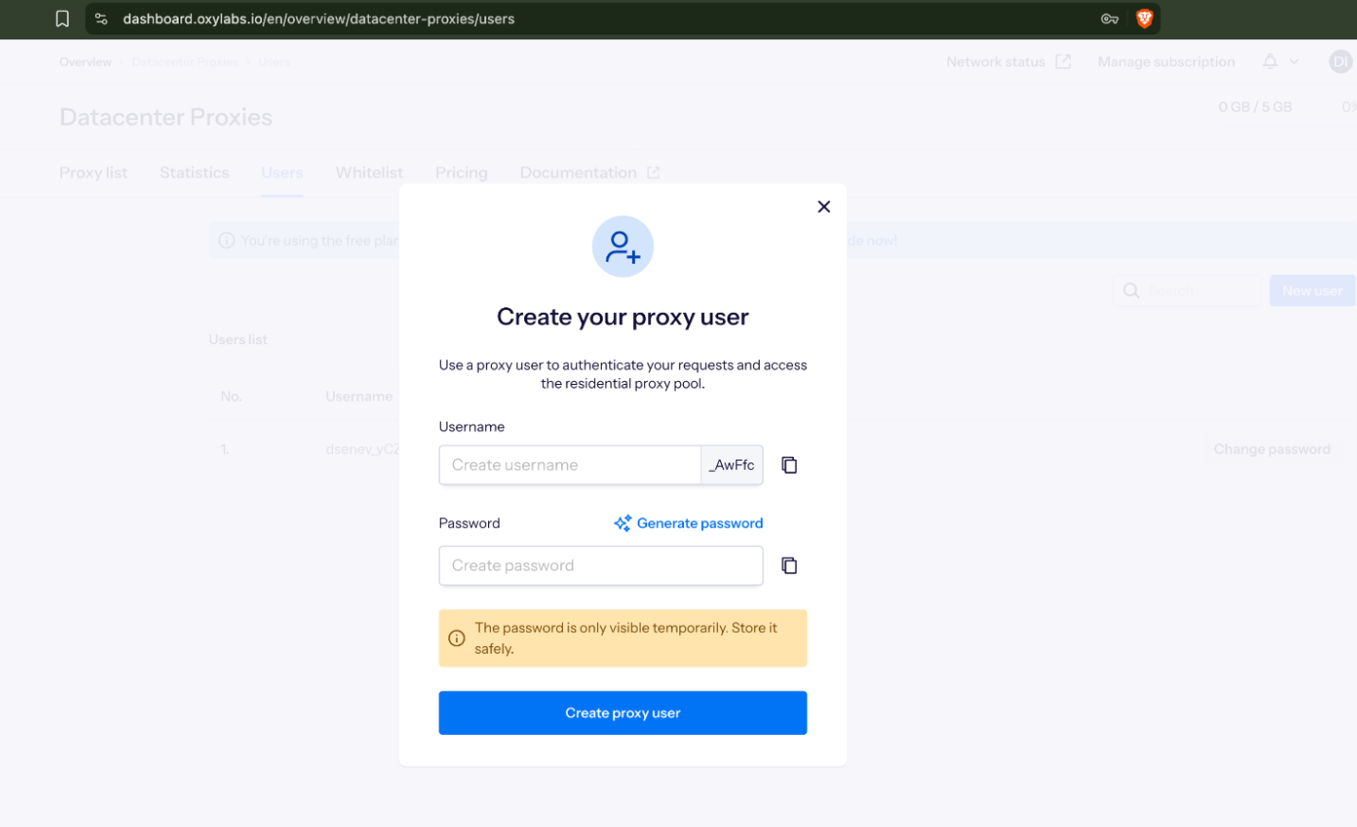
How much usage data you see depends on the product. Rotating networks break down traffic and requests by sub-user, country, and domain. Static enterprise plans supposedly go further, down to target, subnet, and individual IP. You can set custom date ranges on every graph, and there's a cost explorer that shows monthly spend by product.
Targeting and session controls work the same way. Residential and mobile get the most filters and sessions up to 24 hours. ISP proxies let you pick country and ASN, and sessions don't expire. Self-serve datacenter plans only allow country level targeting.
For developers, Oxylabs lists 30+ third-party integrations, including Puppeteer, Playwright, and Selenium. The setup widget gives you code snippets in cURL, Python, Node.js, PHP, Java, and Go. There's also a public API for managing sub-users, usage stats, and IP allowlisting on residential and enterprise datacenter products.
Oxylabs proxy service review: ease of use, support, and documentation
Signing up takes a couple of minutes, and you can use email, Google, Microsoft, or corporate SSO. Once you're in, you'll find the dashboard pretty clean. Your active products show up as tabs on the overview page, and each one has a traffic summary and a setup widget that gives you working connection strings you can copy as they are.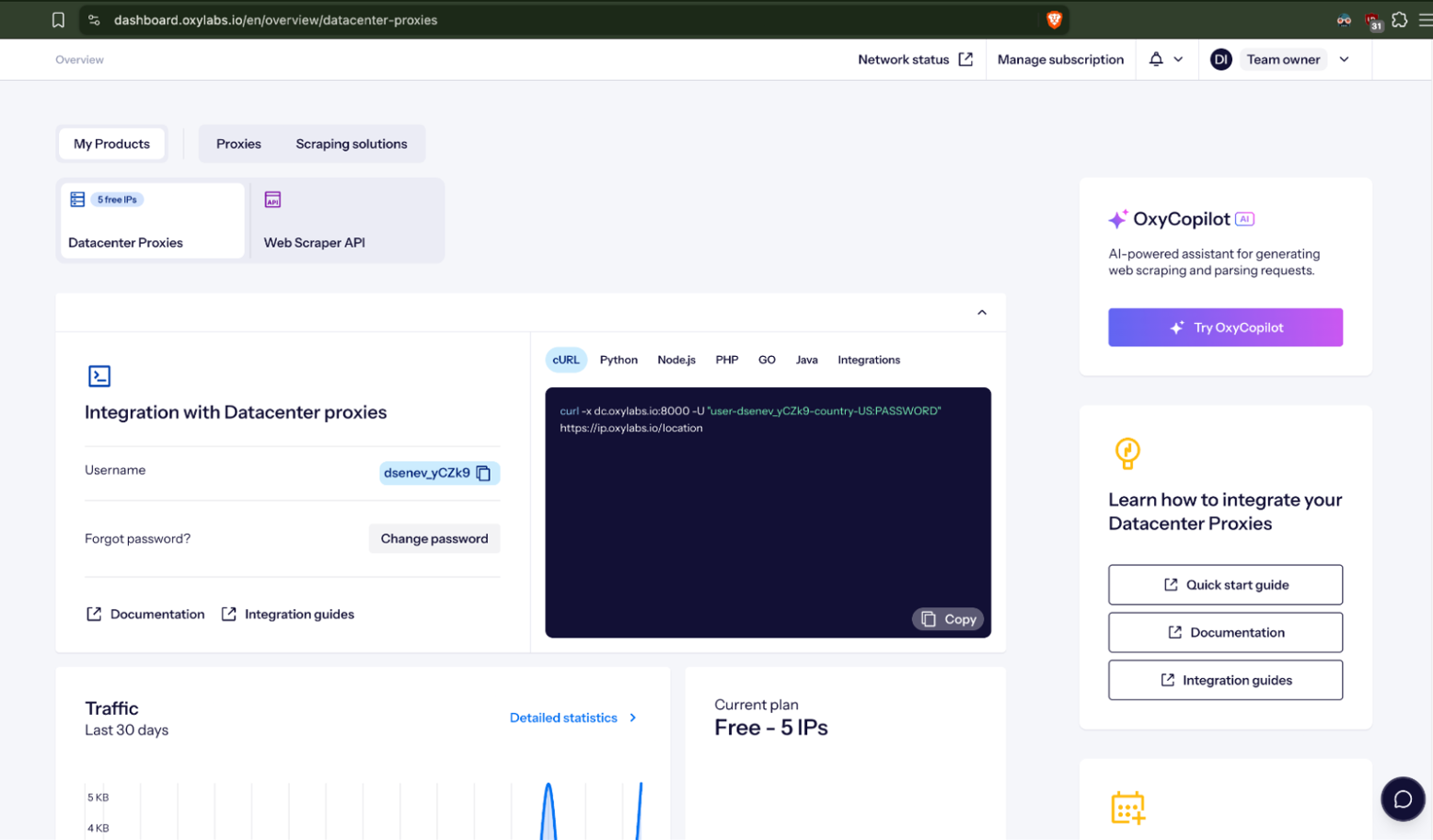
For more detail, use the left sidebar. Every product you own has its own pages for the proxy list, statistics, users, allowlists, pricing, and documentation. Products you haven't bought yet are listed there too, under Proxies and Scraping Solutions, each with an info page on pricing and use cases. When you make a purchase, it triggers a KYC check, so you might have to wait a bit depending on your situation.
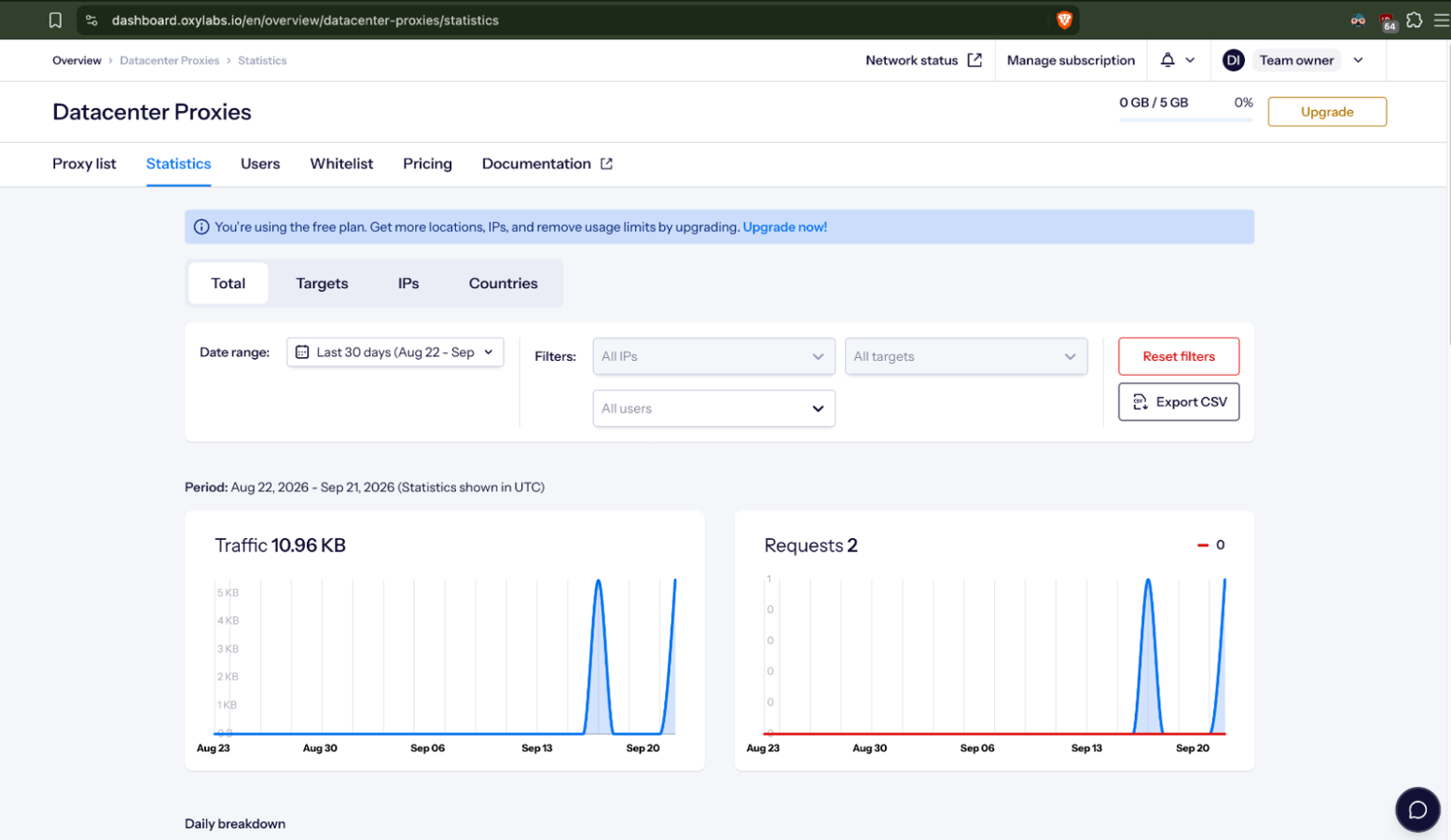
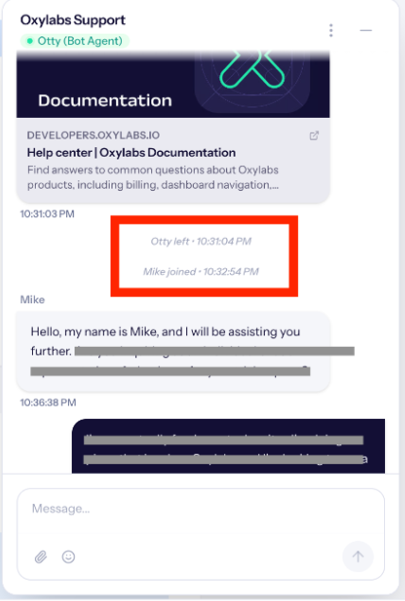
Support is available via online-chat. A chatbot answers the common questions and hands anything more complicated over to a person. It told us the wait would be 15 minutes, but an agent actually joined in under 2. Chat is available 24/7, and email replies take anywhere from a few hours to a day.
Every product has setup and integration guides with code samples, and the Learning Hub answers account and pre-sales questions. If you're technical, you should be able to get set up without ever opening a ticket.
A dedicated account manager comes with the highest tiers rather than every plan. On residential, that's the Corporate plan. It starts at $2,500 a month for 1TB and up.
KYC, compliance, and free trial
Oxylabs doesn't verify you at signup, and you can use the free datacenter IPs right away. Once you buy a paid plan, though, you'll go through a KYC check. The form asks for your company details, contact info, and what you plan to use the proxies for. Depending on your answers or where you're located, it may also ask for supporting documents. Most approvals take anywhere from a few minutes to a few days, but some can take longer if the automated checks flag something.
Procurement teams will probably like how thorough this is. If you're trying to compare three providers this week, though, it can slow you down quite a bit. Not every provider asks for KYC on a starter plan, so testing side by side is usually quicker elsewhere.
Some targets are off limits no matter what. Banking, government, and mailing service domains are blocked on residential proxies by default. Datacenter proxies are less strict, and you can unlock some categories by going through an extra KYC step with support.
What about free trials? That depends on the product and whether you're signing up as a company or an individual. Datacenter, for instance, gives anyone five shared IPs and 5GB of traffic a month without a credit card. Residential and most other products come with a 7-day trial, but only for verified companies, and it has limited bandwidth and some restricted targets.
Pros and performance strengths of Oxylabs
Oxylabs has a lot going for it, especially if you're a data engineering team running serious volume with compliance requirements. Let's quickly run through what we found while putting together this Oxylabs review.
- Oxylabs returned 3.24M unique residential IPs over 21 days in Proxyway’s test, more than any other provider in the lineup
- Residential success rates stayed above 99% on every gateway tested
- ZIP code, coordinate, ASN, and OS filters are available without talking to sales
- KYC, a published sourcing handbook, an AUP, and GDPR compliance give legal teams real documents to review
- Web Unblocker, Scraper API, and OxyCopilot cover CAPTCHA handling, rendering, and parsing, so you build less yourself
- Live chat got us to a human in under 2 minutes
Cons, limitations, and common pitfalls
Oxylabs also has a number of disadvantages and limitations that you should keep in mind. Let's go through them.
- Residential costs $5/GB at 50GB, so mid-sized teams pay near-entry rates
- Self-serve plans are monthly subscriptions with no pay-as-you-go, so spiky traffic makes budgeting harder
- Paid plans come with a KYC check, and automated flags can slow down approval
- Fair usage caps limit "unlimited" traffic on datacenter lists and ISP proxies
- Dedicated account managers and priority escalation are reserved for enterprise accounts, starting at $2,500 a month on residential
- The US datacenter pool has low subnet diversity
- Banking, government, and mailing targets are blocked on residential by default
Who Oxylabs is best for, and who should look elsewhere
You're almost at the end of this Oxylabs proxy provider review. If you're still wondering whether Oxylabs is the right fit for you, the buyer profiles below should help you figure that out.
Buyer profile | Verdict | Why |
Enterprise data team, 1TB+/month | Strong fit | Scale, benchmark results, and compliance documents justify the premium |
Team buying proxies and managed scraping together | Strong fit | Every product sits under one dashboard and one bill |
Mid-market team, 20-100GB/month | Evaluate carefully | Performance is there, but you’re paying near-entry rates |
Team with seasonal or unpredictable traffic | Evaluate carefully | No PAYG and monthly expiry make costs hard to control |
Solo developer or team under 20GB/month | Poor fit | KYC, pricing, and complexity outweigh the benefits |
Non-technical buyer who just needs data | Poor fit | A scraper API or dataset fits better than proxy infrastructure |
Alternatives to Oxylabs in 2026
If this Oxylabs review has you second-guessing the price, the best alternative for you depends on how much traffic you use, how technical your team is, and how much procurement hassle you're okay with. For a wider comparison, check out our best proxy providers roundup.
Proxy-Seller works well for mid-market teams that want enterprise features without signing an enterprise contract. You get sandbox access the same day, public pricing from $3.50/GB on residential and $3 on ISP, 25-30% wholesale discounts from 1TB or 1,000 IPs, and PO or Net-15/Net-30 billing from $500 MRR. Support is handled through direct Slack or Telegram channels, with a 24-hour SLA on every tier.
Bright Data is the closest match at enterprise scale, and its tools and prices are in the same range. It advertises 400M+ monthly residential IPs, which is the biggest number on the market. Keep in mind that this counts IPs seen over a rolling month, and Bright Data didn't take part in Proxyway's 2026 benchmark, so you can't really compare it with Oxylabs' 177M+. Bright Data also shut down its mobile proxies in April 2026, so that's something to know if you use them.
Decodo, formerly Smartproxy, is where a lot of teams go when Oxylabs is too expensive. It advertises 115M+ residential IPs, came very close to Oxylabs on success rate and pool size in Proxyway's tests, and still has pay-as-you-go. Our Decodo review covers it in detail.
SOAX is a good option for smaller teams that want flexible filtering and a simpler dashboard. Its advertised residential pool is 155M+.
Residential IPs from $1.45
Stop paying entry-level rates at mid-market volume.
Proxy-Seller’s residential proxies come with public wholesale pricing, Net-30 billing, and real people on Slack or Telegram from day one.
Conclusion
Pull your last 90 days of proxy usage and turn it into a monthly GB figure. The pool size, reliability, and compliance paperwork that Oxylabs gives you earn the premium if it's above 100GB. Otherwise, you'll pay close to entry rates for infrastructure you won't come close to fully using.
If you land somewhere in the middle, run a short pilot with two providers on your actual targets. Compare cost per successful request and not the headline price per GB.
FAQ
Residential proxies start at $6/GB and fall to $2.50/GB at 1TB. Datacenter proxies start at $1.20 per shared IP or $0.59/GB for the rotating pool, ISP proxies at $1.60 per shared IP, and mobile proxies at $7.50/GB. Web Unblocker lists at $9.40/GB but currently sells for $5.64/GB. All proxy plans are monthly subscriptions, and rates only drop gradually throughout the subscription tiers.
Start with the free datacenter tier. You get five shared IPs and 5GB of monthly traffic with no credit card, which is enough to test your setup and check IP quality on your own targets. If you’re ready to pay and your work is specifically web scraping, Web Scraper API is the easiest paid option, since rotation, CAPTCHA handling, and retries are built in.
For mid-market teams, Proxy-Seller is the strongest alternative. You get self-serve access, public pricing, and invoice billing from $500 MRR, without the long sales cycle. Bright Data is the closest enterprise rival on features and price. Decodo delivers similar benchmark performance for less and keeps pay-as-you-go. SOAX works for smaller teams that want flexible filters.
In Proxyway’s 2026 test, 99.01% of global residential IPs checked out as residential, and Scamalytics gave them a low average risk score of 2.61. US quality was slightly weaker at 96.38%. The datacenter pool is the weak spot, with only 89 /24 subnets in the US sample. For comparison, Proxy-Seller's global datacenter pool spans 600+ unique /24 subnets, so run your own checks on the free tier before you scale up.
PROXIES FROM $0.02/IP
Ready to put this into practice?
Pick a proxy type and location, and start using it within minutes.
Instant delivery
24/7 support
Refund policy
About the author