 Proxy for Telegram
 Proxy for LinkedIn
 Proxy for Google
 Proxy for Ebay
 Proxy for Twitter
 Proxy for TikTok
Decodo review (formerly Smartproxy)

Smartproxy rebranded to Decodo in April 2025. The infrastructure, the IP pool, and the products haven't changed, and existing customers were migrated automatically. If you landed here searching for a Smartproxy review, this Decodo review is what you're looking for.
Decodo serves developers, small teams, and mid-market businesses that need residential, mobile, ISP, and datacenter proxies without the enterprise minimums Tier-1 providers require.
In Proxyway's 2026 proxy market benchmarks, Decodo posted the second-fastest residential response time at 0.53 seconds with a 99.92% success rate. Excellent numbers for SERP monitoring, price intelligence, and ad verification. Past 1TB/month though, the $2/GB rate loses its edge. Our overall Decodo review rating: 8.6/10 (weighted average across pool size, performance, pricing, ease of use, tools, support, and compliance — full breakdown in the final scorecard).
Our quick Decodo review verdict
We've seen enough proxy evaluations to know where Decodo fits. Strong on pool size and performance, priced below Tier-1, and self-serve enough to skip the procurement cycle. Here's our quick take on who needs it and who doesn't.
Who it’s for | Who it’s not for |
Developers and data teams needing rotating sessions and granular geo-targeting without a custom contract. | Teams past 1TB/month. Proxy-Seller's $1.45/GB cuts unit cost by 27%, dedicated pools, and a named account manager from $500 MRR. |
SEO and price intelligence teams needing high success rates on SERP and e-commerce endpoints at mid-market pricing. | Low-volume users under 10GB/month. PAYG at $4/GB costs more than the entry subscription. |
SMBs wanting self-serve onboarding, compliance documentation, and 24/7 live support. | Anyone requiring SOC 2 certification or a full compliance package out of the box. |
Teams wanting residential, ISP, mobile, and datacenter proxies under one dashboard. |
Decodo at a glance: key specs and product overview
Here's what Decodo (formerly Smartproxy) looks like on paper before we get into the detail in our Decodo review.
Former name | Smartproxy |
Year founded | 2018 |
Residential IP pool | 115M+ IPs |
Mobile IP pool | 10M+ IPs |
Datacenter IP pool | 500K shared and dedicated IPs |
Locations | 195+ |
Proxy types | Residential, static residential (ISP), mobile, datacenter (shared, dedicated, rotating) |
Scraping tools | Web Scraping API, SERP API, eCommerce API, Social API, Site Unblocker |
Protocols | HTTP, HTTPS, SOCKS5 (UDP available on request) |
Authentication | Username/password, IP allowlist |
Free trial | 3-day free trial on most products |
Refund policy | 14-day limited refund |
Support | 24/7 live chat and email; dedicated account managers on enterprise plans only |
What is Decodo (formerly Smartproxy)?
Decodo is Smartproxy, rebranded in April 2025. Same infrastructure, same IP pool, same team. They've since pulled their scraping APIs into a single subscription and positioned the product as a broader web data collection platform. The company's based in Vilnius, Lithuania, where it has been operating since 2018.
Proxyway's given Decodo its Best Value Provider award four years in a row, which tracks with what we saw putting this together. On G2, it holds 4.6/5 across 648+ Decodo reviews, and 4.2/5 from 1,989+ on Trustpilot (as of publication).
Across independent Decodo proxy reviews, pool reliability, dashboard usability, and support responsiveness come up consistently as positives. Pricing at both ends of the spectrum (too expensive for low-volume users on PAYG; less competitive than dedicated providers past 1 TB) comes up as negatives.
Note: Our Decodo proxy provider review focuses on the proxy infrastructure. If you're weighing your options, check our best proxy providers roundup first.
Decodo product lineup: proxies, APIs, and tools
This Decodo review covers all major Decodo products below, from the core proxy types through to the scraping tools.
Product | Best for |
Residential proxies | Large-scale scraping, SERP monitoring, and ad verification. |
Static residential proxies | Account management and checkout automation needing persistent sessions. |
Mobile proxies | Workloads that need the hardest-to-block IPs. |
Datacenter proxies (shared) | High-volume, low-detection-risk workloads at the lowest price point. |
Dedicated datacenter proxies | Automation tasks needing clean, exclusive IP pools. |
Site Unblocker | Managed anti-bot bypass via a single endpoint. |
Web Scraping API | Web, SERP, eCommerce, and social scraping under one subscription. |
Decodo residential proxies review: pool size, targeting, and pricing
The flagship proxy type in this Decodo review and the strongest performer in independent benchmarks. Here's what you get:
- 115M+ ethically sourced IPs across 195+ locations
- Targeting down to country, state, city, and ASN level
- Rotating and sticky sessions up to 24 hours
- Unlimited concurrent connections
- HTTP(S) and SOCKS5 support
- Compatible with Requests, Playwright, Puppeteer, and Selenium
- Subscriptions from $3.75/GB, scaling to ~$2/GB at volume; PAYG at $4/GB
Decodo ISP proxies: persistent sessions and static IPs
ISP proxies are the most straightforward product in Decodo's lineup. You get shared and dedicated pools across US, UK, and EU with country-level targeting, and IPs stay fixed unless you explicitly request rotation. That makes them the right call for teams managing their own brand accounts and checkout workflows where a changing IP breaks the session. Pricing starts at $3.33/IP per month.
Mobile proxies: carrier-grade IPs and ASN targeting
The hardest-to-block proxy type in Decodo's lineup. You get:
- 10M+ IPs across 160+ locations and 700+ ASNs
- 3G/4G/5G network coverage
- City-level targeting and carrier-level ASN selection
- IPs originate from real carrier networks, so anti-bot systems rarely flag them
- Pricing from $3.75/GB on subscription
Datacenter proxies: speed, volume, and block rate trade-offs
This Decodo review found the datacenter tier offers the lowest entry point across all proxy types, with the trade-off being higher block rates on hardened targets. You get:
- 100K+ IPs across US, EU, and APAC
- Shared rotating pools, dedicated static lists, or rotating dedicated configurations
- Unlimited threads on rotating plans
- Shared plans from $0.60/GB
- Expect higher block rates on social platforms and major e-commerce sites
Site Unblocker: managed anti-bot bypass on demand
A single endpoint that handles the hard parts of scraping automatically:
- CAPTCHA solving
- Automatic retries
- Browser fingerprinting
- JavaScript rendering
- Pay-per-success pricing, so failed attempts don't cost you
Web Scraping API: SERP, eCommerce, and social endpoints
Decodo pulled its scraping APIs into one subscription as part of the rebrand. Coverage includes:
- General web scraping
- SERP (Google and Bing)
- eCommerce endpoints
- Social endpoints
- Pricing from $0.50 per 2K requests
Browser extensions and proxy checker
Chrome and Firefox extensions handle quick browser-level routing. There's also a free desktop proxy checker for bulk-validating IP lists: timeouts, geolocation, protocol errors.
Integrations, sub-user API, and developer setup
We didn't run into configuration issues dropping Decodo into a standard scraping stack. It works with MuLogin, AdsPower, Multilogin, Playwright, Puppeteer, Selenium, and Scrapy natively. Teams managing multiple users also get a sub-user management API for account creation, traffic limits, and usage stats. Code samples in Python, Node.js, and Java are on GitHub.
Decodo performance: benchmark results across proxy types
Proxyway's 2026 market research study covered 3.6 million requests across 13 providers over a span of two months.
Proxy type | Success rate | Response time |
Residential | 99.92% | 0.53s |
Mobile | 99.75% | 0.74s |
Datacenter | 99.94% | <0.34s |
At this performance level, pricing and pool size are what actually separate providers. That said, benchmark targets don't always reflect your real-world endpoints.
To check performance yourself, run this command, replacing USER, PASS, and PORT with the credentials from your Decodo dashboard:
curl -x http://USER:PASS@gate.decodo.com:PORT \
-o /dev/null -s \
-w "DNS: %[time_namelookup]s Connect: %[time_connect]s TTFB: %[time_starttransfer]s Total: %[time_total]s\n" \
https://ip.decodo.com/
Run it at least five times, across different times of day and each location and proxy type you plan to use.
Benchmark numbers don't replace a test on your actual targets. Proxy-Seller's 14-day A/B pilot runs against your real endpoints, with endpoint-level logs showing valid response rate and cost per valid response before you commit. Request a 14-day pilot.
Decodo pricing: subscription, PAYG, and volume rates
Decodo scales with commitment. The more you put in upfront, the lower the unit rate, whether that's per GB (residential, mobile, shared datacenter) or per IP per month (ISP, dedicated datacenter). PAYG is available for one-off projects at $4/GB.
The Decodo review pricing breakdown below reflects listed rates as of 2026.
Proxy type | Entry price | Best volume rate |
Residential | $3.75/GB | $2/GB at 1TB+ |
ISP (static residential) | $3.33/IP/mo | $2/IP at 2,000+ IPs |
Mobile | $3.75/GB | $2.25 at 500GB+ |
Datacenter (shared) | $0.60/GB | $0.38 at 10TB+ |
Dedicated datacenter | $1.85/IP/mo | $1.15 at 2,000+ IPs |
Web Scraping API | $0.50/2K requests | Free for the first 4k requests |
Enterprise pricing is available on request. Worth contacting support if you're buying at volume.
Getting started with Decodo: setup in under ten minutes
Decodo's onboarding is self-serve. During tests for this Decodo proxy review, we got through setup in under ten minutes. Here's how to get started:
- Sign up at decodo.com with email and password, or via Google. Email verification is required before purchasing.
- New accounts go through automated fraud screening at registration. If flagged, ID verification unlocks purchases, restricted target categories, and the largest plans.
- Select your proxy type or service from the left sidebar.
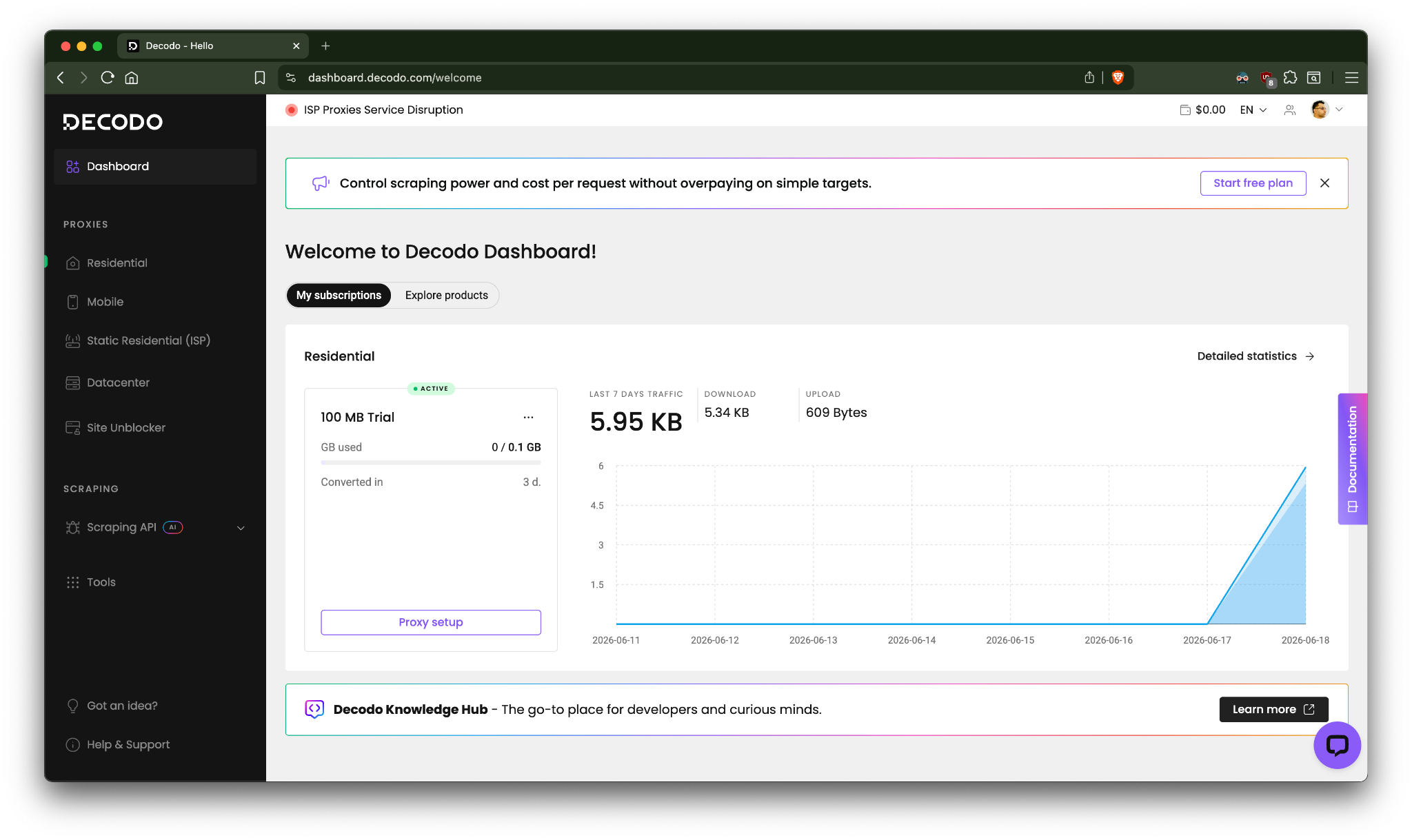
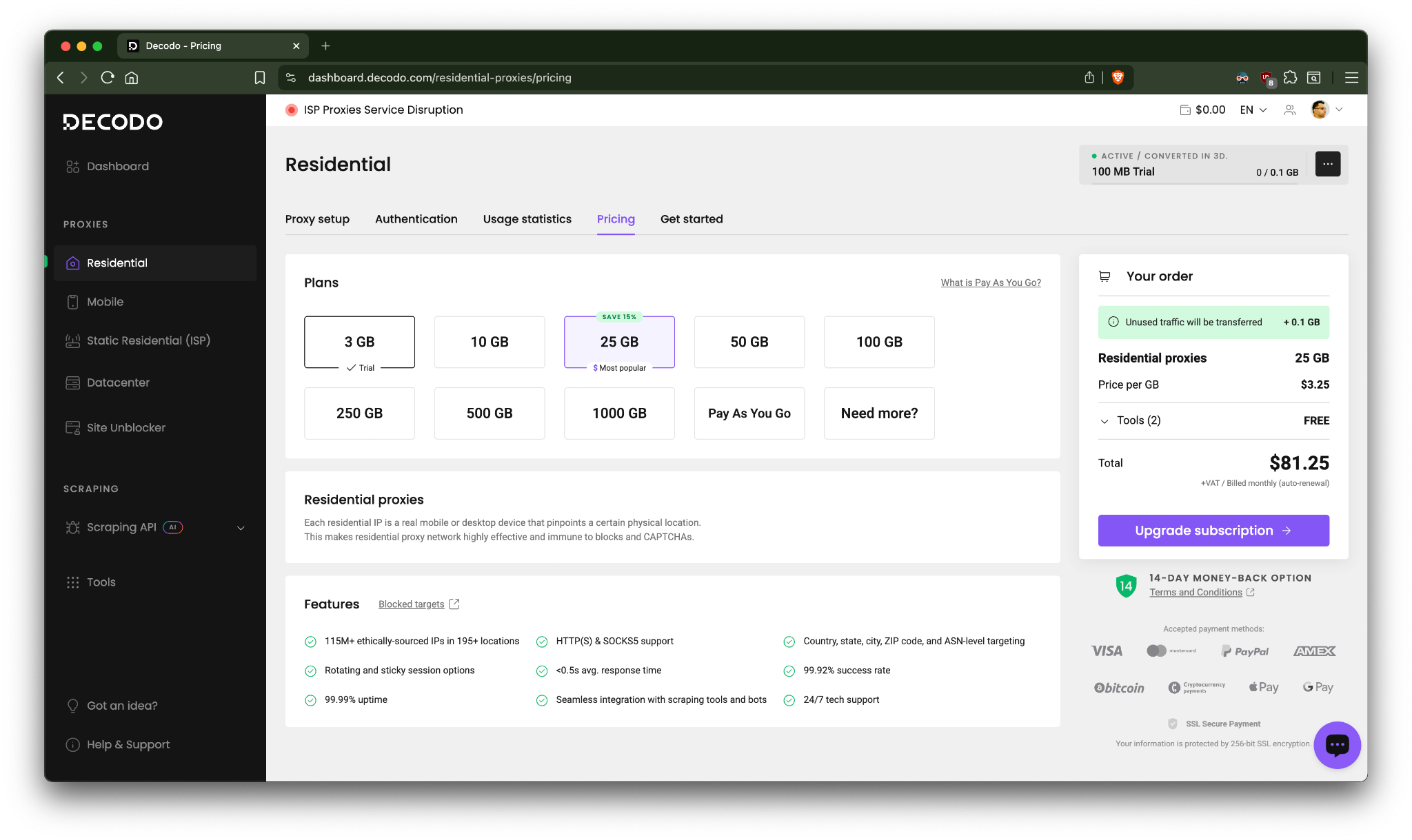
- Pick a plan and select Continue to checkout, or Start with a trial to test first.
- Credentials (host, port, username, password) are generated under the relevant service tab. Set your location, protocol, and session type, then run a quick test:
curl -U "username:password" -x "gate.decodo.com:10001" "https://ip.decodo.com/json"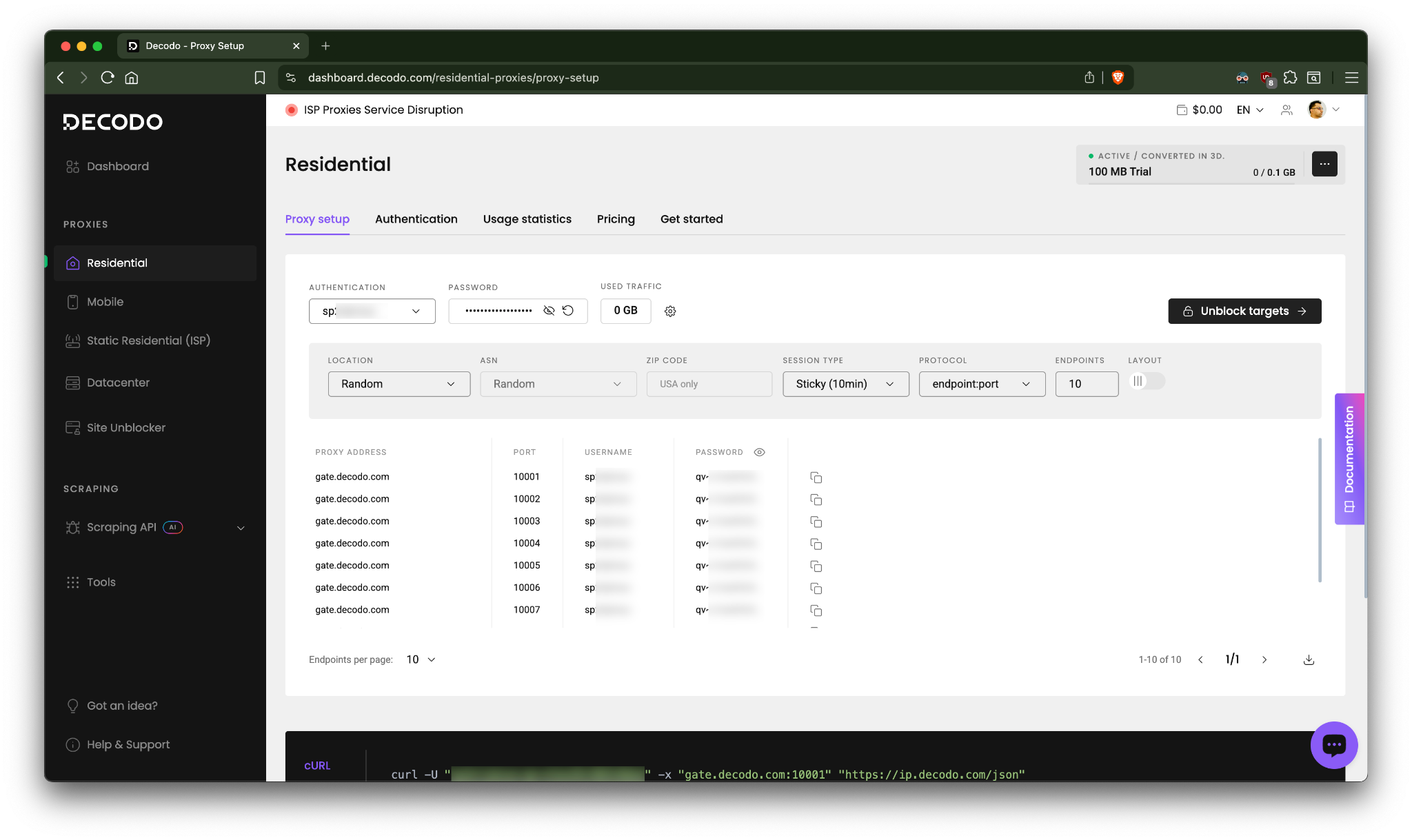
- Hit an IP lookup endpoint to confirm the returned IP matches your selected location before running production jobs.
Customer support: live chat, Discord, and account management
Decodo's live chat is AI-first (routes to human agents when needed). It's fast at surfacing docs and handling routine setup questions during business hours; complex compliance or refund questions are expected to take longer to escalate to a human specialist. Discord is available too. The community isn't particularly active, but it's a reasonable place to get input from other users on common scraping and configuration questions.
Standard tiers don't include a dedicated account manager. If that's a hard requirement, enterprise pricing is available and worth discussing directly.
For contrast, Proxy-Seller's live chat is staffed by human technical specialists, with a median first-response time under 60 seconds. No bot triage layer between you and an engineer. Beyond live chat, teams from $500 MRR get a named account manager reachable on Slack or Telegram. No shared inbox, no ticket queue.
Security and compliance: ISO 27001, EWDCI, and GDPR
Decodo's security setup covers ISO/IEC 27001:2022 across access management, encryption, risk management, and continuous monitoring. As a co-founder of the Ethical Web Data Collection Initiative (EWDCI), it only sources IPs from end-users who've consented to their devices being used as proxy nodes.
GDPR alignment is also in place, and certain high-risk target categories (banking platforms, government portals, streaming services, ticketing sites) are blocked outright regardless of KYC status.
Note: Decodo doesn't offer tunnel-level encryption. Teams that need VPN-equivalent security will need to evaluate that separately.
Decodo vs competitors: where it wins and where it doesn't
This section of the Decodo proxies review benchmarks head-to-head against the main alternatives below. The question isn't who wins. It's which trade-offs fit your workload.
Provider | Residential pool | Price | Best for |
Proxy-Seller | 47M+ IPs, 220+ locations | $0.3/GB at scale | Mid- to high-volume teams that need large-scale residential proxy access at mid-market pricing without going through a procurement process. |
Decodo | 115M+ IPs, 195+ countries | $3.75/GB (subscription) and $2/GB at 1TB+ | Mid-market teams needing a large rotating pool, solid performance, and self-serve onboarding. |
Bright Data | 150M+ IPs | $7/GB | Enterprise teams needing the deepest feature set and largest pool regardless of cost. |
Oxylabs | 100M+ IPs | $6/GB | Enterprise teams prioritizing mobile proxy performance and dedicated account management. |
SOAX | 191M+ IPs | $3.60/GB | Teams needing strong customization and flexible session controls. |
Webshare | Datacenter-focused | $3.50/GB | Budget-first, low-sensitivity, high-volume workloads. |
For a deeper look at how the enterprise tier stacks up, see our Oxylabs vs Proxy-Seller comparison.
Past 1TB/month, $2/GB adds up fast. Proxy-Seller's dedicated residential pools start at $0.3/GB at scale with no shared SMB traffic and a named account manager from $500K MRR.
Decodo review: who should use Decodo and who shouldn't
Here's where we'd specifically recommend it in our Decodo review:
- SEO and SERP monitoring: Residential pool depth and city-level geo-targeting hold up well for rank tracking and SERP data collection across multiple regions.
- Price intelligence and eCommerce scraping: Rotating residential IPs with city-level targeting and the eCommerce Scraping API cover product and pricing data collection across major retail platforms.
- Ad verification: Clean residential IPs with strong regional coverage handle geo-specific ad placement verification without triggering bot detection.
- Brand account management: ISP proxies maintain persistent sessions for teams managing their own brand profiles across platforms, with consistent IPs that don't trigger re-authentication.
Pros | Cons |
115M+ ethically sourced residential IPs across 195+ locations. | PAYG at $4/GB costs more than the $3.75/GB entry subscription. |
Second-fastest residential response time (0.53s) across 13 providers; 99.92% global success rate. | Complex pricing: traffic-based, unit-based, and success-based models vary by product. |
All four proxy types plus scraping APIs, Site Unblocker, and free Chrome/Firefox extensions under one dashboard. | Documentation has gaps in advanced use cases. |
Unlimited concurrent connections on residential proxies. | Shared pool architecture by default; dedicated clean subnets require a separate plan. |
24/7 live chat and Discord community. | |
EWDCI co-founder; ISO/IEC 27001:2022 certified. | |
3-day free trial; no sales call required. |
Not sure which use case fits? See our breakdown of the best proxy services by use case.
Decodo review final verdict: is Decodo worth it in 2026?
Decodo's a solid pick for developers and small teams that want a large residential pool with self-serve onboarding. The 115M+ IPs, top-tier Proxyway 2026 numbers, and 24/7 live chat are hard to match at $3.75/GB entry, scaling to $2.75/GB at 100 GB.
Past 1TB/month, the pricing ceiling shows. At $2/GB, it faces stronger price pressure at scale, while Proxy-Seller lists residential pricing from $3.5/GB entry with lower volume rates discussed via larger packages. That's a 27% cost difference that compounds fast at scale. Add a named account manager from $500 MRR to the list of requirements, and the case for switching gets harder to ignore.
Category | Score |
Pool size and coverage | 9/10 |
Performance | 9.5/10 |
Pricing and value | 8/10 |
Ease of use | 9/10 |
Tools and integrations | 8.5/10 |
Support | 8/10 |
Security and compliance | 8.5/10 |
Overall | 8.6/10 |
Decodo review TL;DR: For developers, SEO teams, and data teams running consistent residential workloads at mid-to-high volume, Decodo's a strong call. G2 (600+ reviews, 4.6/5) and Trustpilot (1,950+ reviews, 4.3/5) back that up. Scale past 1TB/month or add compliance requirements to the mix, and Proxy-Seller is the stronger fit.
Running more than 1TB/month?Let’s start with same-day sandbox access. Proxy-Seller offers same-day sandbox access for testing on your own targets before scaling. Same-day sandbox, no sales cycle.
FAQ
Switch session type first by rotating to sticky or vice versa. Try a different geo or ASN. If residential IPs keep getting blocked, mobile proxies or Site Unblocker are worth considering. Site Unblocker handles CAPTCHA solving and retries automatically.
Proxy-Seller for high-volume teams needing dedicated residential pools with no shared traffic, +20–30% VRR uplift in pilots, and a named account manager from $1K MRR. Bright Data for enterprise feature depth. Oxylabs for enterprise mobile proxy performance. See the full Decodo alternatives breakdown for a detailed comparison.
Yes, with caveats. The Scraping API covers SERP, eCommerce, and social endpoints. AIMultiple's 2026 benchmark rated Decodo's eCommerce scraping among the top performers, but flagged lower coverage on Facebook and Instagram metadata versus specialist providers.
Residential proxies cover 195+ countries with targeting down to city, state, ZIP code, and ASN level. ISP and datacenter coverage is more limited, primarily US, UK, and EU.
Residential proxies start at $3.75/GB on subscription and $4/GB on PAYG. Datacenter proxies start at $0.60/GB. Most proxy types come with a 3-day free trial and 100MB of data.
Yes. Decodo's been operating since 2018 out of Vilnius, Lithuania, holds ISO/IEC 27001:2022 certification, and co-founded the Ethical Web Data Collection Initiative. Fortune 500 companies and individual developers both use it. Proxyway has also independently verified the performance across millions of requests. Our full Decodo review confirms the compliance stack aligns with what mid-market buyers expect for GDPR-scoped workloads.
PROXIES FROM $0.02/IP
Ready to put this into practice?
Pick a proxy type and location, and start using it within minutes.
Instant delivery
24/7 support
Refund policy
About the author