 Proxy for Telegram
 Proxy for LinkedIn
 Proxy for Google
 Proxy for Ebay
 Proxy for Twitter
 Proxy for TikTok
Bright Data review 2026: performance, features, pricing, pros and cons

The price on Bright Data’s pricing page and the price on your invoice aren’t the same. Residential traffic is listed at $4/GB, but that’s a 50% promo code, and after three months the rate goes back to $8/GB. In this Bright Data review, I check gaps like that one across the whole product line, from raw IPs to ready-made datasets.
The same gap shows up in reliability. Bright Data advertises 99.99% network uptime, but its own SLA only promises “commercially reasonable efforts” to reach 99.9%. And when Proxyway last tested the network independently, in March 2024, requests to Amazon and Instagram averaged 84.63% success. This Bright Data review checks both gaps for two kinds of buyers: data teams that run large-scale collection, and smaller teams that want ready data without managing scrapers.
*All prices, ratings, and product details in this review were checked on the providers’ own pages and review platforms in October 2026 and may have changed since.
Bright Data review at a glance: what it is and who it is for
Bright Data is an Israeli proxy provider and web data platform for large-scale data collection. It started in 2014 under the name Luminati, took its current name in 2021, and has been owned by private equity firm EMK Capital since 2017.
Its main selling point is scale. Bright Data advertises 400M+ residential IPs in 195 countries, which would make it one of the largest residential pools on the market, and says it serves more than 50,000 customers.
Bright Data at a glance | |
Proxy types | Residential, ISP, datacenter (mobile no longer listed) |
Residential pool | 400M+ IPs in 195 countries (advertised) |
Starting price | Residential $8/GB pay as you go, ISP from $1.3/IP, datacenter from $0.9/IP |
Trial | $2 in credit, plus $5 after you add a payment method |
KYC | Required for residential, registered companies only |
Best for | Data teams that need scale, wide geo coverage, and audited compliance |
Not for | Individuals, hobby projects, and small teams that need residential IPs today |
Short verdict: worth the premium for registered companies that spend $500+ a month and need audited compliance. Small teams and individuals will start faster and pay less elsewhere.
Bright Data proxy infrastructure: residential, ISP, and datacenter networks
Bright Data publicly sells three proxy networks. For this Bright Data review, I compared them by access rules, price, and the targets they handle well.
Residential proxies: a 400M+ pool, now for verified companies only
Targeting is free down to country, state, city, ZIP code, and ASN, and the pool holds up in testing: in Proxyway’s March 2024 tests, 1.2M requests over 21 days returned 885,512 unique IPs, 98.59% of them residential. That makes the network a fit for protected e-commerce targets, local price monitoring, and ad verification across markets.
Since July 7, 2026, new residential zones open only after KYC approval, and only for registered companies. According to Proxyway, Bright Data also blocks Google on this network and points you to its SERP API instead.
ISP proxies: static residential IPs priced per IP or per GB
Bright Data lists 1.3M+ static ISP IPs, hosted in data centers but associated with residential ISPs, and you can buy them without KYC. Shared IPs cost $1.8 each for 10 and $1.3 at 1,000. Dedicated IPs are pricier on small orders: $3.5/IP a month for 10, vs $2.91 at Proxy-Seller and Decodo. The gap narrows at 100 IPs, where Bright Data charges $2.75, Decodo $2.6, and Proxy-Seller $2.55 for US IPs.
Datacenter proxies cost little per GB but struggle on protected targets
The 1.3M+ datacenter IPs come shared or dedicated from $0.9/IP, again with no KYC. Like any provider’s datacenter IPs, they struggle on protected targets: in Proxyway’s 2026 market research, datacenter proxies across tested providers had a median success rate of 57.46% on Amazon and Google.
Side by side, the three networks differ mainly in pricing unit and access rules:
Network | Pricing unit | KYC | Best for |
Residential | Per GB | Required; companies only | Protected e-commerce and local targets |
ISP | Per IP or per GB | Not required | Long sessions and ad verification |
Datacenter | Per IP or per GB | Not required | High volume on lightly protected sites |
All three networks connect through one gateway over HTTP, HTTPS, and SOCKS5. You authenticate with a username and password, and an IP allowlist adds account-level security. Residential IPs support country-level targeting and rotate on every request unless you add a session ID. ISP and datacenter IPs bought per IP stay static.
NB: Bright Data no longer sells mobile proxies to new customers. Many reviews still list them: PCMag’s 2025 review counts 7 million mobile IPs. In 2026, Bright Data quietly removed the product from its menu and pricing pages, and the old mobile proxies page now redirects to its general proxy page. There was no announcement on its blog, and customers who bought mobile proxies earlier kept access.
MOBILE PROXIES, PRICED PER IP
Carrier IPs for ad verification and app testing.
Proxy-Seller mobile proxies start at $10 per IP, with carrier-level targeting, IP rotation by link or every 5 minutes, and access minutes after checkout.
Web scraping tools: Web Unlocker, scraper API, and Browser API
Bright Data’s scraping tools change the billing unit: with raw proxies, you pay for traffic even when a request fails, while Web Unlocker and the SERP API charge only per successful request.
Tool | For whom | When it replaces raw proxies | Pricing unit |
Web Unlocker | Developers scraping protected pages | CAPTCHAs, retries, and headers eat engineering time | $1.50 per 1K successful requests |
SERP API | SEO and rank-tracking teams | You need search engine results at scale | From $1 per 1K requests |
Scraper APIs | Teams that need structured data | A ready parser for one of 800+ sites beats building your own | From $0.75 per 1K records (discounted from $1) |
Browser API | Teams scraping JavaScript-heavy pages | You need a full remote browser over CDP | From $5/GB |
My take: raw proxies look cheaper at first, but on protected targets you also pay for failed requests. Instagram returned 72.50% success in Proxyway’s test, and Bright Data points Google traffic to its SERP API instead of the residential network. Per-success pricing moves that risk to Bright Data. By my math, raw proxies at $8/GB still win on pages under about 190 KB, where 1,000 pages cost less than Web Unlocker’s $1.50 (current pay-as-you-go pricing).
Datasets and AI scraper tools for teams that need ready data
If you don’t want to run scrapers, Bright Data sells pre-collected datasets from 900+ domains, starting at $250 per 100K records. Newer AI products include an MCP server with a free tier, which connects AI assistants to live web data, and Agent Browser.
Datasets fit a periodic pull when you don’t have engineers to maintain scrapers, though 2026 G2 reviewers mention limited historical data.
Bright Data performance: claimed uptime vs measured results
Bright Data didn’t take part in Proxyway’s 2026 market research, so the latest proxy-network tests on real targets that any Bright Data review can cite are from March 2024.
Metric | What Bright Data claims | What contracts and independent tests show | Source and date |
Network uptime | 99.99% | Best-effort 99.9% in the SLA | Bright Data SLA, May 2026 |
Success rate, test server | Not published | 98.96% global, 99.14% US | Proxyway, March 2024 |
Success rate, real targets | Not published | Amazon 96.75%, Instagram 72.50%, Google not tested | Proxyway, March 2024 |
Response time | Not published | 1.12 s on the test server, 4.51 s on Amazon, 12.56 s on Instagram | Proxyway, March 2024 |
IP quality (fraud score) | Not published | 44.52 global, 71.76 US | Proxyway via IPQualityScore, 2024 |
Reliability and latency, 2026 | Not published | Residential 98.3% reliability (5th of 13), 3.0 s latency (13th of 13) | ProxyPerf, October 2026 (month to date) |
Infrastructure success rates are solid in both tests. The drop comes on real targets, and Proxyway noted that Bright Data’s “results have changed little in two years, while major competitors have been making significant improvements.”
If you pay per GB, a 72.50% success rate means roughly 38% more requests for every page you actually collect (1 ÷ 0.725), and each failed attempt still uses traffic.
To test it yourself, run the same 1,000 URLs through each provider:
Metric | How to get it |
Usable responses | Check the content, not just the status code: a block page can still return HTTP 200 |
Total spend | The provider’s dashboard for the test window |
Cost per successful request | Total spend ÷ usable responses |
For illustration, assume every request at Instagram’s 72.50% success rate uses about 500 KB. Then 1,000 usable pages take roughly 1,380 requests and 0.69 GB: about $5.50 at $8/GB, vs $1.50 through Web Unlocker. Failed requests can weigh more or less, so your test gives the real figure.
Bright Data pricing: what pay as you go and monthly plans cost
Bright Data pricing works in two modes: pay as you go, or a monthly plan with lower unit rates once your spend reaches about $500. The main pricing finding of this Bright Data review: each product uses its own billing unit, so the headline numbers don’t compare directly.
Product | Entry price | You pay for |
Residential proxies | $8/GB ($4/GB for 3 months with the promo code) | All traffic, including failed requests |
ISP proxies | $1.8/IP for 10 shared IPs, or $8/GB | IPs per month, or all traffic |
Datacenter proxies | $1.4/IP for 10 shared IPs, or $0.60/GB | IPs per month, or all traffic |
Web Unlocker | $1.50 per 1K requests | Successful requests only, by default |
Datasets | $250 per 100K records | Every record delivered |
Monthly plans from $499 lower these rates as your volume grows. My Bright Data pricing breakdown lists every tier.
Bright Data also matches your first deposit up to $500 and accepts cards, PayPal, wire transfers, and AWS Marketplace.
Against other providers: Proxy-Seller residential proxies start at $3.5/GB and Oxylabs residential proxies at $6/GB, vs $8/GB at Bright Data. For 10 shared ISP IPs, Oxylabs charges $1.5 per IP vs Bright Data’s $1.8, and datacenter traffic costs $0.60/GB at both.
Three costs the pricing page doesn’t show:
- The promo ends. The 50% discount lasts three months. During the promo, the $999/month plan works out to $3/GB, or 332 GB. After it, the rate doubles to $6/GB, so the same $999 buys about 166 GB, and keeping 332 GB means moving up to the $1,999 plan. On pay as you go, small teams return to $8/GB, more than double the 2026 market median of $3.75/GB for a 5 GB package, according to Proxyway’s market research.
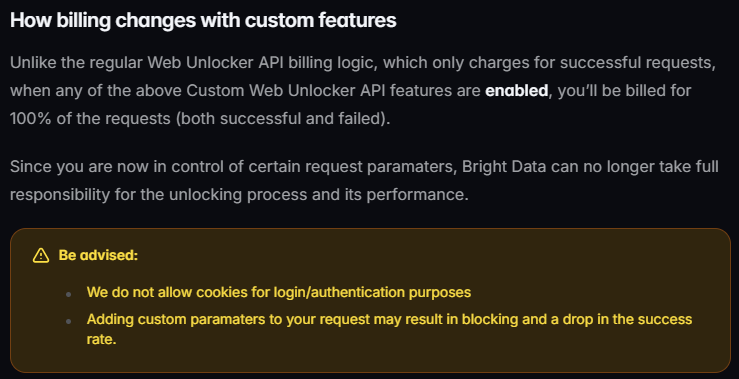
- Failed requests can still cost money. Web Unlocker bills only successful requests by default. But Bright Data’s documentation says that once you enable custom features, such as custom headers or cookies, you’re billed for both successful and failed requests.
- Per-record products have no ceiling. In December 2025, a single uncapped dataset scrape returned 682,000 records and a $1,023 bill for StationX’s Nathan House. Bright Data refunded it, although by his account nothing in the terms required it to. Set spend limits in your account before your first big job.
RESIDENTIAL PROXIES, NO HIDDEN FEES
Stop budgeting around a promo that ends in month four.
Proxy-Seller residential proxies start at $3.5/GB with no monthly lock-ins, and volume plans drop to $1.45/GB as you scale.
From sign-up to first request: KYC and the Bright Data dashboard
ISP proxies, datacenter proxies, and Web Unlocker work as soon as you create a zone. Residential proxies don’t, and that’s where buyers get stuck.
- Sign up with a work email. Google and Okta SSO are supported.
- Verify a payment method. Bright Data runs an authorization charge and adds $5 to your account.
- Create a zone. Each product runs in its own zone, with its own credentials.
- Request residential access. Use a company email, fund your balance (KYC isn’t available in trial modes), and submit your use case with a company registration document. Compliance may ask for a video call. You pay before you know whether access will be approved.
- Wait for the decision. Bright Data promises an update within 48 hours, though its proxy FAQ says about two to three business days. Access covers only the approved use case.
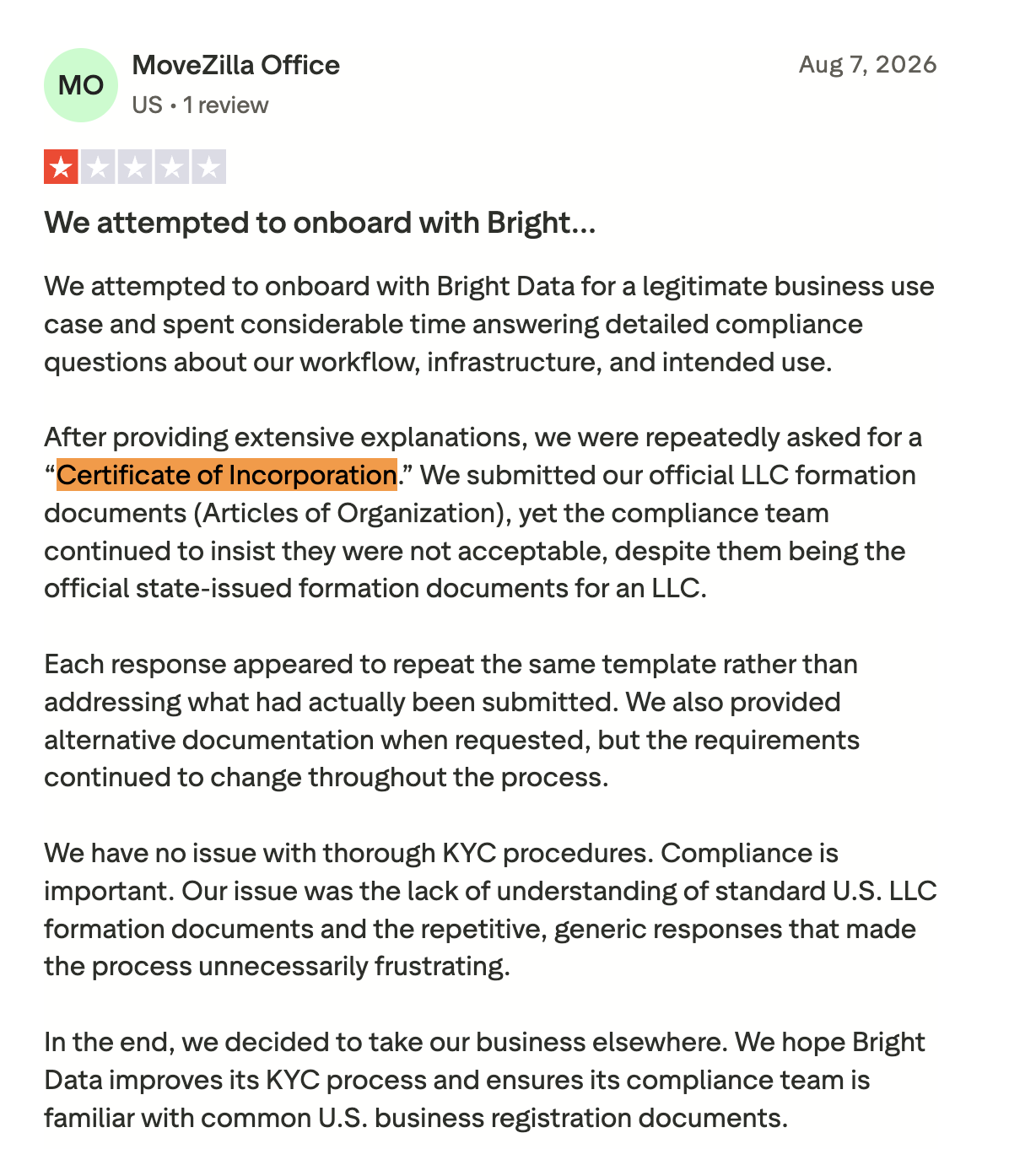
One US company told Trustpilot in August 2026 that compliance kept asking for a “Certificate of Incorporation” after it submitted LLC formation documents, so it switched providers.
No registered company? Residential access isn’t an option, so go straight to the alternatives below. That same vetting is also the main argument for Bright Data’s safety, which the next section covers.
Is Bright Data legit and safe to use?
Yes. Bright Data is a legitimate company that has operated since 2014, sources residential IPs through an opt-in SDK, and lists ISO certificates and a SOC 2 report in its Trust Center. For you as a customer, safety comes down to how those IPs are sourced and how strictly Bright Data vets who uses them.
How it sources residential IPs. Device owners opt in through Bright SDK inside third-party apps in exchange for perks such as an ad-free version, a consent-based way to source residential IPs. We’ve covered how free smart TV apps route proxy traffic through Bright SDK on our blog before.
How it vets customers. KYC is also a safety feature. Bright Data approves residential access only for a verified use case and actively monitors how customers use residential traffic.
Certifications. Bright Data’s Trust Center lists ISO certificates, a SOC 2 report on request, a public SOC 3 report, a CSA STAR registry listing, and a PwC independent assurance report.
What the privacy policy means for you.When I read Bright Data’s privacy policy, I found that onboarding data includes ID documents, and compliance checks may involve recorded audio or video calls. The policy also covers publicly posted personal data from online sources, such as name, email, and job title. It sets no fixed retention periods, keeping data “for as long as necessary to provide the Service.” EU residents can request erasure, and Bright Data aims to answer California requests within 45 days.
NB: Whichever provider you pick, ask how its residential IPs are sourced: the consent flow, the SDK apps, and the latest audit date. Your procurement or legal team may ask for these.
Customer support: what the SLA and a dedicated account manager cover
Bright Data’s product pages promise “24/7 Live Support.” Its SLA, part of the Master Service Agreement, is narrower. Support runs Sunday to Friday, 7 AM to 8 PM UTC, and 24/7 applies only to critical P0 incidents.
Account type | What you get |
Every account | Tickets, email, WhatsApp, and Telegram; Trustpilot reviewers report an AI assistant on first contact |
Committed plan | A dedicated account manager |
Enterprise customer with an MSA | Named support manager, contractual response times (15 minutes for P0, 4 business hours for P1), premium SLA |
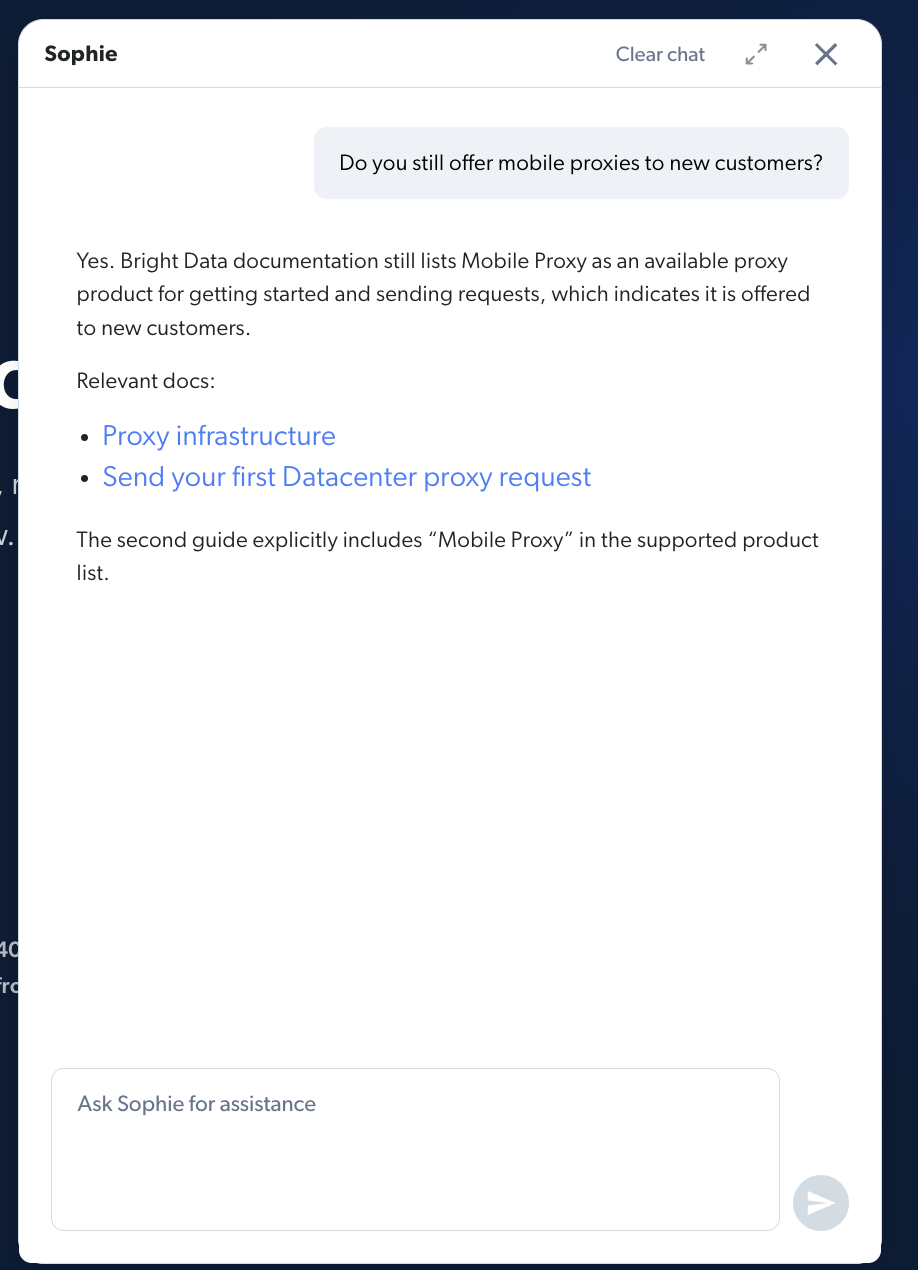
When I asked Bright Data’s website chat on October 14, 2026, whether it still offers mobile proxies to new customers, Sophie, its AI assistant, replied in about five seconds. The answer was a confident yes, based on setup docs, even though mobile proxies are gone from the product menu and pricing pages.
My take: for a large team, the committed plan and its account manager are part of the price, so get the SLA terms in writing before you sign. For a small team on pay as you go, expect tickets and a bot first.
HUMAN SUPPORT, NO TICKET QUEUES
Skip the bot and talk to a person who knows your setup.
Proxy-Seller gives you 24/7 human support with no ticket queues, and teams from $500 MRR get a dedicated account manager.
Bright Data reviews: what Trustpilot, G2, and Capterra users report
Ratings are high on all three platforms, but read the caveats before you trust any single Bright Data review.
Platform | Rating | Reviews | Caveat |
Trustpilot | 4.3 | 1,026 (155 in the past 12 months) | Invites customers to review; replies to 65% of negative reviews |
G2 | 4.7 | 346 | Some reviews are marked as seller-invited or incentivized |
Capterra | 4.7 | 68 | Most reviews date from 2020 to 2023 |
Reviewers praise how fast problems get fixed once a human rep takes the ticket. On G2, users also like the dataset sample previews and the MCP integration.
The most common complaints are KYC rejections and an AI bot that stands between users and a human. Price comes up too: “Expensive” appears as a G2 con tag eight times, and one 2025 Capterra review mentions charges for failed requests.
Bright Data pros and cons
Each point below comes from a section of this Bright Data review.
Pros:
400M+ advertised residential IPs with targeting down to ZIP code and ASN
Per-success billing on Web Unlocker, as long as you skip custom features
Audited compliance and consent-based residential IP sourcing
Scraping APIs and a dataset marketplace alongside the proxies
Cons:
$8/GB residential rate once the 3-month promo ends
Residential access only for registered companies after a manual KYC check
“24/7 Live Support” in marketing, business hours in the SLA
Latest real-target proxy benchmark is from March 2024
Mobile proxies no longer listed publicly
Bright Data alternatives: Proxy-Seller, Oxylabs, and Decodo compared
If this Bright Data review has you weighing other options, compare entry price and how fast you can start.
Provider | Pool (advertised) | Proxy types | Entry pricing (residential) | Best for |
47M+ IPs in 220+ locations | Residential, ISP, datacenter, mobile | $3.5/GB | Teams that want enterprise-grade infrastructure at mid-market prices, with human support | |
Bright Data | 400M+ residential IPs | Residential, ISP, datacenter | $8/GB pay as you go | Teams that want proxies, scraping APIs, and datasets from one vendor |
Oxylabs | 175M+ residential IPs | Residential, ISP, datacenter, mobile | $6/GB (up to 5 GB) | Enterprise teams that want a lower entry rate and 2026 real-target benchmarks |
Decodo | 115M+ residential IPs | Residential, ISP, datacenter, mobile | $4/GB pay as you go | Teams that want pay as you go with a 14-day money-back window |
Our Decodo review covers its pool and plans in detail.If you’re looking for more options and a deeper comparison, see our guide to Bright Data alternatives.
If none of these fits your use case, see our comparison of the best proxy providers.
Bright Data review verdict: who gets value for the price
My Bright Data review verdict depends on who’s buying.
Bright Data is worth the price if you:
- Spend $500+ a month across many countries and need audit reports and a signed SLA for procurement
- Scrape protected targets, where per-success billing saves engineering time
Look elsewhere if you:
- Need residential IPs this week without a registered company
- Scrape a few targets and buy under 5 GB a month
- Need a human on call at night without an enterprise contract
One practical step: run the performance-section test on the two or three sites you actually scrape, then compare cost per successful request rather than price per GB. Use this Bright Data review to build the shortlist and the test to make the call.
PROXIES FROM $0.02/IP
Ready to put this into practice?
Pick a proxy type and location, and start using it within minutes.
Instant delivery
24/7 support
Refund policy
About the author