 Proxy for Telegram
 Proxy for LinkedIn
 Proxy for Ebay
 Proxy for Twitter
 Proxy for TikTok
 Proxy for Google
AI data collection: artificial intelligence data collection methods

At least 50% of AI projects don't fail at the actual model. They fail two steps earlier, at data collection. If the data coming in is blocked, stale, or incomplete, no model can fix that. AI and data collection sit at the top of every ML workflow. Before the model can learn, predict, or generate, the right data has to be gathered, cleaned, and refreshed on an ongoing basis.
This guide outlines how AI data collection works, which methods hold up at scale, and why proxies are a natural fit for web-focused AI systems.
What is AI data collection and why does it matter?
AI data collection is the initial stage of gathering, structuring, and preparing the inputs that feed an ML model through training, fine-tuning, and inference. It covers everything from sourcing raw inputs (web pages, transactions, sensor logs) to the cleaning and labeling that make those inputs actually usable. Get this stage wrong, and the rest of the stack inherits the problem.
In the ML lifecycle, collection comes before preprocessing, which sits before training. Every downstream stage inherits the quality of what came in. That’s why the accuracy, relevance, bias, scalability, and final model performance all trace back to decisions made at the collection stage.
This is the relationship between data collection and AI that every team eventually learns the hard way: bad inputs produce bad outputs, no matter how advanced their model is. Stale data hurts accuracy. Mis-scoped sources hurt relevance. Skewed sampling embeds bias. Slow or capped pipelines cap scalability. And gaps anywhere in the chain show up in production as edge-case failures the model can't explain.
That's why collection has to be engineered, not improvised. Teams must identify the right sources, build pipelines that pull raw records on a schedule, and add quality checks so the model sees clean inputs every time it trains or refreshes.
How does AI collect data?
Typically, AI does not autonomously collect data. A team builds the AI data collection workflow that does: it selects the source, extracts the raw records, validates them against the use case, and ships them into the training or development environment. The AI sits at the end of that pipeline, not the start.
In most cases, the end-to-end data gathering process usually involves the following steps.
Define the AI data collection use case
Before anything gets collected, decide what the model is supposed to do and what output it needs to produce. A churn-prediction model needs labeled customer history, while a SERP-monitoring AI needs fresh search results from each target geo. The use case sets every downstream constraint, such as source types, volume, refresh rate, and labeling rules.
Identify sources for AI training
Match the source type to the AI data collection use case. Internal databases work for models trained on owned data like transactions, support tickets, or product logs. Public web data covers anything outside the company's walls, be it prices, reviews, SERPs, or social signals. Most production systems pull from more than one, since each source has its own latency, cost, and compliance shape.
Extract raw records from selected sources
This is the actual collection layer where scrapers, API calls, ETL jobs, or batch exports pull each source on a schedule. The extraction layer also handles authentication, retries, rate limiting, and the geo or IP routing that keeps the source reachable. The output from this step is raw, unstructured records ready for the next stage.
Clean and label data for model training
Raw inputs land messy. The preprocessing layer strips duplicates, normalizes formats, and fills or flags missing fields so every record looks the same to the model. Supervision can be the final layer, where humans or other models tag each record with the ground truth the system is meant to learn.
It’s worth noting that AI collecting data for a one-off task is a fundamentally different process from running an entire system built on large datasets from multiple sources.
A startup building its own niche chatbot might only need one curated document set. But a team running market research, web scraping, and AI agents needs a continuous collection, quality check, and scheduled updates automation in place.
Data types that shape model performance
AI data collection splits training inputs into three distinct shapes. Structured (rows and columns with fixed schemas, like SQL tables or CSV exports), semi-structured (JSON, XML, log entries with fixed fields but variable values), and unstructured (text, images, video, audio, web pages, anything without a predefined schema).
Industry estimates put roughly 80% of enterprise data in the unstructured category, which is why most modern AI work (LLMs, computer vision, voice models, RAG) runs on it. The catch is that unstructured content takes the most preprocessing to eventually turn into something a model can properly train on. Structured is much faster to use but also much rarer in the wild.
Five quality dimensions that shape model performance
A model is only as good as the data it trains on. In reality, "good data" spans at least five distinct dimensions, and weak performance on any one shows up in production:
- Accuracy: Do the values actually reflect reality? Stale prices, mislabeled categories, and OCR errors all hurt here.
- Completeness: How many records have all the required fields? Missing values force the model to guess.
- Freshness: How old are the records relative to the decisions the model makes? Yesterday's market prices broke today's pricing model.
- Consistency: Do equivalent records use the same format, units, and conventions across sources?
- Representativeness: Does the dataset cover the full range of cases the model will see, including edge cases and minority subgroups?
Skip auditing quality at the AI data collection stage, and fixing it downstream can cost 10–100×.
Artificial intelligence data collection methods
The five main artificial intelligence data collection categories map where the inputs come from and how they get structured. The choice between them usually comes down to four key factors: how often the model needs fresh inputs, how clean the source already is, what compliance constraints apply, and what the team can run reliably without becoming a full-time data engineering shop.
APIs and structured feeds
APIs are the cleanest path when the source already publishes structured output. For example, Stripe and Bloomberg can cover transactional feeds. Reddit or YouTube Data API covers public content. In any case, you get predictable schemas and minimal parsing work. The tradeoffs here are rate limits, per-call pricing that scales with volume, and full dependency on the provider's schema.
Public web scraping and crawling
Public web scraping covers anything outside the company's walls and isn't gated behind an API. Stacks typically pair web scrapers with a proxy layer for diverse IP pools and IP rotation. You get the widest real-time coverage on prices, SERPs, reviews, and competitor moves. The tradeoff: blocks, retries, and parser maintenance scale with the source's anti-bot pushback.
Internal first-party data
Internal first-party data comes from the company's own systems, for example product analytics, CRM records, transactions, support tickets, and knowledge bases. All this information is already verified and company-specific. The catch is that the scope is limited to what the company has already touched, so it rarely gives the full context for decisions about the outside market.
Sensors and event streams
Sensors and event streams cover devices, machines, and the software they connect to. Apache Kafka or AWS IoT Core can handle ingest, while tools like OpenTelemetry handle application-side events. Industrial and manufacturing teams pull these for equipment monitoring, fleet tracking, and live operational dashboards, though the volume and storage costs often grow faster than model accuracy gains.
Human annotation and labeling
Human annotation is the labeling and quality-control layer that supervised learning depends on. Platforms like Scale AI, Labelbox, and Prodigy run the workflow, and teams handle it in-house when the data is sensitive enough to keep off external platforms. The tradeoffs here are the cost per label and throughput limits, which is why teams often blend human labels with model-assisted labeling for the bulk of the dataset. When that model-assisted labeling calls GPT-4 or similar APIs at scale, a ChatGPT proxy setup keeps the connection stable across rate limits and geo restrictions.
Tools and techniques that support web-scale collection
Methods describe how and where data is collected. Tools are what actually run the collection reliably at scale. The more sources you work with, the more complicated the gathering process gets. Pages change, schemas drift, anti-bot defenses tighten, and access conditions differ by device and region.
A production AI data collection pipeline typically combines five layers:
- Crawlers and headless browsers: Scrapy for high-throughput static sites, and Playwright or Puppeteer for JavaScript-heavy targets.
- HTML and data parsers: BeautifulSoup, lxml, and Cheerio pull structured fields out of raw HTML once the crawler delivers it.
- Schedulers and orchestrators: Apache Airflow, Prefect, and Dagster run the pipeline on a cadence, retry failures, and surface broken DAGs before the dataset goes stale.
- Storage: PostgreSQL or MongoDB for transactional state, S3 or GCS for raw artifacts, and Snowflake or BigQuery for the analytical layer the model trains on.
- Proxy infrastructure: datacenter, ISP, residential, and mobile proxy pools. Providers like Proxy-Seller supply IP rotation, geo-targeting, and clean dedicated pools that keep requests actually reaching their targets.
The importance of proxies in data collection AI workflows
The moment an AI data collection pipeline scales from one site to dozens, or from one region to many, it stops being a software challenge and starts being a network problem. The same target page that returned clean HTML at 10 requests an hour starts returning CAPTCHAs at 1,000. The same source that loads instantly from the team's office IP fails silently from a different country. The feed dries up, and the model trains on whatever made it through.
Proxies sit at the network layer between the AI pipeline and the target. They rotate the source IP per request, route through the geo the model needs, absorb anti-bot pushback, and surface failure modes (blocks, retries, rate-limited responses) that a single IP would silently hide.
Proxy-Seller for AI data collection
For data collection for AI systems that run on public-web sources, the network layer is where most pipelines actually break. Proxy-Seller is used by mid-market data engineering teams for AI data collection workflows across SERP, marketplace, ad verification, and AI/LLM data supply. The product covers all four major networks (residential, ISP, datacenter, and mobile 4G/5G/LTE) across 220+ locations, with a residential pool of 47M+ IPs. It supports both HTTPS and SOCKS5, and the full API plugs the proxy layer directly into existing scraper, ETL, or training pipelines.
Each proxy network maps to a different collection profile, and most production AI runs combine at least a few:
- Residential IPs sit on consumer-grade ISP connections and pass trust checks that flag datacenter ASNs, making them reliable for SERP rank tracking and geo-sensitive sources where datacenter IPs get filtered.
- ISP proxies hold sticky sessions long enough for multi-step scraping (login, click-through, pagination) without the rotation overhead of pure residential.
- Datacenter proxies clear speed and volume for public, indexable targets that don't filter by IP type.
- Mobile proxies rotate through carrier-grade NAT, so each request looks like a different phone on the same network. Best for the strictest sources that flag everything else.
Under one dashboard, the same Proxy-Seller account lets teams match each source's behavior, location, and refresh strategy to the right proxy layer. The platform ships with ethical IP sourcing and a full audit trail, DPA and SCC ready from day one for procurement review, and +20–30% valid response rate uplift on scraping endpoints in A/B pilots.
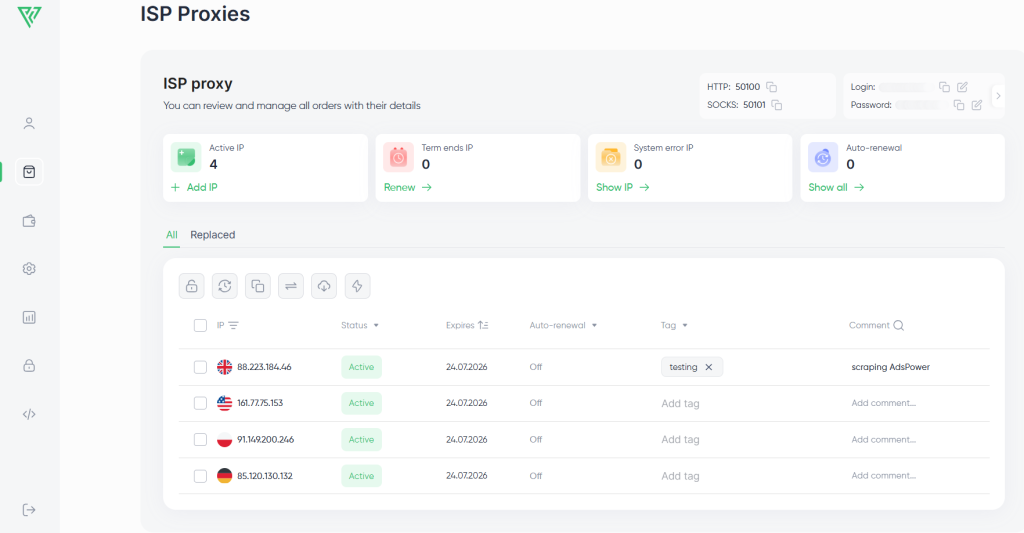
Proxy-Seller's clean dedicated pools reduce cost per valid response by 20–35% in A/B pilots. Start your 14-day pilot today to optimize your data collection infrastructure and cut operational costs.
How Proxy-Seller fits into the extraction layer
In the AI data collection workflow, Proxy-Seller sits at the routing and extraction layer. Each request decides what IP it leaves on, what geo it lands in, and what session shape it carries. Everything downstream (cleaning, labeling, training) inherits whatever made it through.
The same layer runs the same set of jobs: SERP and marketplace collection, training-data expansion from public web text, RAG corpus refresh from docs and knowledge pages, and market signal collection feeding analytical AI.
Without a proxy infrastructure, each data collection task can run into the same failure modes, such as blocks, geo-restricted sources, silent failures, or the budget impact of running blind.
Proxy-Seller addresses each of these potential challenges in the initial layer:
- Blocks at scale: clean dedicated pools reduce block rates against anti-bot defenses that flag shared traffic.
- Geo-restricted sources: route per-request to the geo the model needs, not the team's region.
- Silent failures: endpoint-level logs and an error taxonomy turn outages into automated retry rules.
- Support when it breaks: 24h SLA, direct Slack or Telegram access, named account manager from $1K MRR.
Closing thoughts
The team that treats AI data collection as engineering ships a model that holds up in production: versioned sources, scheduled refresh, quality gates at the extraction layer. Everyone else spends the next quarter debugging bad inputs. The practical move is to lock in the source mix and collection methods, set quality checks at the extraction layer (not after training), and automate refresh on the schedule the model actually needs.
The public web is now central in virtually all AI systems because it’s the only place that brings the scale, freshness, and real-world signals that internal datasets simply lack. And once collection moves into repetitive web extraction at scale, the proxy layer stops being optional. It's the difference between a model trained on the full picture and one trained on whatever survived the blocks.
FAQ: AI data collection
What is AI data collection?
AI data collection is the upstream work of gathering, structuring, and labeling the data a machine learning model trains on. It pulls from sources like the public web, APIs, internal databases, sensors, and human annotators, then cleans and labels the raw output so the training pipeline can use it. Skip the work upstream and the model inherits whatever errors made it through.
What are the main challenges of AI data collection?
The biggest ones tend to be: blocks and anti-bot defenses on public web sources that flag requests at scale; cost overruns when retries and rate limits stack up; bias baked in from skewed sampling or limited source diversity; compliance pressure around where the data came from and who consented to it; and data going stale faster than the refresh schedule can keep up. Most of these only surface once collection runs at production scale, not during the pilot.
How much data does an AI model need?
There's no universal number. A fine-tuned classifier might work with a few thousand labeled records; a foundation-model-scale system pulls trillions of tokens. The practical rule: collection volume should match the model's task complexity and the variance in the input space, not a round number from a competitor's blog post. Most teams under-collect on coverage (geos, edge cases, demographics) before they under-collect on raw volume.
Is web scraping legal for AI training?
Depends on what's being scraped and where. Publicly accessible web data is generally fair game for collection in most jurisdictions, but ToS violations, login-gated content, personal data under GDPR or CCPA, and copyrighted material under emerging AI-training laws can each create real legal exposure. The safer move: document the source list, the consent basis, and the audit trail before the collection runs, not after legal sends an email.
PROXIES FROM $0.02/IP
Ready to put this into practice?
Pick a proxy type and location, and start using it within minutes.
Instant delivery
24/7 support
Refund policy
About the author