 Proxy for Telegram
 Proxy for LinkedIn
 Proxy for Google
 Proxy for Ebay
 Proxy for Twitter
 Proxy for TikTok
Proxy-Seller vs Decodo: pricing, features, and proxy types

Proxy-Seller and Decodo (formerly Smartproxy) sit in the same mid-market category, but they make different bets on how to serve it. Decodo built a tooling layer on top of its residential pool: Web Scraping API, Site Unblocker, subscription tiers that reward committing volume upfront. Proxy-Seller stayed on raw infrastructure, added a sixth proxy type that Decodo doesn't sell, and packaged compliance documentation the way procurement teams want it. Which bet fits depends on whether your team wants managed data collection or per-product control.
This Proxy-Seller vs Decodo comparison runs both providers side by side on entry pricing, proxy type coverage, compliance posture, and support depth.
- Price per GB: Our residential entry starts lower, and the gap gets wider on datacenter. IPv6 from $0.02/IP at volume has no Decodo equivalent.
- Proxy types: Both cover residential, mobile, ISP, and datacenter IPv4. We also add datacenter IPv6 on top of that.
- Compliance: Both hold ISO/IEC 27001:2022. We cover CCPA and the ePrivacy Directive.
- Support: Both offer 24/7 coverage. Our team is engineer-staffed, with a 30-second median reply time and a dedicated account manager starting at $500 MRR.
Pick Proxy-Seller if you need IP addresses of all existing types at lower prices, compliance that clears enterprise procurement, and engineer-led support without enterprise minimums. Pick Decodo if your volume justifies the subscription tiers or your team needs scraping tools on top of raw infrastructure.
Proxy-Seller vs Decodo proxy provider at a glance
Decodo has been building proxy and web data infrastructure since 2018: 115M+ residential IPs across 195+ locations, a Web Scraping API, Site Unblocker, and a browser extension layered on top. Proxyway also recognized Decodo as Best Value Provider for four consecutive years.
Proxy-Seller has been building since 2014, now serving 185,000+ users across six proxy types from a single dashboard. Entry pricing runs lower than Decodo across most products; compliance covers GDPR, CCPA, ISO/IEC 27001:2022, ISO 9001:2015, and the ePrivacy Directive, and support is staffed by engineers with dedicated account management from $500 MRR.
Feature/Criteria | Proxy-Seller | Decodo |
Product line | Residential, mobile, ISP, datacenter IPv4, datacenter IPv6 | Residential, mobile, ISP, datacenter |
Pool size | ~47M+ residential IPs, 220+ locations | 115M+ residential IPs, 195+ locations |
Entry pricing | Residential from $3/GB (3 GB plan); IPv4 from $1.64/IP | Residential from $3.75/GB (3GB plan); datacenter from $1.85/IP |
Minimal order | 1 IP / 1 GB residential | 3 IP/3GB |
Trial | Same-day sandbox access; free POC for larger deployments | 100MB/3 days (card required, auto-renews) |
Compliance posture | GDPR, CCPA, ISO/IEC 27001:2022, ISO 9001:2015, ePrivacy Directive | ISO/IEC 27001:2022, GDPR-aligned |
Best for | Mid-market teams, agencies, and developers consolidating providers | Mid-market to enterprise data teams using bundled scraping tools |
Decodo proxy pricing vs Proxy-Seller pricing
Both providers use per-GB billing for residential proxies and per-IP billing for datacenter and ISP. Mobile is where the model splits: Decodo bills per GB, Proxy-Seller bills per IP with unmetered traffic on the carrier side.
Entry pricing and trial access
Decodo’s trial gives you 100MB over three days. Card verification is required, and your chosen plan kicks in automatically when the trial ends. That’s enough to confirm a connection works. Not enough to validate a scraping pipeline. A 14-day money-back guarantee applies to paid plans.
Proxy-Seller offers same-day sandbox access, and a free POC is available for larger deployments. On a per-GB basis, residential runs $3.50/GB on the entry 1 GB plan, and volume discounts stack as usage scales.
Purchasing model
Decodo structures residential proxies across subscription tiers from 3GB to 1TB. The best per-GB rates require committing to a tier upfront. Pay-as-you-go through the Decodo Wallet runs $4/GB, which is higher than the $3.75/GB entry subscription rate.
Our model is per-product and self-serve. Residential, mobile, ISP, IPv4, or IPv6 are bought independently at the volume you need. Volume and duration discounts stack across all products, so the effective rate drops without locking you into a tier.
Buyer scenarios
Where the pricing gap actually shows up depends on what you’re running:
- Light testing (5–10 GB/month): Decodo’s entry tier runs $3.75/GB on subscription, $4/GB on PAYG. We let you start at 1GB and buy more once you know the target works.
- Moderate operations (50–100 GB/month): at the 100 GB volume tier, Proxy-Seller residential runs $2.20/GB versus Decodo's $2.75/GB. On a 100 GB monthly package, that's $220 vs $275 (a $55 monthly saving, before any additional stacking from duration discounts).
- High volume, mixed proxy types: We consolidate all five types under one account. At 3TB+, residential drops to $0.30/GB. For targets that respond better to datacenter traffic, IPv6 IPs run from $0.02/IP at volume. Decodo doesn’t offer that proxy class at any price point.
.png)
Proxy types compared: residential, mobile, ISP, datacenter
Both providers cover the core network types mid-market teams actually need. Proxy-Seller covers all six. That includes datacenter IPv6, which Decodo doesn’t offer, at lower per-unit prices across most categories.
Residential proxies
Decodo proxies run deeper. 115M+ IPs across 195+ locations, with city, ZIP code (US only), and ASN-level targeting. That’s a real advantage at high-concurrency scale against heavily defended retail or social targets.
Proxy-Seller runs 47M+ IP addresses across 220+ locations. Entry starts at $3.50/GB and scales to $0.30/GB at volume. Consent-based sourcing passes ethics review in enterprise procurement, which matters more than most buyers expect going in. The IP pool delivers 99.5% success rates without the cost of depth most teams never actually use.
Mobile proxies
Mobile IPs are the right call for cellular-specific workflows: app-level testing, mobile ad verification, and any target that serves different content to mobile user agents than it does to desktop.
Proxy-Seller prices mobile per IP per month, across shared and dedicated plans. Shared runs from $10/IP; dedicated starts at $49/IP for teams that need an isolated carrier session. The per-IP model works like a gateway: the customer buys one mobile IP address, and we handle the pool behind it. You choose the location, carrier, rotation trigger (URL, 5-minute, or 30-minute timer), and authentication method, and we enforce them server-side. There’s no per-GB traffic charge; bandwidth is bounded only by the carrier’s own policy.
Decodo, by contrast, prices mobile per GB starting at $3.75/GB across 10M+ IPs from 700+ carriers in 160+ locations. The pool is configured after the GB plan is purchased.
ISP proxies (static residential IPs)
Static residential IPs sit in a specific lane. Long sessions, account management, and authenticated flows where IP addresses need to look like a real ISP assignment rather than a datacenter range.
Our ISP proxies start at $3/IP basic, from $0.98/IP at volume, with no per-GB traffic charges on dedicated plans. That makes them the more cost-effective option per IP for teams running the kind of persistent, session-heavy workflows where static residential IPs earn their place.
Decodo’s dedicated ISP starts at $3.33/IP, dropping to $2.00/IP at enterprise volume. There’s also a shared per-GB option from $3/GB that can undercut at high bandwidth, but it adds a cost variable that fixed per-IP billing sidesteps entirely.
Datacenter proxies (IPv4 and IPv6)
Proxy-Seller’s IPv4 starts at $1.64/IP basic, from $0.49/IP at volume. IPv6 starts at $0.16/IP basic, from $0.02/IP at volume. Decodo product line doesn’t include IPv6 at any price point. For teams running SERP monitoring or public data collection at scale, that changes the economics of the operation in a way that’s hard to ignore.
Predictable per-IP billing and no per-GB traffic charges make the cost side of the equation easy to model. Decodo’s datacenter covers shared and dedicated plans at a higher per-IP entry, and that’s where the product line ends.
Our best proxy providers roundup gives you the full picture on how these proxy servers stack up across providers.
Compliance and infrastructure trust
Procurement review on proxy infrastructure comes down to a specific set of questions. How are IPs sourced? What certifications does the provider hold? Is a Data Processing Agreement available before the contract is signed?
Both providers have answers to those questions, and that’s actually worth saying out loud. A lot of proxy services at this price point don’t. Mid-market teams get a DPA, AUP, and ISO/IEC 27001:2022 documentation ready from day one, the same docs Bright Data reserves for $10K+ MRR accounts and Oxylabs gates behind a formal procurement cycle. Decodo can produce the same due-diligence answers. But Proxy-Seller does it without the enterprise price floor attached.
On certifications, Proxy-Seller holds ISO/IEC 27001:2022 and ISO 9001:2015. Decodo holds ISO/IEC 27001:2022 and picked up G2 recognition as one of the best security products in 2026. Both source residential IPs through opt-in programs, which is the sourcing question procurement asks first. IP provenance documentation is available on request from Proxy-Seller for buyers who need to demonstrate that to their own legal or ethics reviewers.
The rest of the due-diligence stack on the Proxy-Seller side: a Data Processing Agreement ready from day one with no sales cycle required, and regulatory coverage extending to GDPR, CCPA, and the ePrivacy Directive. For enterprise procurement teams, the documentation exists before the conversation even starts.
Protocols, authentication, and session management
On the protocol layer, there’s less to compare than you might expect. Both providers support HTTP, HTTPS, and SOCKS5, with username/password and IP allowlist authentication, and both rotating and sticky session modes. Switching from Decodo’s proxy service to ours doesn’t touch your existing scraping code. The migration is three steps.
- Update the proxy endpoint hostname to point to Proxy-Seller’s infrastructure
- Keep the same authentication method, whether that’s username/password or IP allowlist
- Keep your rotation and session handling logic exactly as it is
Platform tooling and scraping features
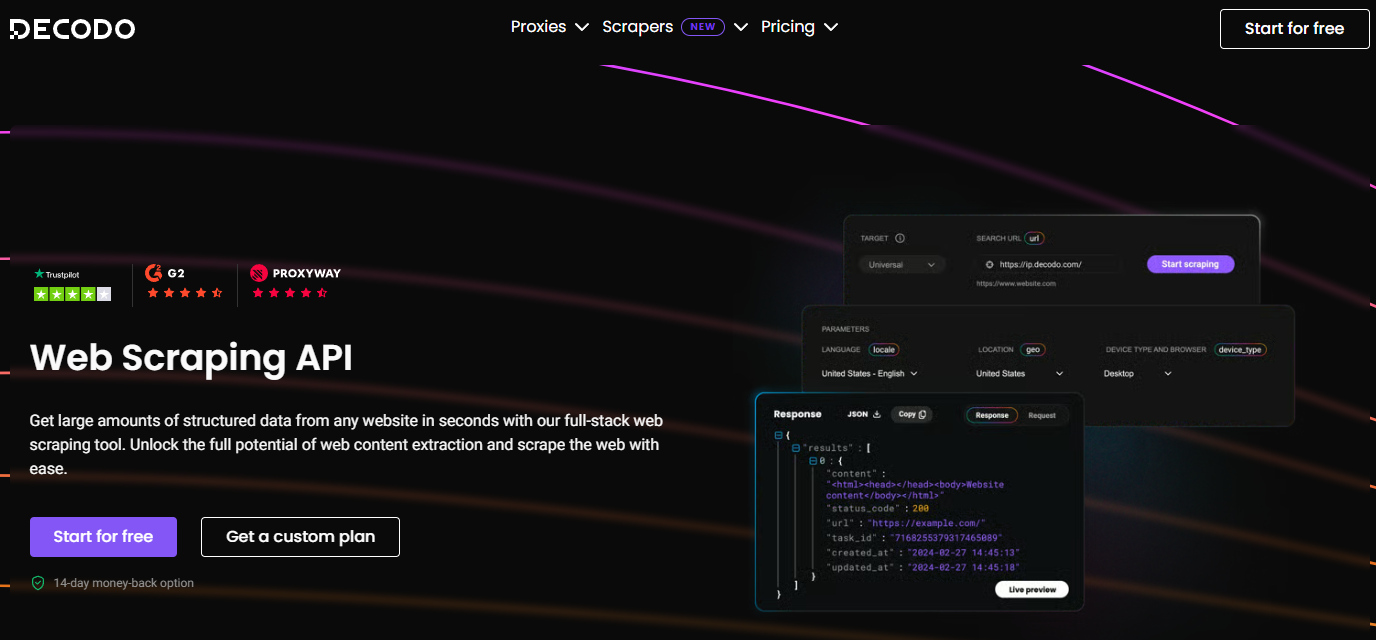
Decodo has built a tooling layer on top of its proxy network. A Web Scraping API covering SERP, eCommerce, and social media endpoints priced per successful request, a Site Unblocker for JavaScript-heavy targets, and a browser extension for manual browsing. If your team wants a partially managed data collection layer, Decodo’s suite covers more of that stack out of the box.
Proxy-Seller focuses on raw IP infrastructure, and that’s a deliberate choice rather than a gap. REST API and SDK support simplify integration, with documentation for Python, cURL, Node.js, Java, and Go.Sandbox access is available the same day after sign-up, with no sales cycle required. Sandbox access is available the same day after sign-up, with no sales cycle required.
Your current provider’s success rates dropping? Test on your own targets with same-day sandbox access, and ask about a free POC for larger deployments. Teams switching to Proxy-Seller have seen +20–30% VRR uplift and –20–35% CPVR reduction in A/B pilots. Same-day sandbox, no procurement cycle.
Support experience
Both providers advertise 24/7 support. The difference shows up when you actually have an integration problem to solve.
Proxy-Seller’s support is staffed by engineers. When you open a ticket about a subnet that’s getting blocked or an integration behavior you can’t explain, the person who responds can diagnose it on first contact. No escalation through tiers, no waiting for someone technical to get looped in. Stated SLA benchmarks are a median live-chat first response under 30 seconds and an average 10-minute email response time.
Account management is the second differentiator. Proxy-Seller assigns a dedicated account manager from $500 MRR. Bright Data and Oxylabs reserve that level of service for $50K+ accounts. Decodo ties it to higher subscription tiers. For mid-market teams, that’s named-contact ownership without the enterprise price floor attached to it.
Decodo competitors: where Proxy-Seller fits in the alternatives landscape
If you’re evaluating Decodo, these are the other Decodo competitors that tend to come up in the same conversation, and where each one actually sits:
- Bright Data: 400M+ residential IPs, a full data platform, and a dataset marketplace. Enterprise contract structure and KYC process make it the right fit at serious scale, not for mid-market teams evaluating cost.
- Oxylabs: 175M+ residential IPs and a full scraper API suite built for enterprise procurement cycles.
- Webshare: Suits developers who need a starting point without minimum spend. Permanent free tier (10 IPs, no card required), but no mobile proxies or managed scraping layer.
- IPRoyal: 64M+ residential pool, residential from $7/GB dropping to $1.75/GB at volume, no traffic expiry and no monthly minimum.
- SOAX: 155M+ residential IPs, subscription plans from $200/month with Tier 1 residential at $3/GB on the entry plan, plus a Web Data API.
Proxy-Seller sits between the budget and enterprise tiers. Lower entry pricing, compliance that clears enterprise procurement, and engineer-led support with a dedicated account manager from $500 MRR. That combination is harder to find at this price point than it should be. Proxy-Seller holds a 4.8/5 rating on G2.
Our best proxy services roundup covers more of the alternatives landscape. For a direct enterprise-tier comparison, Oxylabs vs Proxy-Seller goes deeper on where we stand at the high end.
Which provider should you actually choose?
Proxy-Seller is the call if you want all five proxy types at lower prices, compliance documentation that holds up in enterprise procurement, and engineers picking up your support tickets instead of a first-line queue. Teams running search and social data collection at scale get something else on top of that: datacenter IPv6 from $0.02/IP at volume.
Proxy-Seller delivers enterprise-grade infrastructure with a named account manager from $500 MRR. A comprehensive product line, clean dedicated pools, and a named account manager from day one.
Decodo makes sense if your team is going to put the managed scraping tools to work. The Web Scraping API, Site Unblocker, and browser extension justify the platform if that’s genuinely part of your workflow. High-volume operations that need subscription-tier pricing and ASN-level targeting across a 115M+ IP pool will also find a better home here.
FAQ
Both hold ISO/IEC 27001:2022 certification and source residential IPs through opt-in programs. Proxy-Seller also holds ISO 9001:2015 and extends coverage to CCPA and the ePrivacy Directive, which becomes relevant when you’re handling data from US and EU users under separate regulatory frameworks. Data Processing Agreements are ready from day one. No sales cycle required to get them.
Yes, and it’s simpler than most people expect. Both providers support HTTP, HTTPS, and SOCKS5 with username/password and IP allowlist authentication. Update the endpoint hostname, keep the same auth type, keep the same rotation logic. Nothing in your scraping code needs to change.
Yes and no. Proxy-Seller has a better product range: residential, mobile, ISP, datacenter IPv4, and datacenter IPv6 from $0.02/IP at volume, which Decodo doesn’t publicly sell as a standalone product. Decodo proxy service covers more tooling: Web Scraping API, Site Unblocker, and a browser extension sit on top of its IP pool. Proxy-Seller focuses on raw infrastructure and doesn’t currently ship a managed scraping layer. Both providers offer 24/7 support, but Proxy-Seller’s is engineer-staffed with a 30-second live chat response target and a dedicated account manager from $500 MRR.
Yes, and the gap shows up when you compare packages side by side. On residential, a 100 GB monthly package costs $220 with Proxy-Seller ($2.20/GB) versus $275 with Decodo ($2.75/GB), a $55 saving on the same volume. On datacenter, a 25-IPv4 pack runs $0.74/IP with Proxy-Seller and $1.65/IP with Decodo, a 55% per-IP difference at the entry volume most teams start on.
PROXIES FROM $0.02/IP
Ready to put this into practice?
Pick a proxy type and location, and start using it within minutes.
Instant delivery
24/7 support
Refund policy
About the author